
Inverse kinetic isotope effects in the charge transfer reactions of ammonia with rare gas ions.
作者信息
Tsikritea A, Park K, Bertier P, Loreau J, Softley T P, Heazlewood B R
机构信息
Department of Chemistry, University of Oxford, Physical and Theoretical Chemistry South Parks Road Oxford OX1 3QZ UK.
Department of Physics, University of Liverpool Liverpool L69 7ZE UK
出版信息
Chem Sci. 2021 Jun 22;12(29):10005-10013. doi: 10.1039/d1sc01652k. eCollection 2021 Jul 28.
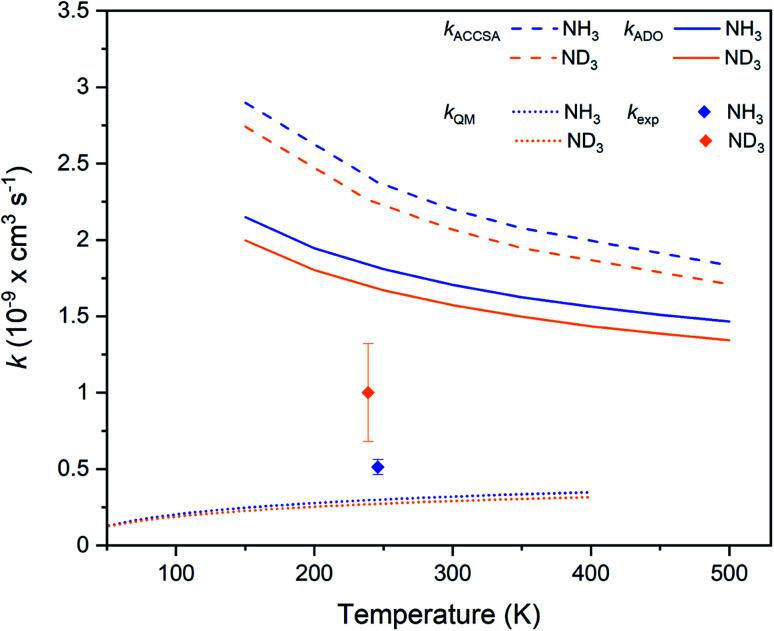
In the absence of experimental data, models of complex chemical environments rely on predicted reaction properties. Astrochemistry models, for example, typically adopt variants of capture theory to estimate the reactivity of ionic species present in interstellar environments. In this work, we examine astrochemically-relevant charge transfer reactions between two isotopologues of ammonia, NH and ND, and two rare gas ions, Kr and Ar. An inverse kinetic isotope effect is observed; ND reacts faster than NH. Combining these results with findings from an earlier study on Xe (Petralia , , 2020, 11, 1), we note that the magnitude of the kinetic isotope effect shows a dependence on the identity of the rare gas ion. Capture theory models consistently overestimate the reaction rate coefficients and cannot account for the observed inverse kinetic isotope effects. In all three cases, the reactant and product potential energy surfaces, constructed from high-level calculations, do not exhibit any energetically-accessible crossing points. Aided by a one-dimensional quantum-mechanical model, we propose a possible explanation for the presence of inverse kinetic isotope effects in these charge transfer reaction systems.




 Zotero 插件