Walsh Karin S, Wolters Pamela L, Widemann Brigitte C, Del Castillo Allison, Sady Maegan D, Inker Tess, Roderick Marie Claire, Martin Staci, Toledo-Tamula Mary Anne, Struemph Kari, Paltin Iris, Collier Victoria, Mullin Kathy, Fisher Michael J, Packer Roger J
Children's National Medical Center (K.S.W., A.C., M.D.S., T.I., R.J.P.), Washington, DC; National Cancer Institute (P.L.W., B.C.W., M.C.R., S.M., K.S.), Bethesda, MD; Clinical Research Directorate (M.A.T.-T.), Frederick National Library for Cancer Research, MD; and Children's Hospital of Philadelphia (I.P., V.C., K.M., M.J.F.), Philadelphia.
Neurol Genet. 2021 Aug 6;7(5):e616. doi: 10.1212/NXG.0000000000000616. eCollection 2021 Oct.
Neurofibromatosis type 1 (NF1)-associated cognitive impairments carry significant lifelong morbidity. The lack of targeted biologic treatments remains a significant unmet need. We examine changes in cognition in patients with NF1 in the first 48 weeks of mitogen-activated protein kinase inhibitor (MEKi) treatment.
Fifty-nine patients with NF1 aged 5-27 years on an MEKi clinical trial treating plexiform neurofibroma underwent pretreatment and follow-up cognitive assessments over 48 weeks of treatment. Performance tasks (Cogstate) and observer-reported functioning (BRIEF) were the primary outcomes. Group-level (paired tests) and individual-level analyses (Reliable Change Index, RCI) were used.
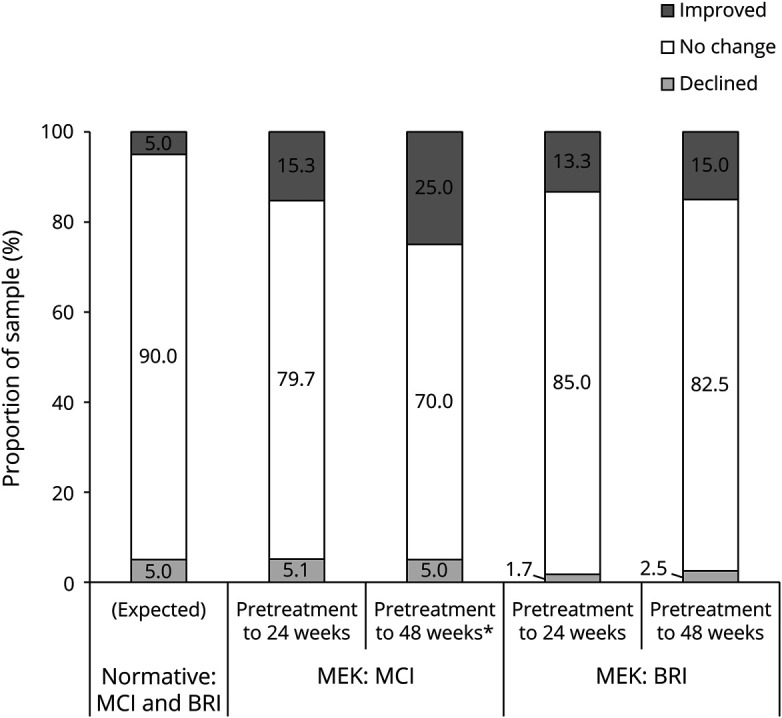
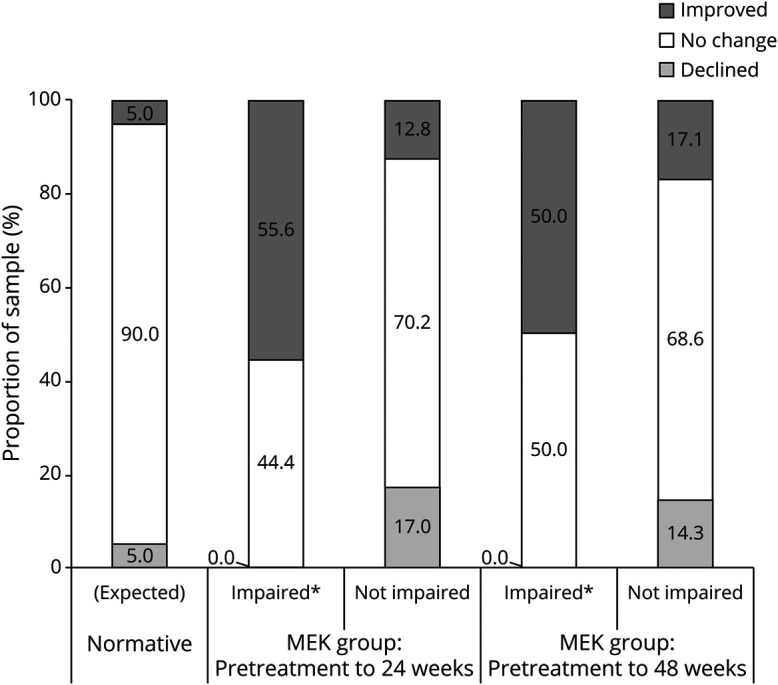
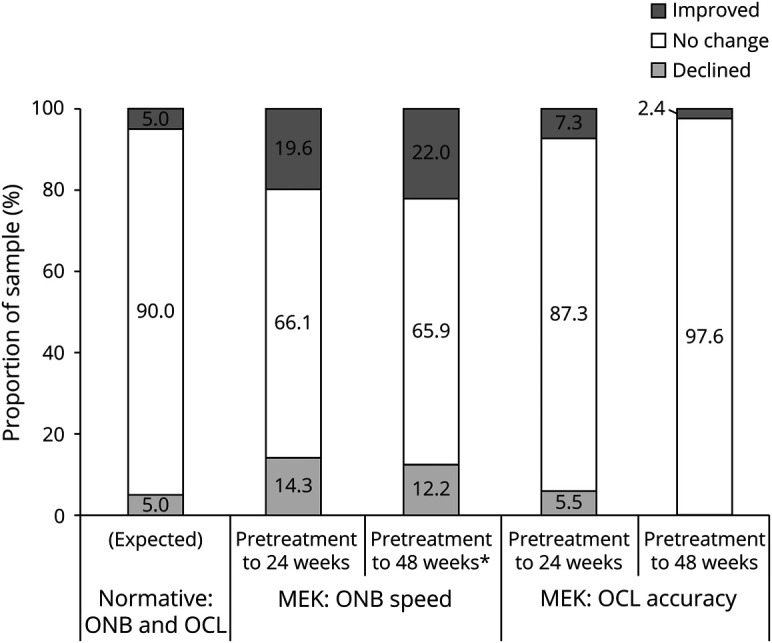
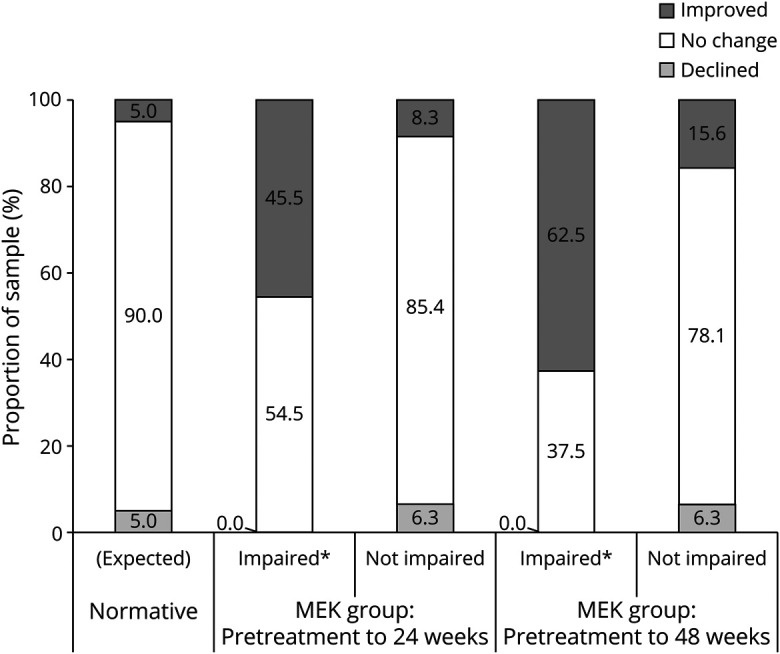
Analysis showed statistically significant improvements on BRIEF compared with baseline (24-week Behavioral Regulation Index: = 3.03, = 0.004, = 0.24; 48-week Metacognition Index: = 2.70, = 0.01, = 0.27). RCI indicated that more patients had clinically significant improvement at 48 weeks than expected by chance (χ = 11.95, = 0.001, odds ratio [OR] = 6.3). Group-level analyses indicated stable performance on Cogstate ( > 0.05). RCI statistics showed high proportions of improved working memory (24-week χ = 8.36, = 0.004, OR = 4.6, and 48-week χ = 9.34, = 0.004, OR = 5.3) but not visual learning/memory. Patients with baseline impairments on BRIEF were more likely to show significant improvement than nonimpaired patients (24 weeks 46% vs 8%; χ = 9.54, = 0.008, OR = 9.22; 48 weeks 63% vs 16%; χ = 7.50, = 0.02, OR = 9.0).
Our data show no evidence of neurotoxicity in 48 weeks of treatment with an MEKi and a potential clinical signal supporting future research of MEKi as a cognitive intervention.
1型神经纤维瘤病(NF1)相关的认知障碍会导致严重的终身发病。缺乏针对性的生物治疗仍然是一个重大的未满足需求。我们研究了丝裂原活化蛋白激酶抑制剂(MEKi)治疗的前48周内NF1患者认知功能的变化。
59例年龄在5 - 27岁、正在接受MEKi治疗丛状神经纤维瘤的NF1患者在治疗的48周内接受了治疗前和随访认知评估。主要结局指标为执行任务(Cogstate)和观察者报告的功能(BRIEF)。采用组水平分析(配对检验)和个体水平分析(可靠变化指数,RCI)。
分析显示,与基线相比,BRIEF有统计学意义的改善(24周行为调节指数:t = 3.03,P = 0.004,效应量 = 0.24;48周元认知指数:t = 2.70,P = 0.01,效应量 = 0.27)。RCI表明,48周时临床上有显著改善的患者比偶然预期的更多(χ² = 11.95,P = 0.001,优势比[OR] = 6.3)。组水平分析表明Cogstate表现稳定(P > 0.05)。RCI统计显示,工作记忆改善的比例较高(24周χ² = 8.36,P = 0.004,OR = 4.6;48周χ² = 9.34,P = 0.004,OR = 5.3),但视觉学习/记忆无改善。BRIEF基线有损伤的患者比无损伤的患者更有可能表现出显著改善(24周时分别为46%和8%;χ² = 9.54,P = 0.008,OR = 9.22;48周时分别为63%和16%;χ² = 7.50,P = 0.02,OR = 9.0)。
我们的数据显示,MEKi治疗48周没有神经毒性的证据,并且有一个潜在的临床信号支持未来将MEKi作为一种认知干预措施进行研究。