Department of Internal Medicine, Pusan National University School of Medicine and Medical Research Institute, Pusan National University Hospital, Busan, Republic of Korea.
Microbiol Spectr. 2021 Sep 3;9(1):e0011621. doi: 10.1128/Spectrum.00116-21. Epub 2021 Aug 11.
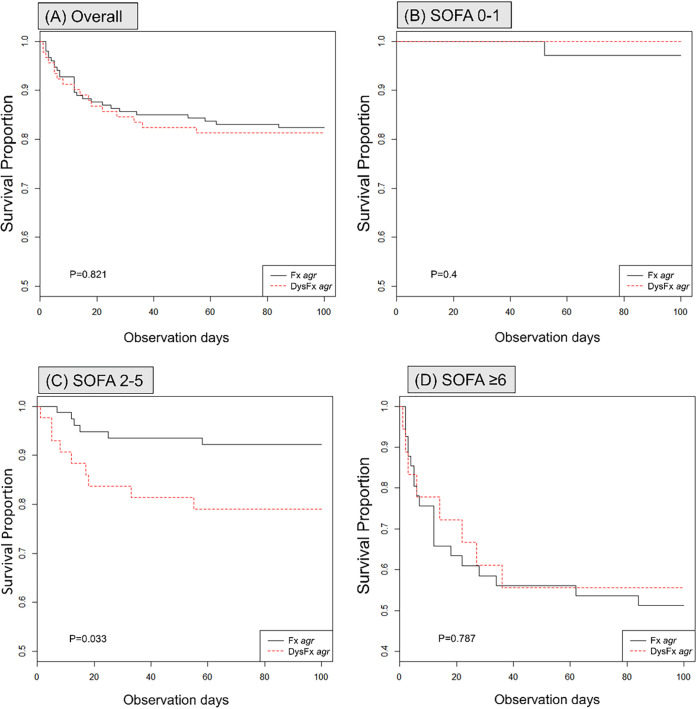
Dysfunctional accessory gene regulator () is associated with unfavorable outcomes in invasive methicillin-resistant Staphylococcus aureus infections. However, it is unknown whether this association persists in methicillin-susceptible Staphylococcus aureus bacteremia (MSSA-B). This study evaluated the association between dysfunction and mortality in patients with MSSA-B. This retrospective cohort study included MSSA-B patients (≥15 years) enrolled from June 2014 to June 2019 and retrospectively collected their demographic and clinical information. Stored causative strains were measured for functionality by δ-hemolysin production assays. Among 244 MSSA-B patients, 91 (37.3%) and 153 (62.7%) had dysfunctional and functional MSSA-B, respectively. Ninety-day mortality occurred in 18.7% and 17.6% dysfunctional and functional groups, respectively ( = 0.97). Kaplan-Meier analysis showed that mortality due to dysfunctional MSSA-B was not significantly higher ( = 0.82). Age, sites, the severity of infection, and comorbidity adjusted hazard ratio (aHR) of the dysfunctional group for 90-day mortality was 1.303 (95% confidence interval [CI], 0.698 to 2.436, = 0.41). Mortality due to MSSA-B with sequential organ failure assessment (SOFA) scores of 2 to 5 was significantly higher in the dysfunctional group ( = 0.03), and the dysfunctional aHR for 90-day mortality was 3.260 (95% CI, 1.050 to 10.118, = 0.04). The dysfunction of causative organisms can have a significant effect on the outcomes of MSSA-B in patients with moderate severity (SOFA scores 2 to 5). Few studies have examined the association between methicillin-susceptible Staphylococcus aureus (MSSA) infection and accessory gene regulator () functionality. We evaluated the association between dysfunction and mortality in patients with MSSA bacteremia. Dysfunctional is associated with lower survival in MSSA bacteremia patients with moderately severe sequential organ failure assessment (SOFA) scores of 2 to 5. We found that the functionality of causative organisms may have an effect on patients' outcomes in MSSA like in methicillin-resistant S. aureus.
功能失调的辅助基因调控因子()与侵袭性耐甲氧西林金黄色葡萄球菌(MRSA)感染的不良结局相关。然而,在耐甲氧西林金黄色葡萄球菌菌血症(MSSA-B)中,这种关联是否仍然存在尚不清楚。本研究评估了 MSSA-B 患者中 功能障碍与死亡率之间的关系。这项回顾性队列研究纳入了 2014 年 6 月至 2019 年 6 月期间入组的 MSSA-B 患者(≥15 岁),并回顾性收集了他们的人口统计学和临床信息。通过δ-溶血素产生测定法测量储存的病原体菌株的 功能。在 244 例 MSSA-B 患者中,分别有 91 例(37.3%)和 153 例(62.7%)存在功能失调和功能正常的 MSSA-B。90 天死亡率分别为功能失调和功能正常组的 18.7%和 17.6%(=0.97)。Kaplan-Meier 分析表明,由于功能失调的 MSSA-B 导致的死亡率没有显著升高(=0.82)。年龄、部位、感染严重程度和合并症调整的功能失调组 90 天死亡率的风险比(aHR)为 1.303(95%置信区间[CI],0.698 至 2.436,=0.41)。在功能失调组中,序贯器官衰竭评估(SOFA)评分 2 至 5 的 MSSA-B 死亡率显著更高(=0.03),功能失调的 90 天死亡率的 aHR 为 3.260(95%CI,1.050 至 10.118,=0.04)。病原体的 功能障碍可能对中重度(SOFA 评分 2 至 5)MSSA-B 患者的结局产生重大影响。很少有研究检测过耐甲氧西林金黄色葡萄球菌(MSSA)感染与辅助基因调控因子()功能之间的关联。我们评估了 MSSA 菌血症患者中 功能障碍与死亡率之间的关系。在 SOFA 评分 2 至 5 的中重度 MSSA 菌血症患者中,功能失调的 与生存率降低相关。我们发现,病原体的 功能可能会对 MSSA 患者的结局产生影响,就像对耐甲氧西林金黄色葡萄球菌(MRSA)一样。