• 文献检索
  • 文档翻译
  • 深度研究
  • 学术资讯
  • Suppr Zotero 插件Zotero 插件
  • 邀请有礼
  • 套餐&价格
  • 历史记录
应用&插件
Suppr Zotero 插件Zotero 插件浏览器插件Mac 客户端Windows 客户端微信小程序
定价
高级版会员购买积分包购买API积分包
服务
文献检索文档翻译深度研究API 文档MCP 服务
关于我们
关于 Suppr公司介绍联系我们用户协议隐私条款
关注我们

Suppr 超能文献

核心技术专利:CN118964589B侵权必究
粤ICP备2023148730 号-1Suppr @ 2026

文献检索

告别复杂PubMed语法,用中文像聊天一样搜索,搜遍4000万医学文献。AI智能推荐,让科研检索更轻松。

立即免费搜索

文件翻译

保留排版,准确专业,支持PDF/Word/PPT等文件格式,支持 12+语言互译。

免费翻译文档

深度研究

AI帮你快速写综述,25分钟生成高质量综述,智能提取关键信息,辅助科研写作。

立即免费体验

抗生素耐药性、药物靶点达成率、细菌致病性和毒力,以及抗生素的可及性和可负担性对新生儿败血症结局的影响:一项国际微生物学和药物评价前瞻性子研究(BARNARDS)。

Effects of antibiotic resistance, drug target attainment, bacterial pathogenicity and virulence, and antibiotic access and affordability on outcomes in neonatal sepsis: an international microbiology and drug evaluation prospective substudy (BARNARDS).

机构信息

Institute of Infection and Immunity, School of Medicine, Cardiff University, Cardiff, UK; Oxford Institute of Antimicrobial Research, Department of Zoology, University of Oxford, Oxford, UK.

Institute of Infection and Immunity, School of Medicine, Cardiff University, Cardiff, UK; Centre for Trials Research, Cardiff University, Cardiff, UK.

出版信息

Lancet Infect Dis. 2021 Dec;21(12):1677-1688. doi: 10.1016/S1473-3099(21)00050-5. Epub 2021 Aug 9.

DOI:10.1016/S1473-3099(21)00050-5
PMID:34384533
原文链接:https://pmc.ncbi.nlm.nih.gov/articles/PMC8612937/
Abstract

BACKGROUND

Sepsis is a major contributor to neonatal mortality, particularly in low-income and middle-income countries (LMICs). WHO advocates ampicillin-gentamicin as first-line therapy for the management of neonatal sepsis. In the BARNARDS observational cohort study of neonatal sepsis and antimicrobial resistance in LMICs, common sepsis pathogens were characterised via whole genome sequencing (WGS) and antimicrobial resistance profiles. In this substudy of BARNARDS, we aimed to assess the use and efficacy of empirical antibiotic therapies commonly used in LMICs for neonatal sepsis.

METHODS

In BARNARDS, consenting mother-neonates aged 0-60 days dyads were enrolled on delivery or neonatal presentation with suspected sepsis at 12 BARNARDS clinical sites in Bangladesh, Ethiopia, India, Pakistan, Nigeria, Rwanda, and South Africa. Stillborn babies were excluded from the study. Blood samples were collected from neonates presenting with clinical signs of sepsis, and WGS and minimum inhibitory concentrations for antibiotic treatment were determined for bacterial isolates from culture-confirmed sepsis. Neonatal outcome data were collected following enrolment until 60 days of life. Antibiotic usage and neonatal outcome data were assessed. Survival analyses were adjusted to take into account potential clinical confounding variables related to the birth and pathogen. Additionally, resistance profiles, pharmacokinetic-pharmacodynamic probability of target attainment, and frequency of resistance (ie, resistance defined by in-vitro growth of isolates when challenged by antibiotics) were assessed. Questionnaires on health structures and antibiotic costs evaluated accessibility and affordability.

FINDINGS

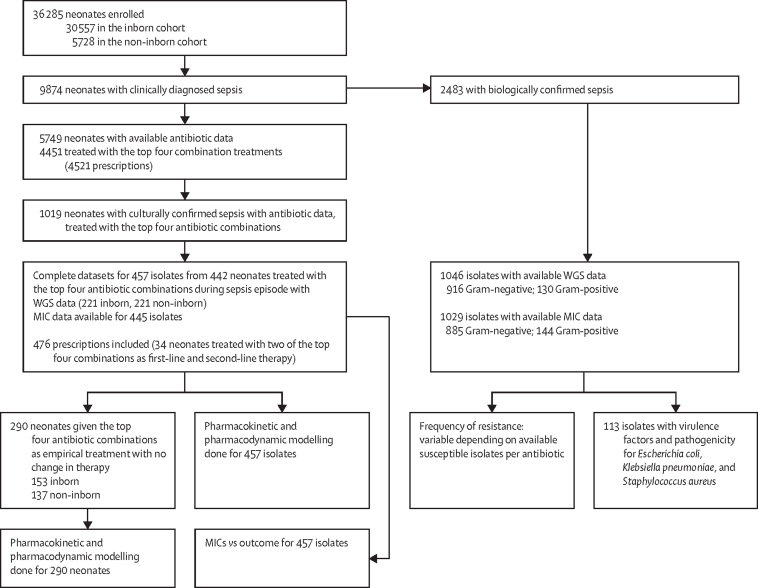
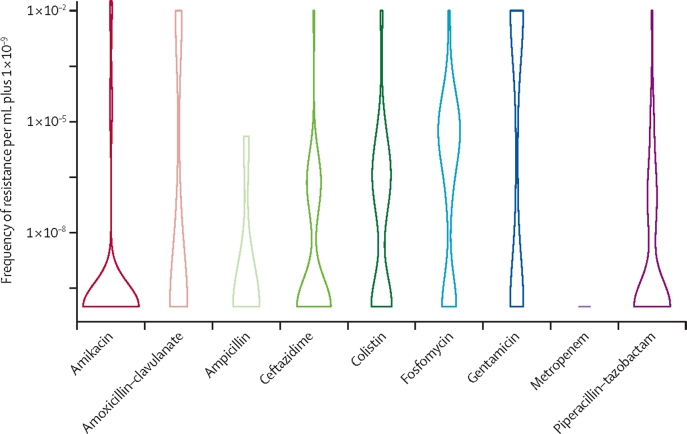
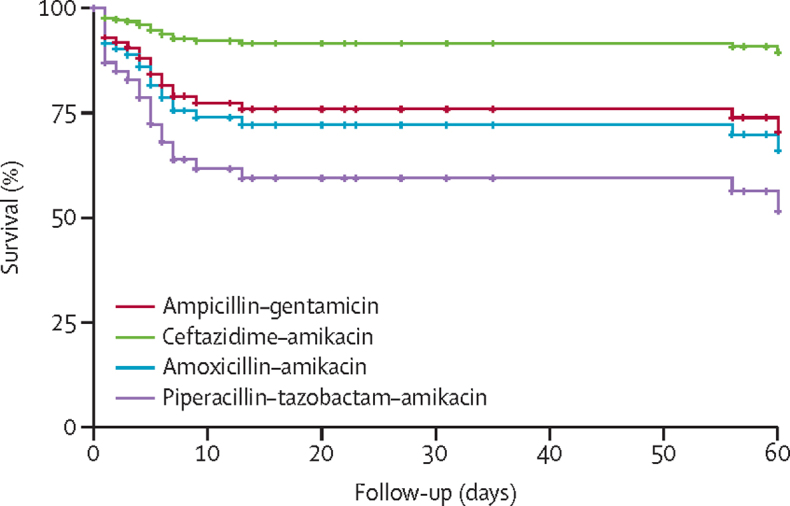
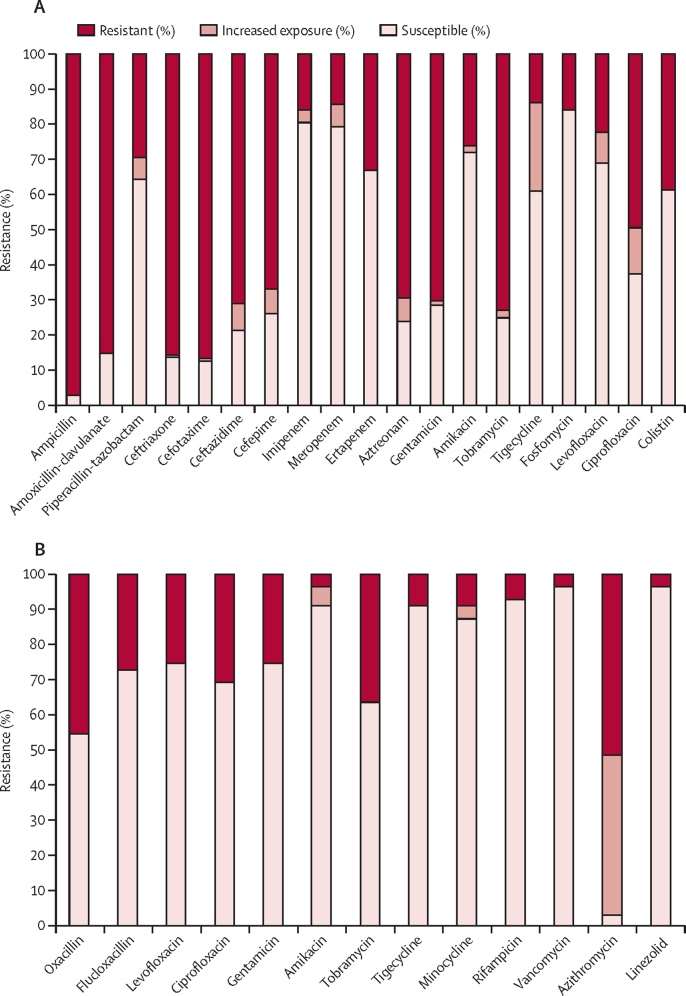
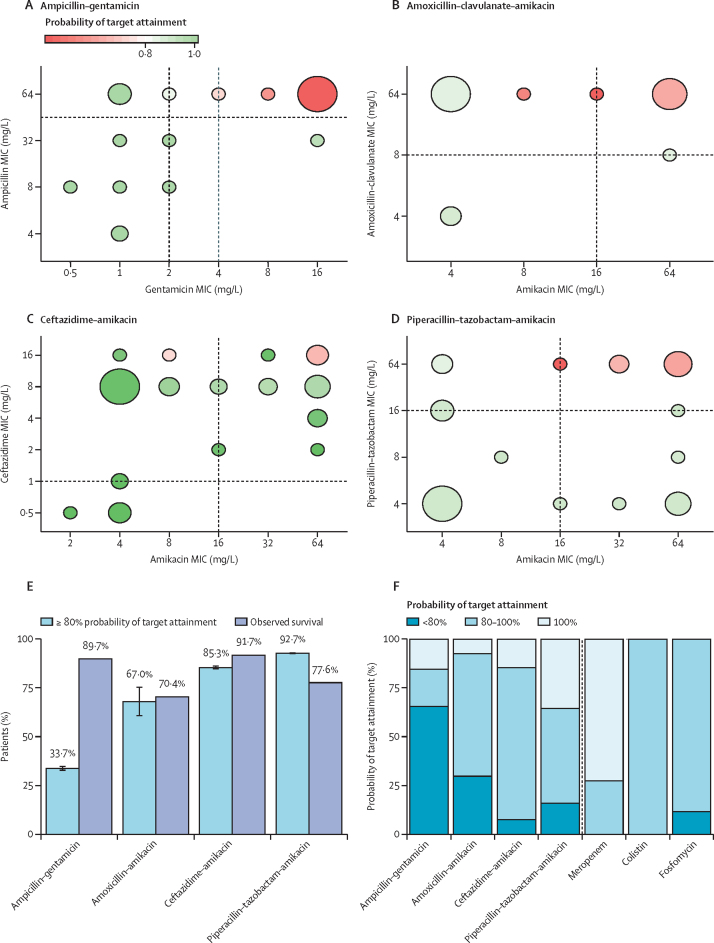
Between Nov 12, 2015, and Feb 1, 2018, 36 285 neonates were enrolled into the main BARNARDS study, of whom 9874 had clinically diagnosed sepsis and 5749 had available antibiotic data. The four most commonly prescribed antibiotic combinations given to 4451 neonates (77·42%) of 5749 were ampicillin-gentamicin, ceftazidime-amikacin, piperacillin-tazobactam-amikacin, and amoxicillin clavulanate-amikacin. This dataset assessed 476 prescriptions for 442 neonates treated with one of these antibiotic combinations with WGS data (all BARNARDS countries were represented in this subset except India). Multiple pathogens were isolated, totalling 457 isolates. Reported mortality was lower for neonates treated with ceftazidime-amikacin than for neonates treated with ampicillin-gentamicin (hazard ratio [adjusted for clinical variables considered potential confounders to outcomes] 0·32, 95% CI 0·14-0·72; p=0·0060). Of 390 Gram-negative isolates, 379 (97·2%) were resistant to ampicillin and 274 (70·3%) were resistant to gentamicin. Susceptibility of Gram-negative isolates to at least one antibiotic in a treatment combination was noted in 111 (28·5%) to ampicillin-gentamicin; 286 (73·3%) to amoxicillin clavulanate-amikacin; 301 (77·2%) to ceftazidime-amikacin; and 312 (80·0%) to piperacillin-tazobactam-amikacin. A probability of target attainment of 80% or more was noted in 26 neonates (33·7% [SD 0·59]) of 78 with ampicillin-gentamicin; 15 (68·0% [3·84]) of 27 with amoxicillin clavulanate-amikacin; 93 (92·7% [0·24]) of 109 with ceftazidime-amikacin; and 70 (85·3% [0·47]) of 76 with piperacillin-tazobactam-amikacin. However, antibiotic and country effects could not be distinguished. Frequency of resistance was recorded most frequently with fosfomycin (in 78 isolates [68·4%] of 114), followed by colistin (55 isolates [57·3%] of 96), and gentamicin (62 isolates [53·0%] of 117). Sites in six of the seven countries (excluding South Africa) stated that the cost of antibiotics would influence treatment of neonatal sepsis.

INTERPRETATION

Our data raise questions about the empirical use of combined ampicillin-gentamicin for neonatal sepsis in LMICs because of its high resistance and high rates of frequency of resistance and low probability of target attainment. Accessibility and affordability need to be considered when advocating antibiotic treatments with variance in economic health structures across LMICs.

FUNDING

The Bill & Melinda Gates Foundation.

摘要

背景

败血症是新生儿死亡的主要原因,尤其是在低收入和中等收入国家(LMICs)。世界卫生组织提倡氨苄西林-庆大霉素作为治疗新生儿败血症的一线药物。在针对 LMICs 中新生儿败血症和抗生素耐药性的 BARNARDS 观察性队列研究中,通过全基因组测序(WGS)和抗生素耐药性分析来描述常见的败血症病原体。在 BARNARDS 的这项子研究中,我们旨在评估在 LMICs 中常用于治疗新生儿败血症的经验性抗生素治疗的使用和疗效。

方法

在 BARNARDS 中,在孟加拉国、埃塞俄比亚、印度、巴基斯坦、尼日利亚、卢旺达和南非的 12 个 BARNARDS 临床站点,对 0-60 天的母婴进行了同意参与的前瞻性登记,有疑似败血症的新生儿。死胎婴儿被排除在研究之外。从有临床败血症体征的新生儿中采集血样,并对从培养确认败血症的细菌分离株中进行 WGS 和抗生素治疗最小抑菌浓度测定。在登记后直到 60 天的生命期内收集新生儿结局数据。评估抗生素使用和新生儿结局数据。生存分析调整了与出生和病原体相关的潜在临床混杂变量。此外,评估了耐药谱、药代动力学-药效学目标获得概率和耐药频率(即,当分离株受到抗生素挑战时,通过体外生长定义的耐药性)。对卫生结构和抗生素成本的调查问卷评估了可及性和可负担性。

结果

2015 年 11 月 12 日至 2018 年 2 月 1 日,共有 36285 名新生儿纳入 BARNARDS 主要研究,其中 9874 名新生儿临床诊断为败血症,5749 名新生儿有可用的抗生素数据。在 5749 名新生儿中,4451 名新生儿(77.42%)接受了四种最常用的抗生素联合治疗,分别为氨苄西林-庆大霉素、头孢他啶-阿米卡星、哌拉西林-他唑巴坦-阿米卡星和阿莫西林克拉维酸-阿米卡星。该数据集评估了用 WGS 数据(除印度外,所有 BARNARDS 国家都有代表)治疗 442 名新生儿的 476 种抗生素处方。共分离出 457 株多种病原体。与接受氨苄西林-庆大霉素治疗的新生儿相比,接受头孢他啶-阿米卡星治疗的新生儿死亡率较低(调整了考虑对结果有潜在影响的临床变量后的危险比[0.32,95%CI 0.14-0.72;p=0.0060])。在 390 株革兰氏阴性菌分离株中,379 株(97.2%)对氨苄西林耐药,274 株(70.3%)对庆大霉素耐药。在 111 株(28.5%)对氨苄西林-庆大霉素;286 株(73.3%)对阿莫西林克拉维酸-阿米卡星;301 株(77.2%)对头孢他啶-阿米卡星;和 312 株(80.0%)对哌拉西林-他唑巴坦-阿米卡星的治疗组合中,至少有一种抗生素的敏感性得到了注意。在接受氨苄西林-庆大霉素治疗的 78 名儿童中有 26 名(33.7%[SD 0.59])达到了 80%或更高的目标获得概率;在接受阿莫西林克拉维酸-阿米卡星治疗的 27 名儿童中有 15 名(68.0%[3.84]);在接受头孢他啶-阿米卡星治疗的 109 名儿童中有 93 名(92.7%[0.24]);在接受哌拉西林-他唑巴坦-阿米卡星治疗的 76 名儿童中有 70 名(85.3%[0.47])。然而,抗生素和国家的影响无法区分。最常记录到的耐药频率是磷霉素(在 114 株分离株中为 78 株[68.4%]),其次是黏菌素(在 96 株分离株中为 55 株[57.3%])和庆大霉素(在 117 株分离株中为 62 株[53.0%])。在除南非以外的七个国家中的六个国家的站点表示,抗生素的成本将影响新生儿败血症的治疗。

解释

我们的数据对在 LMICs 中使用氨苄西林-庆大霉素治疗新生儿败血症提出了质疑,因为它的耐药率高,耐药频率高,目标获得概率低。在具有不同经济卫生结构的 LMICs 中,在提倡抗生素治疗时需要考虑可及性和可负担性。

资金

比尔及梅琳达·盖茨基金会。

https://cdn.ncbi.nlm.nih.gov/pmc/blobs/d66a/8612937/7159bd2d9108/gr5.jpg
https://cdn.ncbi.nlm.nih.gov/pmc/blobs/d66a/8612937/e0ea65d5cd0f/gr1.jpg
https://cdn.ncbi.nlm.nih.gov/pmc/blobs/d66a/8612937/4caa0db58c95/gr2.jpg
https://cdn.ncbi.nlm.nih.gov/pmc/blobs/d66a/8612937/0333a7fe8d76/gr3.jpg
https://cdn.ncbi.nlm.nih.gov/pmc/blobs/d66a/8612937/edd0265632f5/gr4.jpg
https://cdn.ncbi.nlm.nih.gov/pmc/blobs/d66a/8612937/7159bd2d9108/gr5.jpg
https://cdn.ncbi.nlm.nih.gov/pmc/blobs/d66a/8612937/e0ea65d5cd0f/gr1.jpg
https://cdn.ncbi.nlm.nih.gov/pmc/blobs/d66a/8612937/4caa0db58c95/gr2.jpg
https://cdn.ncbi.nlm.nih.gov/pmc/blobs/d66a/8612937/0333a7fe8d76/gr3.jpg
https://cdn.ncbi.nlm.nih.gov/pmc/blobs/d66a/8612937/edd0265632f5/gr4.jpg
https://cdn.ncbi.nlm.nih.gov/pmc/blobs/d66a/8612937/7159bd2d9108/gr5.jpg

相似文献

1
Effects of antibiotic resistance, drug target attainment, bacterial pathogenicity and virulence, and antibiotic access and affordability on outcomes in neonatal sepsis: an international microbiology and drug evaluation prospective substudy (BARNARDS).抗生素耐药性、药物靶点达成率、细菌致病性和毒力,以及抗生素的可及性和可负担性对新生儿败血症结局的影响:一项国际微生物学和药物评价前瞻性子研究(BARNARDS)。
Lancet Infect Dis. 2021 Dec;21(12):1677-1688. doi: 10.1016/S1473-3099(21)00050-5. Epub 2021 Aug 9.
2
Neonatal sepsis and mortality in low-income and middle-income countries from a facility-based birth cohort: an international multisite prospective observational study.中低收入国家基于医疗机构的出生队列研究中新生儿败血症和死亡率:一项国际多中心前瞻性观察研究。
Lancet Glob Health. 2022 May;10(5):e661-e672. doi: 10.1016/S2214-109X(22)00043-2.
3
Literature review on the distribution characteristics and antimicrobial resistance of bacterial pathogens in neonatal sepsis.新生儿败血症中细菌病原体的分布特征及耐药性的文献综述。
J Matern Fetal Neonatal Med. 2022 Mar;35(5):861-870. doi: 10.1080/14767058.2020.1732342. Epub 2020 Feb 26.
4
Characterization of antimicrobial-resistant Gram-negative bacteria that cause neonatal sepsis in seven low- and middle-income countries.鉴定导致七个中低收入国家新生儿败血症的抗微生物药物耐药革兰氏阴性菌。
Nat Microbiol. 2021 Apr;6(4):512-523. doi: 10.1038/s41564-021-00870-7. Epub 2021 Mar 29.
5
Patterns of antibiotic use, pathogens, and prediction of mortality in hospitalized neonates and young infants with sepsis: A global neonatal sepsis observational cohort study (NeoOBS).住院新生儿和小婴儿脓毒症中抗生素使用模式、病原体和死亡率预测:全球新生儿脓毒症观察队列研究(NeoOBS)。
PLoS Med. 2023 Jun 8;20(6):e1004179. doi: 10.1371/journal.pmed.1004179. eCollection 2023 Jun.
6
Gram-negative bacterial sepsis, antimicrobial susceptibility pattern and treatment outcomes at two neonatal intensive care units in Addis Ababa, Ethiopia: A retrospective observational study.埃塞俄比亚亚的斯亚贝巴两家新生儿重症监护病房革兰氏阴性菌败血症、抗菌药物敏感性模式及治疗结果:一项回顾性观察研究
PLoS One. 2025 May 13;20(5):e0323288. doi: 10.1371/journal.pone.0323288. eCollection 2025.
7
Phenotypic bacterial epidemiology and antimicrobial resistance profiles in neonatal sepsis at Jimma medical center, Ethiopia: Insights from prospective study.埃塞俄比亚吉马医疗中心新生儿败血症的表型细菌流行病学和抗菌药物耐药性概况:前瞻性研究的见解
PLoS One. 2024 Sep 16;19(9):e0310376. doi: 10.1371/journal.pone.0310376. eCollection 2024.
8
Bacteriological profile and antibiotic susceptibility of neonatal sepsis in neonatal intensive care unit of a tertiary hospital in Nepal.尼泊尔一家三级医院新生儿重症监护病房新生儿败血症的细菌学特征及抗生素敏感性
BMC Pediatr. 2018 Jun 27;18(1):208. doi: 10.1186/s12887-018-1176-x.
9
Prevalence and risk factors for antimicrobial resistance among newborns with gram-negative sepsis.革兰氏阴性菌败血症新生儿的抗菌药物耐药率及其危险因素。
PLoS One. 2021 Aug 3;16(8):e0255410. doi: 10.1371/journal.pone.0255410. eCollection 2021.
10
Neonatal bloodstream infections in a Ghanaian Tertiary Hospital: Are the current antibiotic recommendations adequate?加纳一家三级医院的新生儿血流感染:当前的抗生素推荐是否足够?
BMC Infect Dis. 2016 Oct 24;16(1):598. doi: 10.1186/s12879-016-1913-4.

引用本文的文献

1
Global, regional, and national burden of neonatal infectious diseases from 1990 to 2021.1990年至2021年全球、区域和国家新生儿传染病负担
Transl Pediatr. 2025 Jul 31;14(7):1498-1510. doi: 10.21037/tp-2025-57. Epub 2025 Jul 28.
2
Development of a mouse model for -associated neonatal sepsis.用于[疾病名称]相关新生儿败血症的小鼠模型的建立。 (你提供的原文中“-associated”部分缺失具体疾病信息)
Microbiol Spectr. 2025 Sep 2;13(9):e0069725. doi: 10.1128/spectrum.00697-25. Epub 2025 Aug 1.
3
Beyond the samples: Nigerian research staff perspectives on a multicentre neonatal sepsis study's impact.

本文引用的文献

1
Characterization of antimicrobial-resistant Gram-negative bacteria that cause neonatal sepsis in seven low- and middle-income countries.鉴定导致七个中低收入国家新生儿败血症的抗微生物药物耐药革兰氏阴性菌。
Nat Microbiol. 2021 Apr;6(4):512-523. doi: 10.1038/s41564-021-00870-7. Epub 2021 Mar 29.
2
Characterization of fosfomycin heteroresistance among multidrug-resistant Escherichia coli isolates from hospitalized patients in Rio de Janeiro, Brazil.巴西里约热内卢住院患者的多药耐药大肠杆菌分离株中磷霉素异质性耐药的特征。
J Glob Antimicrob Resist. 2020 Sep;22:584-593. doi: 10.1016/j.jgar.2020.04.026. Epub 2020 May 7.
3
样本之外:尼日利亚研究人员对一项多中心新生儿败血症研究影响的看法。
Nat Commun. 2025 Jul 22;16(1):6745. doi: 10.1038/s41467-025-62102-4.
4
Investigating the Therapeutic Mechanisms of Honeysuckle (China) in Sepsis Through Network Pharmacology and Experimental Validation.通过网络药理学和实验验证研究金银花(中国)治疗脓毒症的机制
Infect Drug Resist. 2025 Jul 3;18:3257-3277. doi: 10.2147/IDR.S499975. eCollection 2025.
5
Antibiotic strategies for neonatal sepsis: navigating efficacy and emerging resistance patterns.新生儿败血症的抗生素治疗策略:应对疗效与新出现的耐药模式
Eur J Pediatr. 2025 Jun 24;184(7):439. doi: 10.1007/s00431-025-06271-w.
6
The characterization of Klebsiella pneumoniae associated with neonatal sepsis in low- and middle-income countries to inform vaccine design.对低收入和中等收入国家与新生儿败血症相关的肺炎克雷伯菌进行特征分析,以为疫苗设计提供信息。
Commun Biol. 2025 Jun 9;8(1):898. doi: 10.1038/s42003-025-08258-7.
7
Situational analysis of antibiotic prescriptions in Kenyan neonatal units for antimicrobial stewardship: a retrospective longitudinal study.肯尼亚新生儿病房抗生素处方用于抗菌药物管理的情况分析:一项回顾性纵向研究
EClinicalMedicine. 2025 Mar 26;82:103156. doi: 10.1016/j.eclinm.2025.103156. eCollection 2025 Apr.
8
Clinical prediction models to diagnose neonatal sepsis in low-income and middle-income countries: a scoping review.低收入和中等收入国家新生儿败血症诊断的临床预测模型:一项范围综述
BMJ Glob Health. 2025 Apr 9;10(4):e017582. doi: 10.1136/bmjgh-2024-017582.
9
Reserve antibiotics: overcoming limitations of evidence generated from regulatory approval trials.储备抗生素:克服监管批准试验所产生证据的局限性
Global Health. 2025 Apr 3;21(1):17. doi: 10.1186/s12992-025-01109-4.
10
Clinical characteristics, antimicrobial resistance, and mortality of neonatal bloodstream infections in Northern Tanzania, 2022-2023.2022 - 2023年坦桑尼亚北部新生儿血流感染的临床特征、抗菌药物耐药性及死亡率
PLoS One. 2025 Mar 25;20(3):e0319816. doi: 10.1371/journal.pone.0319816. eCollection 2025.
Efficacy of colistin in multidrug-resistant neonatal sepsis: experience from a tertiary care center in Karachi, Pakistan.
多黏菌素在多重耐药新生儿败血症中的疗效:来自巴基斯坦卡拉奇一家三级护理中心的经验。
Arch Dis Child. 2020 Sep;105(9):830-836. doi: 10.1136/archdischild-2019-318067. Epub 2020 Mar 20.
4
Meropenem vs standard of care for treatment of neonatal late onset sepsis (NeoMero1): A randomised controlled trial.美罗培南对比标准治疗用于治疗新生儿晚发性败血症(NeoMero1):一项随机对照试验。
PLoS One. 2020 Mar 4;15(3):e0229380. doi: 10.1371/journal.pone.0229380. eCollection 2020.
5
Evaluation of the Coverage of 3 Antibiotic Regimens for Neonatal Sepsis in the Hospital Setting Across Asian Countries.评估亚洲国家医院环境中 3 种抗生素方案治疗新生儿败血症的覆盖范围。
JAMA Netw Open. 2020 Feb 5;3(2):e1921124. doi: 10.1001/jamanetworkopen.2019.21124.
6
Pediatric pharmacokinetics of the antibiotics in the access and watch groups of the 2019 WHO model list of essential medicines for children: a systematic review.儿科抗生素药代动力学:2019 年世卫组织儿童基本药物标准清单准入和观察名单组:系统评价。
Expert Rev Clin Pharmacol. 2019 Dec;12(12):1099-1106. doi: 10.1080/17512433.2019.1693257. Epub 2019 Nov 25.
7
Pharmacokinetics and Target Attainment of Antibiotics in Critically Ill Children: A Systematic Review of Current Literature.危重症儿童抗生素的药代动力学与目标达成情况:当前文献的系统评价
Clin Pharmacokinet. 2020 Feb;59(2):173-205. doi: 10.1007/s40262-019-00813-w.
8
Use of the WHO Access, Watch, and Reserve classification to define patterns of hospital antibiotic use (AWaRe): an analysis of paediatric survey data from 56 countries.使用世界卫生组织的准入、监测和保留分类来定义医院抗生素使用模式(AWaRe):对来自 56 个国家的儿科调查数据的分析。
Lancet Glob Health. 2019 Jul;7(7):e861-e871. doi: 10.1016/S2214-109X(19)30071-3.
9
National, regional, and worldwide estimates of low birthweight in 2015, with trends from 2000: a systematic analysis.2015 年全球、区域和国家低出生体重估计值及其 2000 年以来的变化趋势:系统分析。
Lancet Glob Health. 2019 Jul;7(7):e849-e860. doi: 10.1016/S2214-109X(18)30565-5. Epub 2019 May 15.
10
Management of Neonates Born at ≥35 0/7 Weeks' Gestation With Suspected or Proven Early-Onset Bacterial Sepsis.胎龄≥35 周的疑似或确诊早发性细菌性败血症新生儿的处理。
Pediatrics. 2018 Dec;142(6). doi: 10.1542/peds.2018-2894.