Department of Joint Surgery, Shandong Provincial Hospital, Cheeloo College of Medicine, Shandong University, Jinan, 250012, Shandong, China.
Department of Joint Surgery, Shandong Provincial Hospital Affiliated to Shandong First Medical University, Jinan, Shandong, China.
BMC Musculoskelet Disord. 2021 Aug 13;22(1):689. doi: 10.1186/s12891-021-04578-x.
Coagulation-related biomarkers are drawing new attention in the diagnosis of periprosthetic joint infection (PJI). The thromboelastography (TEG) assay provides a comprehensive assessment of blood coagulation; therefore, it could be a promising test for PJI. This study aims to assess the value of TEG in diagnosing PJI and to determine the clinical significance of TEG in analysing reimplantation timing for second-stage revision.
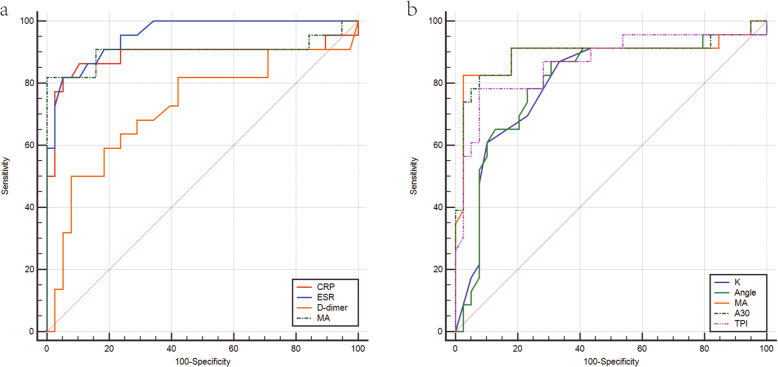
From October 2017 to September 2020, 62 patients who underwent revision arthroplasty were prospectively included. PJI was defined by the 2011 Musculoskeletal Infection Society criteria, in which 23 patients were diagnosed with PJI (Group A), and the remaining 39 patients were included as having aseptic loosening (Group B). In group A, 17 patients completed a two-stage revision in our centre. C-reactive protein (CRP), erythrocyte sedimentation rate (ESR), D-dimer, and TEG parameters (clotting time, α-angle, MA [maximum amplitude], amplitude at 30 min, and thrombodynamic potential index) were measured preoperatively in all included patients. In addition, receiver operating characteristic curves were used to evaluate the diagnostic value of these biomarkers.
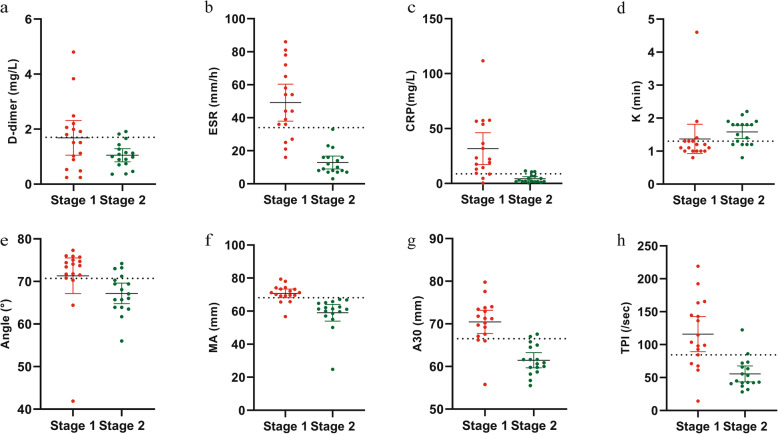
ESR (area under curve [AUC], 0.953; sensitivity, 81.82; specificity, 94.87) performed best for PJI diagnosis, followed by MA (AUC, 0.895; sensitivity, 82.61; specificity, 97.44) and CRP (AUC, 0.893; sensitivity, 82.61; specificity, 94.74). When these biomarkers were combined in pairs, the diagnostic value improved compared with any individual biomarker. The overall success rate of the two-stage revision was 100%. Furthermore, ESR and MA were valuable in determining the time of reimplantation, and their values all decreased below the cut-off values before reimplantation.
TEG could be a promising test in assisting PJI diagnosis, and a useful tool in judging the proper timing of reimplantation.
在假体周围关节感染(PJI)的诊断中,凝血相关生物标志物引起了新的关注。血栓弹力图(TEG)检测可全面评估血液凝固情况;因此,它可能是一种很有前途的 PJI 检测方法。本研究旨在评估 TEG 对 PJI 诊断的价值,并确定 TEG 在分析二期翻修再植入时间方面的临床意义。
从 2017 年 10 月至 2020 年 9 月,前瞻性纳入 62 例接受翻修手术的患者。根据 2011 年肌肉骨骼感染学会(MSIS)标准,将 PJI 定义为 23 例(A 组),其余 39 例为无菌性松动(B 组)。A 组中有 17 例在我们中心完成了二期翻修。所有纳入患者术前均检测 C 反应蛋白(CRP)、红细胞沉降率(ESR)、D-二聚体和 TEG 参数(凝血时间、α 角、最大振幅[MA]、30 分钟时振幅和血栓动力指数)。此外,还使用受试者工作特征曲线评估这些生物标志物的诊断价值。
ESR(曲线下面积[AUC],0.953;敏感性,81.82%;特异性,94.87%)对 PJI 诊断的效果最佳,其次是 MA(AUC,0.895;敏感性,82.61%;特异性,97.44%)和 CRP(AUC,0.893;敏感性,82.61%;特异性,94.74%)。当这些生物标志物两两组合时,与任何单个生物标志物相比,诊断价值均有所提高。二期翻修的总体成功率为 100%。此外,ESR 和 MA 对确定再植入时间有价值,且在再植入前均降至临界值以下。
TEG 可能是一种有前途的 PJI 辅助诊断检测方法,也是判断再植入适当时机的有用工具。