Department of Pediatrics, Radboud Amalia Children's Hospital, Radboud University Medical Center, 6500 HB Nijmegen, The Netherlands.
Department of Laboratory Medicine, Radboud Institute for Molecular Life Sciences (RIMLS), Radboud University Medical Center, 6500 HB Nijmegen, The Netherlands.
J Clin Endocrinol Metab. 2022 Jan 1;107(1):e272-e280. doi: 10.1210/clinem/dgab598.
Testicular adrenal rest tumors (TART) are a common complication in males with classic 21-hydroxylase deficiency (21OHD). TART are likely to contribute to the androgen excess in 21OHD patients, but a direct quantification of steroidogenesis from these tumors has not been yet done.
We aimed to define the production of 11-oxygenated 19-carbon (11oxC19) steroids by TART.
Using liquid chromatography-tandem mass spectrometry, steroids were measured in left (n = 7) and right (n = 4) spermatic vein and simultaneously drawn peripheral blood (n = 7) samples from 7 men with 21OHD and TART. For comparison, we also measured the peripheral steroid concentrations in 5 adrenalectomized patients and 12 age- and BMI-matched controls. Additionally, steroids were quantified in TART cell- and adrenal cell-conditioned medium, with and without adrenocorticotropic hormone (ACTH) stimulation.
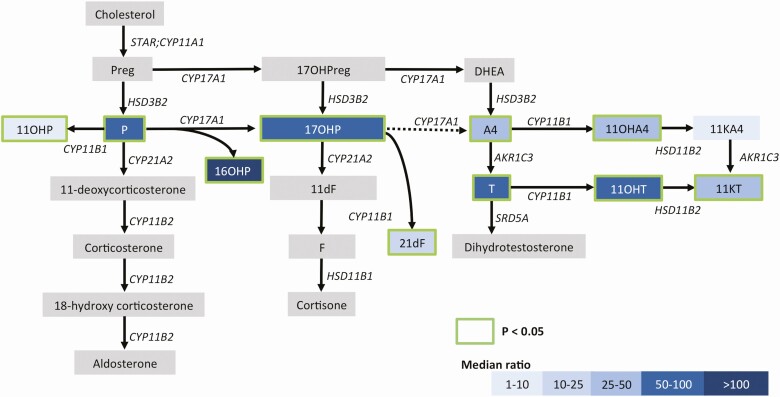
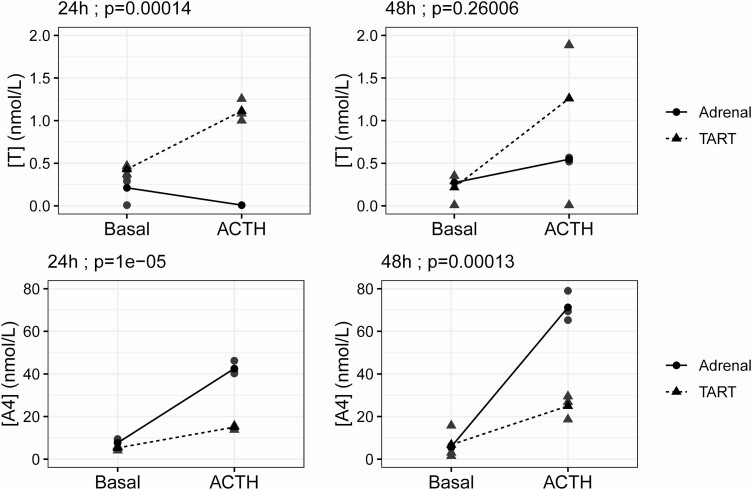
Compared with peripheral blood from 21OHD patients with TART, the spermatic vein samples displayed the highest gradient for 11β-hydroxytestosterone (11OHT; 96-fold) of the 11oxC19 steroids, followed by 11-ketotestosterone (47-fold) and 11β-hydroxyandrostenedione (11OHA4; 29-fold), suggesting production of these steroids in TART. TART cells produced higher levels of testosterone and lower levels of A4 and 11OHA4 after ACTH stimulation compared with adrenal cells, indicating ACTH-induced production of testosterone in TART.
In patients with 21OHD, TART produce 11oxC19 steroids, but in different proportions than the adrenals. The very high ratio of 11OHT in spermatic vs peripheral vein blood suggests the 11-hydroxylation of testosterone by TART, and the in vitro results indicate that this metabolism is ACTH-sensitive.
睾丸肾上腺残迹瘤(TART)是经典 21-羟化酶缺乏症(21OHD)男性的常见并发症。TART 可能导致 21OHD 患者雄激素过多,但尚未对这些肿瘤的类固醇生成进行直接定量。
我们旨在确定 TART 产生的 11-氧代 19-碳(11oxC19)类固醇。
使用液相色谱-串联质谱法,测量了 7 名患有 21OHD 和 TART 的男性左侧(n=7)和右侧(n=4)精索静脉和同时抽取的外周血(n=7)样本中的类固醇。为了比较,我们还测量了 5 例肾上腺切除患者和 12 例年龄和 BMI 匹配的对照者的外周类固醇浓度。此外,在有和没有促肾上腺皮质激素(ACTH)刺激的情况下,定量了 TART 细胞和肾上腺细胞条件培养基中的类固醇。
与患有 TART 的 21OHD 患者的外周血相比,精索静脉样本显示 11β-羟基睾酮(11OHT;96 倍)的 11oxC19 类固醇的梯度最高,其次是 11-酮睾酮(47 倍)和 11β-羟基雄烯二酮(11OHA4;29 倍),表明这些类固醇在 TART 中产生。与肾上腺细胞相比,TART 细胞在 ACTH 刺激后产生更高水平的睾酮和更低水平的 A4 和 11OHA4,表明 TART 中 ACTH 诱导的睾酮产生。
在 21OHD 患者中,TART 产生 11oxC19 类固醇,但与肾上腺的比例不同。精索静脉与外周静脉血中 11OHT 的非常高比值提示 TART 中的睾酮 11-羟化作用,并且体外结果表明这种代谢是 ACTH 敏感的。