Choudhary Pratik, Bellido Virginia, Graner Matthijs, Altpeter Bernd, Cicchetti Americo, Durand-Zaleski Isabelle, Kristensen Finn Børlum
Leicester Diabetes Centre (Bloom), Leicester General Hospital, University of Leicester, Leicester, UK.
Department of Endocrinology and Nutrition, Virgen del Rocío University Hospital, Seville, Spain.
Diabetes Ther. 2021 Sep;12(9):2311-2327. doi: 10.1007/s13300-021-01132-9. Epub 2021 Aug 14.
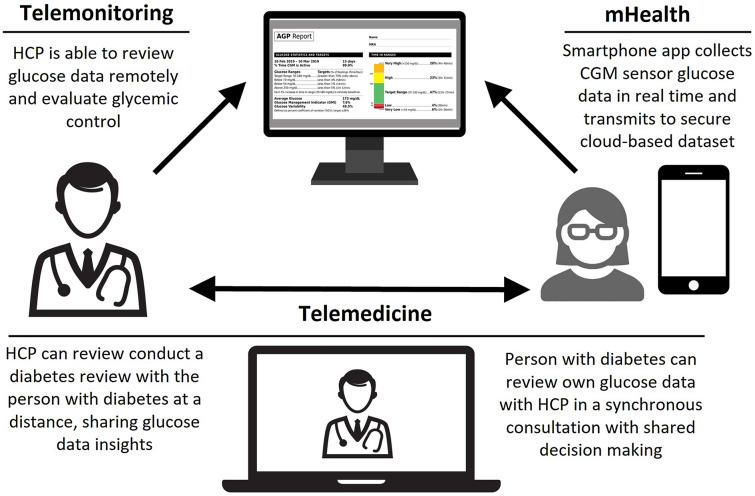
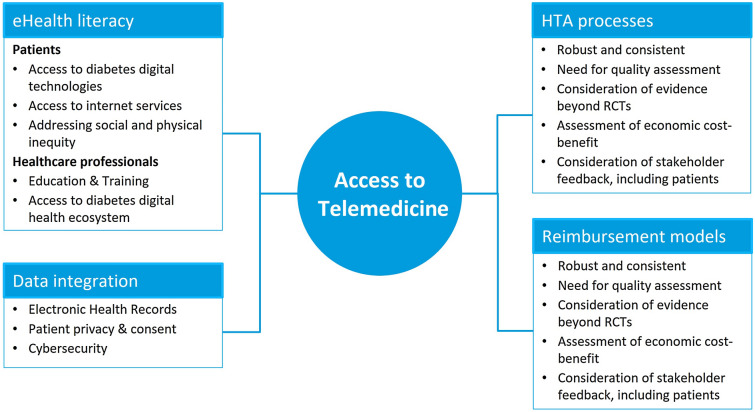
Telemedicine in diabetes care has been evolving over several years, particularly since the advent of cloud-connected technologies for diabetes management, such as glucose monitoring devices, including continuous glucose monitoring (CGM) systems, that facilitate sharing of glucose data between people with diabetes and their healthcare professionals in near-real time. Extreme social distancing and shielding in place for vulnerable patients during the COVID-19 pandemic has created both the challenge and the opportunity to provide care at a distance on a large scale. Available evidence suggests that glucose control has in fact improved during this period for people with diabetes who are able to use CGM devices for remote glucose monitoring. The development of telemedicine as part of the standard of care in diabetes faces significant challenges in the European context, particularly in terms of providing consistent and effective care at a distance to large populations of patients while using robust systems that can be supported by large regional and national healthcare services. These challenges include a fragmented approach to healthcare technology assessment and reimbursement, lack of eHealth education and literacy, particularly amongst healthcare professionals, lack of data integration, as well as concerns about electronic health records, patient consent and privacy. Here we review the benefits of and challenges to wider application of telemedicine and telemonitoring in the post-pandemic future, with the aim to ensure that the value of these eHealth services is provided to patients, healthcare providers and health systems.
远程医疗在糖尿病护理领域已经发展了数年,尤其是自用于糖尿病管理的云连接技术出现以来,比如血糖监测设备,包括连续血糖监测(CGM)系统,这些设备有助于糖尿病患者与其医护人员近乎实时地共享血糖数据。在新冠疫情期间,针对脆弱患者实施的极端社交距离措施和隔离措施既带来了挑战,也创造了大规模远程提供护理的机会。现有证据表明,在此期间,能够使用CGM设备进行远程血糖监测的糖尿病患者的血糖控制情况实际上有所改善。在欧洲背景下,将远程医疗发展成为糖尿病护理标准的一部分面临重大挑战,特别是在利用大型区域和国家医疗服务机构能够支持的强大系统,为大量患者远距离提供持续有效护理方面。这些挑战包括医疗技术评估和报销方式零散、缺乏电子健康素养教育,尤其是在医护人员中、缺乏数据整合,以及对电子健康记录、患者同意和隐私的担忧。在此,我们回顾远程医疗和远程监测在疫情后更广泛应用的益处和挑战,旨在确保这些电子健康服务的价值能够提供给患者、医疗服务提供者和卫生系统。