Harley Jasmine, Hagemann Cathleen, Serio Andrea, Patani Rickie
Department of Neuromuscular Diseases, Queen Square Institute of Neurology, University College London, London WC1N 3BG, UK.
The Francis Crick Institute, London NW1 1AT, UK.
Brain Commun. 2021 Aug 6;3(3):fcab166. doi: 10.1093/braincomms/fcab166. eCollection 2021.
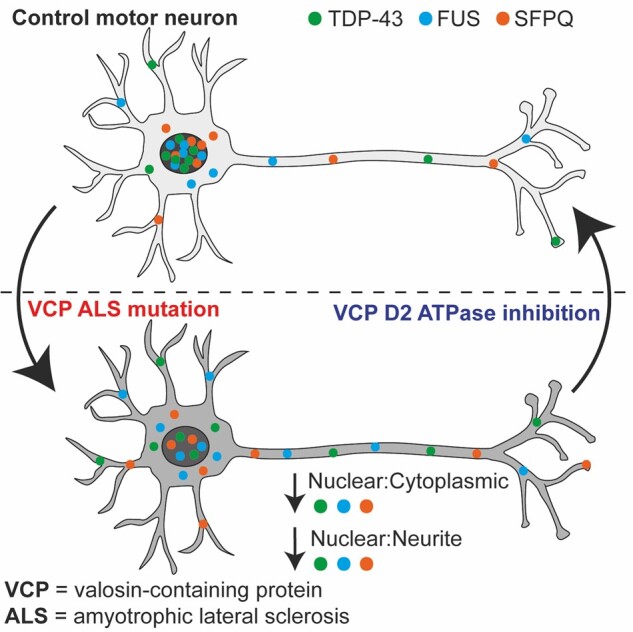
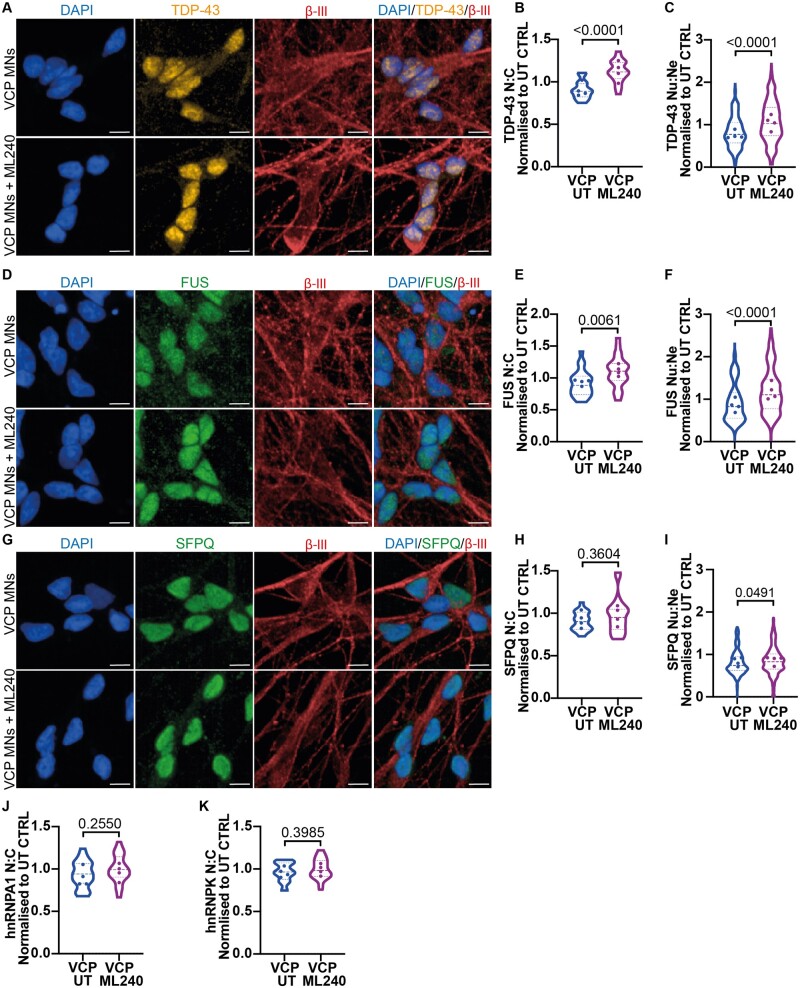
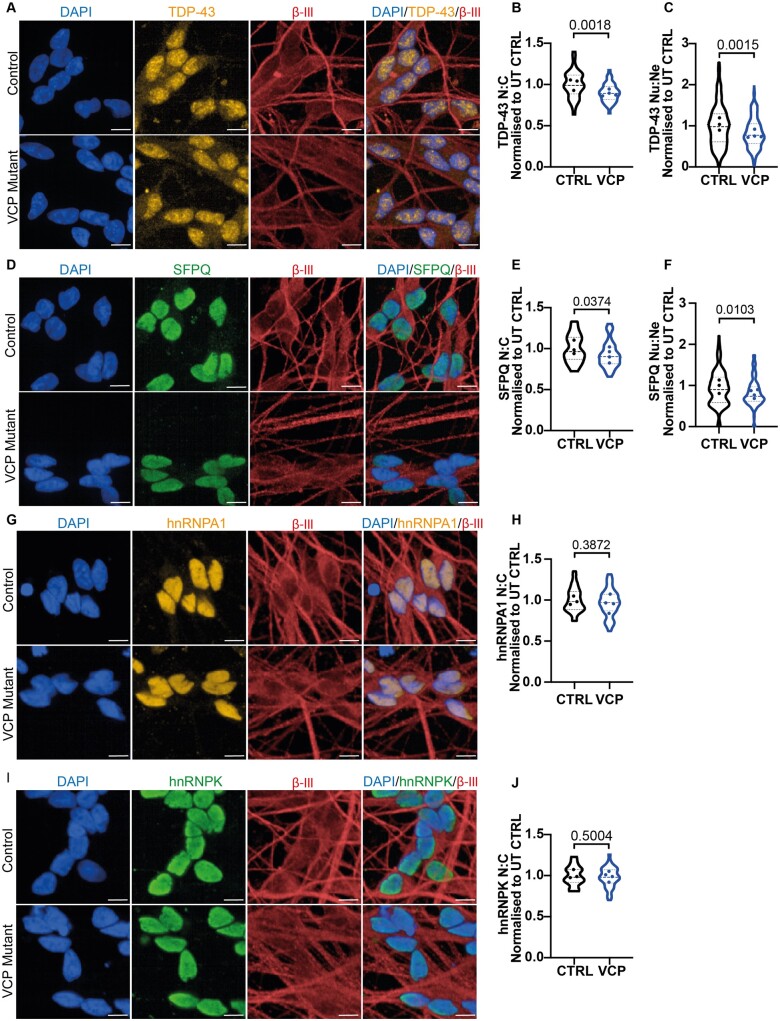
RNA binding proteins have been shown to play a key role in the pathogenesis of amyotrophic lateral sclerosis (ALS). Mutations in valosin-containing protein () cause ALS and exhibit the hallmark nuclear-to-cytoplasmic mislocalization of RNA binding proteins (RBPs). However, the mechanism by which mutations in lead to this mislocalization of RBPs remains incompletely resolved. To address this, we used human-induced pluripotent stem cell-derived motor neurons carrying mutations. We first demonstrate reduced nuclear-to-cytoplasmic ratios of transactive response DNA-binding protein 43 (TDP-43), fused in sarcoma/translocated in liposarcoma (FUS) and splicing factor proline and glutamine rich (SFPQ) in mutant motor neurons. Upon closer analysis, we also find these RBPs are mislocalized to motor neuron neurites themselves. To address the hypothesis that altered function of the D2 ATPase domain of VCP causes RBP mislocalization, we used pharmacological inhibition of this domain in control motor neurons and found this does not recapitulate RBP mislocalization phenotypes. However, D2 domain inhibition in mutant motor neurons was able to robustly reverse mislocalization of both TDP-43 and FUS, in addition to partially relocalizing SFPQ from the neurites. Together these results argue for a gain-of-function of D2 ATPase in mutant human motor neurons driving the mislocalization of TDP-43 and FUS. Our data raise the intriguing possibility of harnessing VCP D2 ATPase inhibitors in the treatment of -related ALS.
RNA结合蛋白已被证明在肌萎缩侧索硬化症(ALS)的发病机制中起关键作用。含缬酪肽蛋白(VCP)的突变会导致ALS,并表现出RNA结合蛋白(RBPs)从细胞核到细胞质的标志性错误定位。然而,VCP突变导致RBPs这种错误定位的机制仍未完全阐明。为了解决这个问题,我们使用了携带VCP突变的人诱导多能干细胞衍生的运动神经元。我们首先证明,在VCP突变的运动神经元中,反式作用应答DNA结合蛋白43(TDP-43)、肉瘤融合蛋白/脂肪肉瘤易位蛋白(FUS)和富含脯氨酸和谷氨酰胺的剪接因子(SFPQ)的核质比降低。经过更仔细的分析,我们还发现这些RBPs错误定位到了运动神经元的神经突本身。为了验证VCP的D2 ATP酶结构域功能改变导致RBP错误定位这一假说,我们在对照运动神经元中对该结构域进行了药理学抑制,发现这并不能重现RBP错误定位的表型。然而,在VCP突变的运动神经元中抑制D2结构域能够有力地逆转TDP-43和FUS的错误定位,此外还能使SFPQ从神经突部分重新定位。这些结果共同表明,在携带VCP突变的人类运动神经元中,D2 ATP酶存在功能获得现象,从而导致TDP-43和FUS的错误定位。我们的数据提出了一个有趣的可能性,即利用VCP D2 ATP酶抑制剂来治疗与VCP相关的ALS。