Department of Neurology, Columbia University Irving Medical Center, New York, NY.
Vagelos College of Physicians and Surgeons, Columbia University Irving Medical Center, New York, NY.
J Acquir Immune Defic Syndr. 2021 Sep 1;88(1):79-85. doi: 10.1097/QAI.0000000000002729.
To investigate a comprehensive array of magnetic resonance imaging (MRI)-based biomarkers of cerebrovascular disease (CVD) in a cohort of people living with HIV (PLWH) and relate these imaging biomarkers to cognition.
Cross-sectional, community-based study.
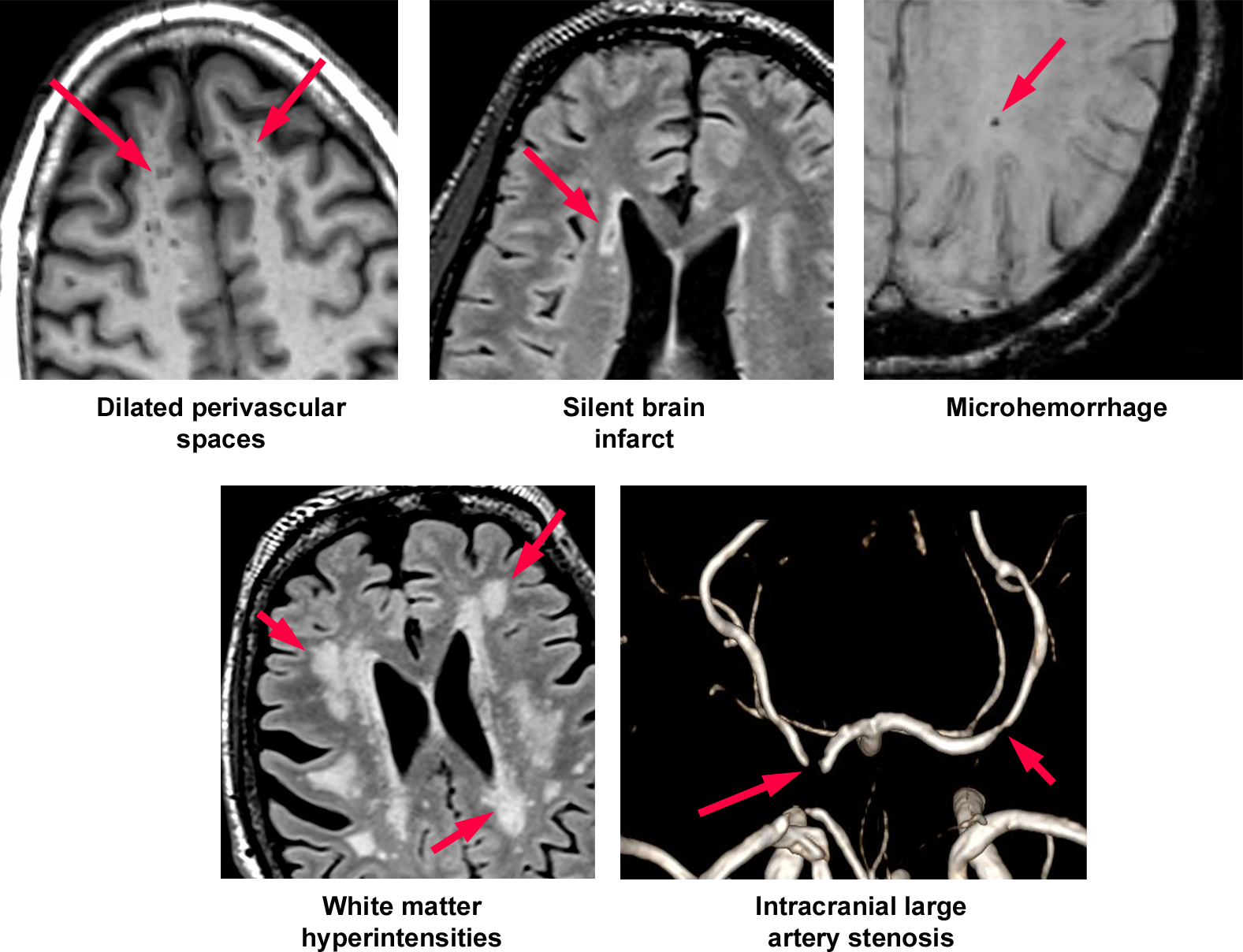
Participants were PLWH in New York City, aged 50 years or older. They underwent a brain magnetic resonance angiography or MRI to ascertain 7 MRI markers of CVD: silent brain infarcts, dilated perivascular spaces, microhemorrhages, white matter hyperintensity volume, white matter fractional anisotropy and mean diffusivity (measures of white matter integrity), and intracranial large artery stenosis. Participants underwent a battery of neurocognitive tests to obtain individual and global cognitive scores representative of various aspects of cognition.
We included 85 participants (mean age 60 ± 6 years, 48% men, 78% non-Hispanic Black), most of them with well-controlled HIV (75% with CD4 cell count > 200 cells/mm3 and viral load < 400 copies/mL at or near the time of the MRI scan). Silent brain infarcts, intracranial large artery stenosis, and poor white matter integrity were associated with poorer performance in at least one cognitive domain, but the sum of these 3 MRI markers of CVD was associated with lower working memory (B = -0.213, P = 0.028), list learning (B = -0.275, P = 0.019), and global cognition (B = -0.129, P = 0.007).
We identified silent brain infarcts, intracranial large artery stenosis, and poor white matter integrity as exposures that may be modifiable and may, therefore, influence cognitive decline. In addition, these MRI markers of CVD may help in identifying PLWH at higher risk of cognitive decline, which may be more amenable to targeted therapies.
本研究旨在调查一组艾滋病毒感染者(PLWH)中脑血管疾病(CVD)的综合磁共振成像(MRI)生物标志物,并将这些影像学生物标志物与认知功能相关联。
横断面、基于社区的研究。
参与者为纽约市的 PLWH,年龄在 50 岁及以上。他们接受了脑部磁共振血管造影或 MRI 检查,以确定 7 种 CVD 的 MRI 标志物:无症状性脑梗死、血管周围间隙扩大、微出血、脑白质高信号体积、脑白质各向异性和平均弥散度(脑白质完整性的测量指标)和颅内大动脉狭窄。参与者接受了一系列神经认知测试,以获得代表认知各个方面的个体和总体认知评分。
我们纳入了 85 名参与者(平均年龄 60±6 岁,48%为男性,78%为非西班牙裔黑人),其中大多数人的 HIV 得到了很好的控制(75%的人在 MRI 扫描时或接近扫描时 CD4 细胞计数>200 个/毫米 3 且病毒载量<400 拷贝/ml)。无症状性脑梗死、颅内大动脉狭窄和脑白质完整性差与至少一个认知领域的表现较差相关,但 CVD 的这 3 种 MRI 标志物的总和与较差的工作记忆(B=-0.213,P=0.028)、列表学习(B=-0.275,P=0.019)和总体认知(B=-0.129,P=0.007)相关。
我们发现无症状性脑梗死、颅内大动脉狭窄和脑白质完整性差是可能可改变的暴露因素,因此可能会影响认知能力下降。此外,这些 CVD 的 MRI 标志物可能有助于识别认知能力下降风险较高的 PLWH,这些患者可能更适合接受靶向治疗。