Mandle Richard J, Sebastián Nerea, Martinez-Perdiguero Josu, Mertelj Alenka
School of Physics and Astronomy, University of Leeds, Leeds, UK.
Department of Chemistry, University of York, York, UK.
Nat Commun. 2021 Aug 16;12(1):4962. doi: 10.1038/s41467-021-25231-0.
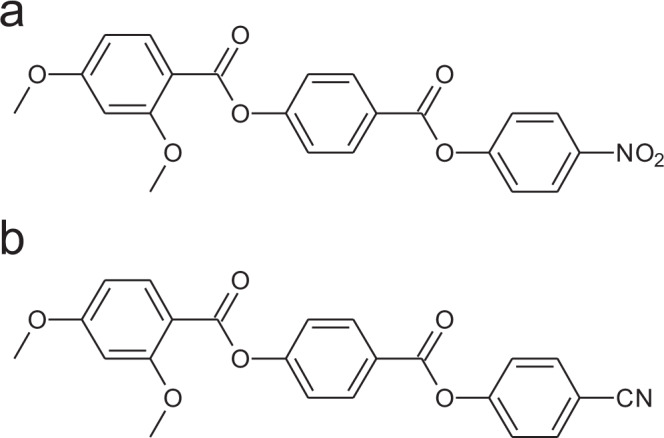
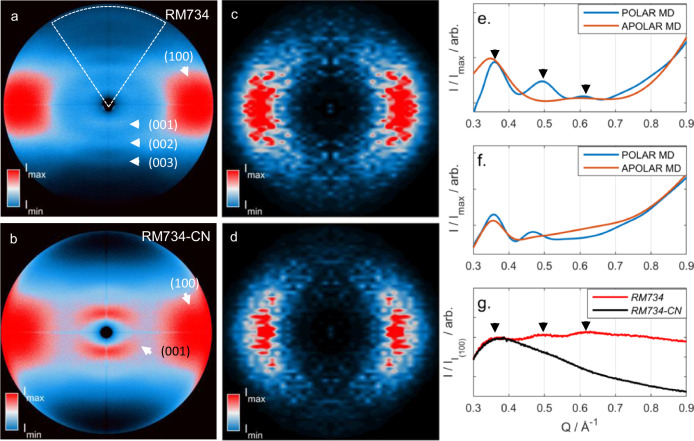
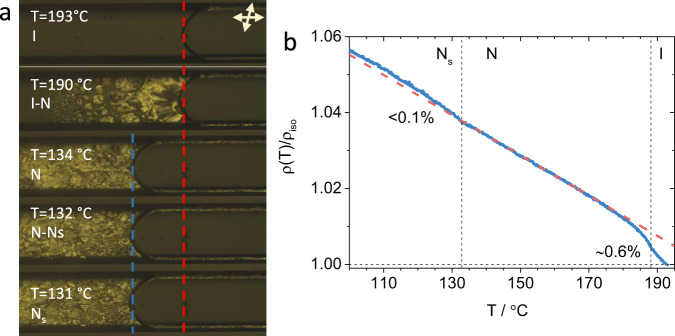
Nematic liquid crystals have been known for more than a century, but it was not until the 60s-70s that, with the development of room temperature nematics, they became widely used in applications. Polar nematic phases have been long-time predicted, but have only been experimentally realized recently. Synthesis of materials with nematic polar ordering at room temperature is certainly challenging and requires a deep understanding of its formation mechanisms, presently lacking. Here, we compare two materials of similar chemical structure and demonstrate that just a subtle change in the molecular structure enables denser packing of the molecules when they exhibit polar order, which shows that reduction of excluded volume is in the origin of the polar nematic phase. Additionally, we propose that molecular dynamics simulations are potent tools for molecular design in order to predict, identify and design materials showing the polar nematic phase and its precursor nematic phases.
向列型液晶已被人们所知超过一个世纪,但直到60年代至70年代,随着室温向列型液晶的发展,它们才在应用中得到广泛使用。极性向列相长期以来一直被预测,但直到最近才通过实验实现。合成在室温下具有向列型极性有序的材料无疑具有挑战性,并且需要深入了解其形成机制,而目前这方面还很欠缺。在这里,我们比较了两种化学结构相似的材料,并证明当分子呈现极性有序时,分子结构中一个细微的变化就能使分子更紧密地堆积,这表明排除体积的减小是极性向列相的起源。此外,我们提出分子动力学模拟是分子设计的有力工具,以便预测、识别和设计呈现极性向列相及其前驱向列相的材料。