Malallah Osamah, Rashid Zara, Li Chee Lok, Alqurshi Abdulmalik, Alhanan Mohamed A, Forbes Ben, Royall Paul G
Institute of Pharmaceutical Science, School of Cancer and Pharmaceutical Sciences, King's College London, 150 Stamford Street, London, SE1 9NH, UK.
Boots Pharmacy, The Brewery, 7 Romford, Essex, RM1 1AU, UK.
AAPS PharmSciTech. 2021 Aug 16;22(7):219. doi: 10.1208/s12249-021-02080-0.
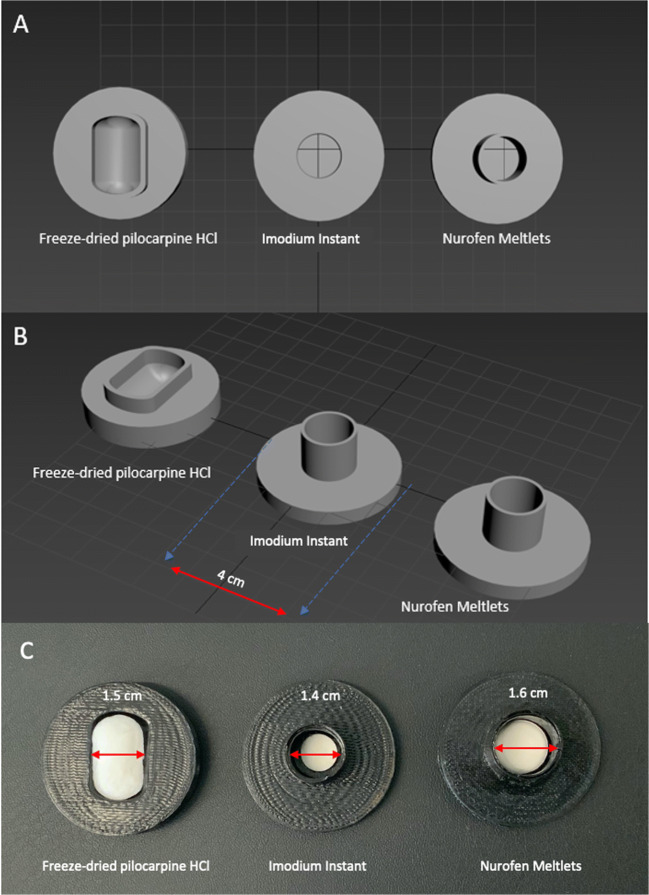
Measuring tablet disintegration is essential for quality control purposes; however, no established method adequately accounts for the timeframe or small volumes of the medium associated with the dissipation process for fast disintegrating tablets (FDTs) in the mouth. We hypothesised that digital imaging to measure disintegration in a low volume of the medium might discriminate between different types of FTD formulation. A digital image disintegration analysis (DIDA) was designed to measure tablet disintegration in 0.05-0.7 mL of medium. A temperature-controlled black vessel was 3D-printed to match the dimensions of each tablet under investigation. An overhead camera recorded the mean grey value of the tablet as a measure of the percentage of the formulation which remained intact as a function of time. Imodium Instants, Nurofen Meltlets and a developmental freeze-dried pilocarpine formulation were investigated. The imaging approach proved effective in discriminating the disintegration of different tablets (p < 0.05). For example, 10 s after 0.7 mL of a saliva simulant was applied, 2.0 ± 0.3% of the new pilocarpine tablet remained, whereas at the same time point, 22 ± 9% of the Imodium Instants had not undergone disintegration (temperature within the vessel was 37 ± 0.5°C). Nurofen Meltlets were observed to swell and showed a percentage recovery of 120.7 ± 2.4% and 135.0 ± 6.1% when 0.05 mL and 0.7 mL volumes were used, respectively. Thus, the new digital image disintegration analysis, DIDA, reported here effectively evaluated fast disintegrating tablets and has the potential as a quality control method for such formulations.
测量片剂崩解对于质量控制至关重要;然而,目前尚无既定方法能够充分考虑口腔中快速崩解片(FDT)崩解过程的时间范围或与之相关的少量介质。我们推测,通过数字成像测量少量介质中的崩解情况,或许能够区分不同类型的FTD制剂。设计了一种数字图像崩解分析(DIDA)方法,用于测量0.05 - 0.7 mL介质中的片剂崩解情况。通过3D打印制作了一个温度可控的黑色容器,使其尺寸与所研究的每片片剂相匹配。一台高架摄像机记录片剂的平均灰度值,以此作为制剂完整保留百分比随时间变化的量度。对易蒙停速溶片、布洛芬口溶膜和一种正在研发的冻干毛果芸香碱制剂进行了研究。成像方法被证明能够有效区分不同片剂的崩解情况(p < 0.05)。例如,在加入0.7 mL唾液模拟物10秒后,新型毛果芸香碱片剂仍有2.0 ± 0.3%保留,而在同一时间点,易蒙停速溶片有22 ± 9%尚未崩解(容器内温度为37 ± 0.5°C)。观察到布洛芬口溶膜会膨胀,当分别使用0.05 mL和0.7 mL体积的介质时,其回收率分别为120.7 ± 2.4%和135.0 ± 6.1%。因此,本文报道的新型数字图像崩解分析方法DIDA能够有效评估快速崩解片,具有作为此类制剂质量控制方法的潜力。