Kumasi Centre for Collaborative Research in Tropical Medicine, Kwame Nkrumah University of Science and Technology, Kumasi, Ghana.
School of Medicine and Dentistry, Kwame Nkrumah University of Science and Technology, Kumasi, Ghana.
Infect Dis Poverty. 2021 Aug 17;10(1):109. doi: 10.1186/s40249-021-00891-8.
Buruli ulcer disease (BUD) is a necrotic skin neglected tropical disease (NTD) that has both a mental and physical health impact on affected individuals. Although there is increasing evidence suggesting a strong association between neglected tropical diseases (NTDs) and mental illness, there is a relative lack of information on BUD's impact on the mental health and quality of life (QoL) of affected individuals in Ghana. This study is to assess the impact of BUD on mental health and quality of life of patients with active and past BUD infection, and their caregivers.
We conducted a case control study in 3 BUD endemic districts in Ghana between August and November 2019. Face-to-face structured questionnaire-based interviews were conducted on BUD patients with active and past infection, as well as caregivers of BUD patients using WHO Quality of Life scale, WHO Disability Assessment Schedule, Self-Reporting Questionnaire, Buruli Ulcer Functional Limitation Score and Hospital Anxiety and Depression Scale data tools. Descriptive statistics were used to summarize the characteristics of the study participants. Participant groups were compared using student t test and chi-square (χ) or Fisher's exact tests. Mean quality of life scores are reported with their respective 95% confidence intervals. Data was analysed using STATA statistical software.
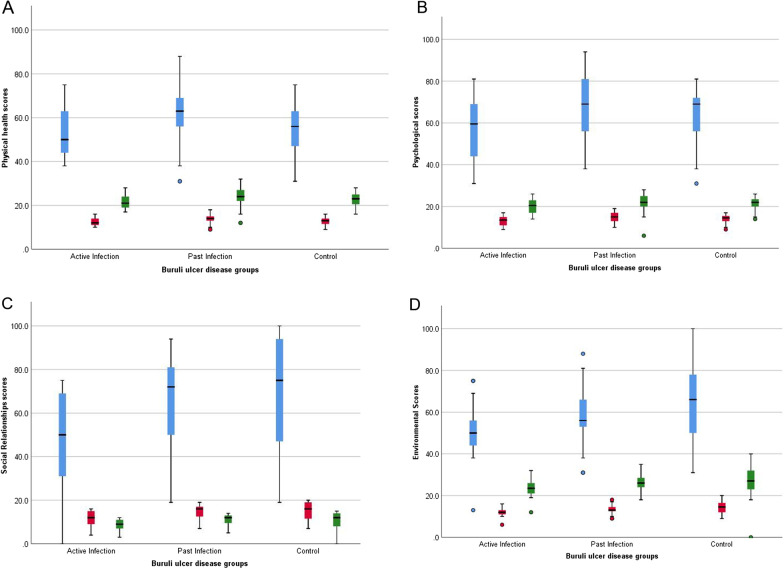
Our results show that BUD patients with active and past infection, along with their caregivers, face significant levels of distress and mental health sequelae compared to controls. Depression (P = 0.003) was more common in participants with active (27%) and past BU infection (17%), compared to controls (0%). Anxiety was found in 42% (11/26) and 20% (6/29) of participants with active and past BUD infection compared to 14% (5/36) of controls. Quality of life was also significantly diminished in active BUD infection, compared to controls. In the physical health domain, mean QoL scores were 54 ± 11.1 and 56 ± 11.0 (95% CI: 49.5‒58.5 and 52.2‒59.7) respectively for participants with active infection and controls. Similarly in the psychological domain, scores were lower for active infection than controls [57.1 ± 15.2 (95% CI: 50.9‒63.2) vs 64.7 ± 11.6 (95% CI: 60.8‒68.6)]. Participants with past infection had high QoL scores in both physical [61.3 ± 13.5 (95% CI: 56.1‒66.5)] and psychological health domains [68.4 ± 14.6 (95% CI: 62.7‒74.0)].
BUD is associated with significant mental health distress and reduced quality of life in affected persons and their caregivers in Ghana. There is a need for integration of psychosocial interventions in the management of the disease.
溃疡分枝杆菌病(BUD)是一种坏死性皮肤被忽视的热带病(NTD),对受影响的个人的身心健康都有影响。尽管越来越多的证据表明,被忽视的热带病(NTD)与精神疾病之间存在密切关联,但有关加纳 BUD 对受感染者心理健康和生活质量(QoL)影响的信息相对较少。本研究旨在评估 BUD 对活跃和既往 BUD 感染患者及其照顾者的心理健康和生活质量的影响。
我们于 2019 年 8 月至 11 月在加纳的 3 个 BUD 流行地区进行了一项病例对照研究。对活跃和既往 BUD 感染的患者以及 BUD 患者的照顾者进行了基于 WHO 生活质量量表、WHO 残疾评估表、自我报告问卷、溃疡分枝杆菌功能障碍评分和医院焦虑和抑郁量表数据工具的面对面结构化问卷调查。使用描述性统计来总结研究参与者的特征。使用学生 t 检验和卡方(χ)或 Fisher 精确检验比较参与者组。报告了平均生活质量评分及其各自的 95%置信区间。使用 STATA 统计软件进行数据分析。
我们的研究结果表明,与对照组相比,活跃和既往 BUD 感染患者及其照顾者均面临着严重的心理困扰和心理健康后遗症。与对照组相比,患有活跃(27%)和既往 BU 感染(17%)的参与者中更常见抑郁(P=0.003)。与对照组(14%,5/36)相比,在患有活跃和既往 BUD 感染的参与者中分别发现了 42%(11/26)和 20%(6/29)的焦虑症。与对照组相比,活跃性 BUD 感染的生活质量也明显下降。在身体健康方面,活跃感染患者的平均 QoL 评分为 54±11.1,对照组为 56±11.0(95%CI:49.5‒58.5 和 52.2‒59.7)。同样在心理领域,活跃感染患者的得分也低于对照组[57.1±15.2(95%CI:50.9‒63.2)比 64.7±11.6(95%CI:60.8‒68.6)]。既往感染患者在生理和心理健康方面均具有较高的 QoL 评分[61.3±13.5(95%CI:56.1‒66.5)和 68.4±14.6(95%CI:62.7‒74.0)]。
BUD 与加纳受感染者及其照顾者的严重心理健康困扰和生活质量下降有关。有必要将心理社会干预措施纳入该疾病的管理中。