Amano Enzyme Inc. Innovation Center, Kakamigahara, Japan.
Sci Rep. 2021 Aug 17;11(1):16631. doi: 10.1038/s41598-021-96058-4.
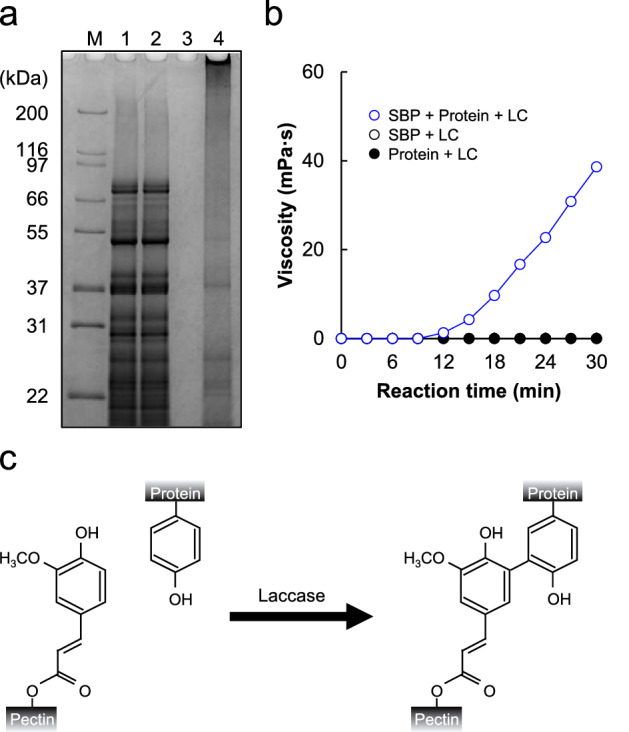
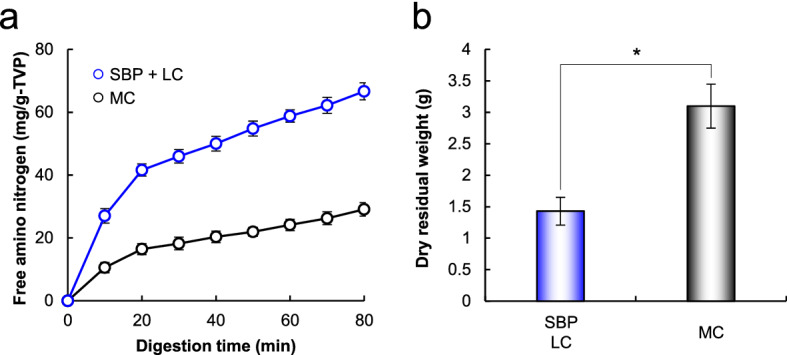
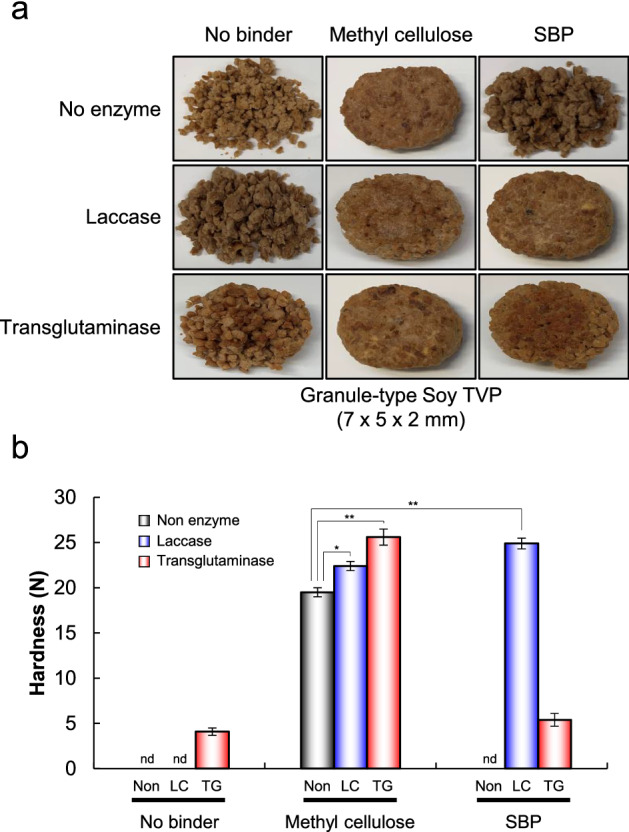
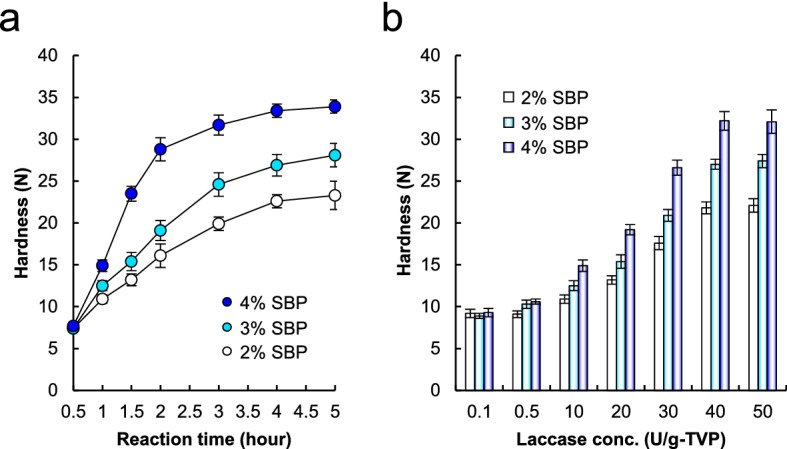
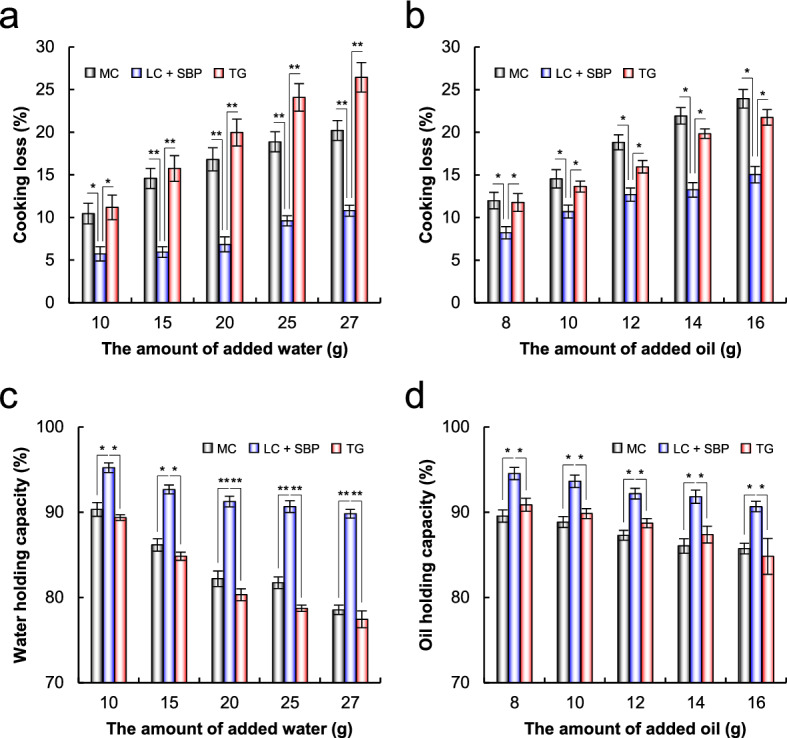
The gap between the current supply and future demand of meat has increased the need to produce plant-based meat analogs. Methylcellulose (MC) is used in most commercial products. Consumers and manufacturers require the development of other novel binding systems, as MC is not chemical-free. We aimed to develop a novel chemical-free binding system for meat analogs. First, we found that laccase (LC) synergistically crosslinks proteins and sugar beet pectin (SBP). To investigate the ability of these SBP-protein crosslinks, textured vegetable protein (TVP) was used. The presence of LC and SBP improved the moldability and binding ability of patties, regardless of the type, shape, and size of TVPs. The hardness of LC-treated patties with SBP reached 32.2 N, which was 1.7- and 7.9-fold higher than that of patties with MC and transglutaminase-treated patties. Additionally, the cooking loss and water/oil-holding capacity of LC-treated patties with SBP improved by up to 8.9-9.4% and 5.8-11.3%, compared with patties with MC. Moreover, after gastrointestinal digestion, free amino nitrogen released from LC-treated patties with SBP was 2.3-fold higher than that released from patties with MC. This is the first study to report protein-SBP crosslinks by LC as chemical-free novel binding systems for meat analogs.
肉类的当前供应与未来需求之间的差距增加了生产植物性肉类仿制品的需求。甲基纤维素(MC)被用于大多数商业产品中。消费者和制造商需要开发其他新型的结合系统,因为 MC 并非完全无化学物质。我们旨在为肉类仿制品开发一种新型的无化学物质结合系统。首先,我们发现漆酶(LC)可协同交联蛋白质和糖甜菜果胶(SBP)。为了研究这些 SBP-蛋白质交联的能力,使用了组织化植物蛋白(TVP)。LC 和 SBP 的存在提高了肉饼的可模制性和结合能力,而与 TVP 的类型、形状和大小无关。用 SBP 处理的 LC 处理的肉饼的硬度达到 32.2 N,比用 MC 和转谷氨酰胺酶处理的肉饼分别高 1.7 倍和 7.9 倍。此外,用 SBP 处理的 LC 处理的肉饼的烹饪损失和水/油保持能力提高了 8.9-9.4%和 5.8-11.3%,与用 MC 处理的肉饼相比。此外,在胃肠道消化后,用 SBP 处理的 LC 处理的肉饼释放的游离氨基酸氮是用 MC 处理的肉饼的 2.3 倍。这是第一项报道 LC 作为化学免费的新型结合系统用于肉类仿制品的蛋白质-SBP 交联的研究。