Department of Pediatrics, Center for Child and Community Health Research (CCHR), Johns Hopkins School of Medicine, 5200 Eastern Avenue, Mason F. Lord Bldg-Center Towers, Suite 4200, Baltimore, MD, 21224, USA.
Department of Health, Behavior and Society, Johns Hopkins Bloomberg School of Public Health, Baltimore, MD, USA.
AIDS Behav. 2022 Mar;26(3):709-718. doi: 10.1007/s10461-021-03430-6. Epub 2021 Aug 17.
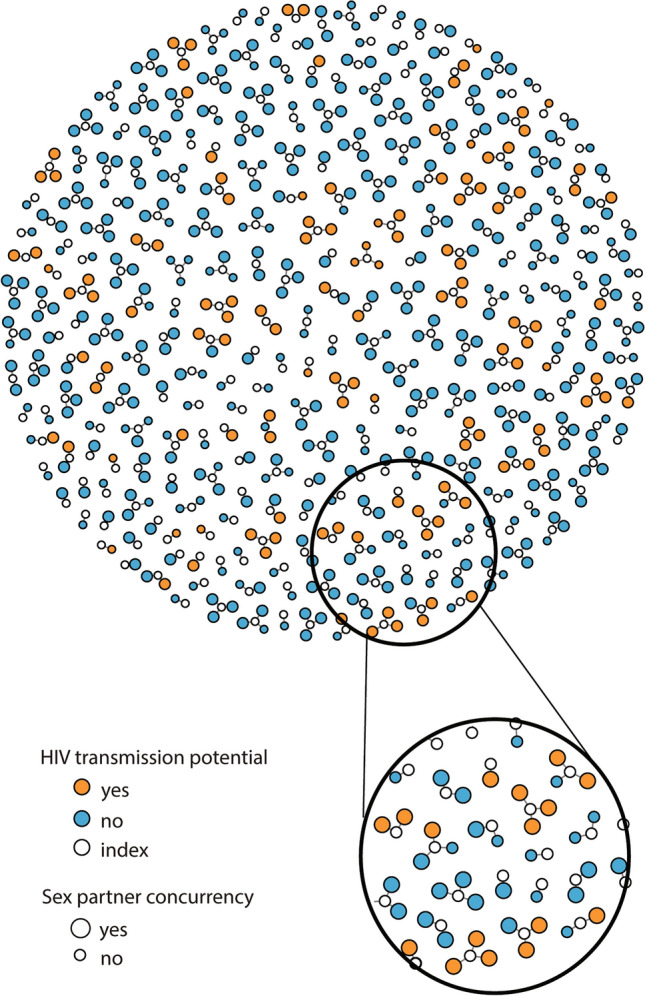
We determined whether racial disparities in HIV infection among gay and bisexual men (MSM) may be partially explained by racial differences in the HIV transmission potential (i.e. mixing of people living with HIV and people not living with HIV or of unknown HIV serostatus) and density (i.e. sex partner concurrency) of sexual networks. Data included a behavioral survey, testing for HIV, and an egocentric sexual network survey. Mixed effects logistic regressions were used for hypothesis testing. Black (vs. non-Black) MSM were more likely to not know their partner's HIV serostatus (21.8% vs. 9.6%). Similar proportions reported sex partner concurrency (67.1% vs. 68.0%). In adjusted analyses, among Black MSM, sex partner concurrency significantly increased the odds of an HIV transmission potential partnership (TPP), and this association was not significant among non-Black indexes. The association between an HIV TPP and sex partner concurrency may help explain persistent racial disparities in HIV prevalence.
我们确定了在男同性恋和双性恋男性(MSM)中艾滋病毒感染的种族差异是否可以部分通过艾滋病毒传播潜力(即艾滋病毒感染者和未感染者或未知艾滋病毒血清状况者之间的混合)以及性网络的密度(即性伴侣同时发生性行为)的种族差异来解释。数据包括行为调查、艾滋病毒检测和以自我为中心的性网络调查。混合效应逻辑回归用于假设检验。黑人(与非黑人)MSM 更有可能不知道其伴侣的艾滋病毒血清状况(21.8%比 9.6%)。报告性伴侣同时发生性行为的比例相似(67.1%比 68.0%)。在调整后的分析中,在黑人 MSM 中,性伴侣同时发生性行为显著增加了艾滋病毒传播潜在伙伴关系(TPP)的可能性,而在非黑人指标中,这种关联并不显著。艾滋病毒 TPP 与性伴侣同时发生性行为之间的关联可能有助于解释艾滋病毒流行率持续存在的种族差异。