Division of Renal Diseases and Hypertension, University of Colorado Anschutz Medical, Aurora, CO, USA.
Center for Transformative Research on Health Behaviors, Fralin Biomedical Research Institute at Virginia Tech Carilion, Roanoke, VA, USA.
Physiol Rep. 2021 Aug;9(16):e14970. doi: 10.14814/phy2.14970.
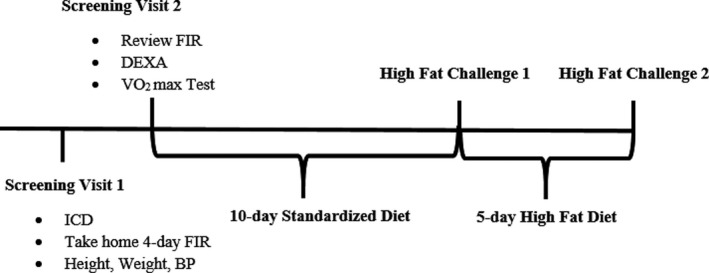
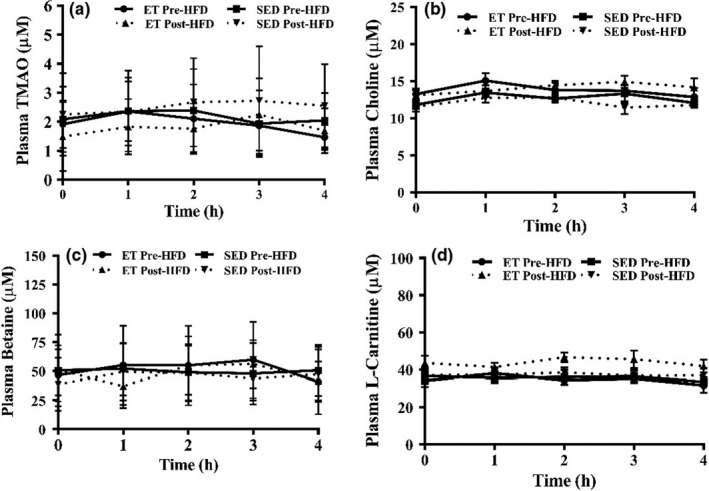
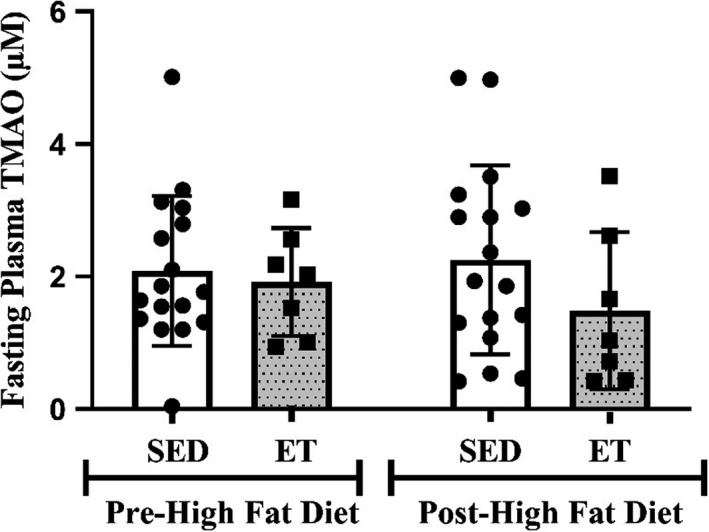
Gut bacteria release trimethylamine (TMA) from dietary substrates. TMA is absorbed and is subsequently oxidized in the liver to produce trimethylamine N-oxide (TMAO). Plasma TMAO levels are positively correlated with risk for type 2 diabetes (T2D) and cardiovascular disease (CVD). High-fat diet (HFD) consumption has been reported to increase fasting and postprandial TMAO in sedentary individuals. However, whether the increase in TMAO with consumption of an HFD is observed in endurance-trained males is unknown. Healthy, sedentary (n = 17), and endurance-trained (n = 7) males consumed a 10-day eucaloric diet comprised of 55% carbohydrate, 30% total fat, and <10% saturated fat prior to baseline testing. Blood samples were obtained in a fasted state and for a 4-hour high-fat challenge (HFC) meal at baseline and then again following 5-day HFD (30% carbohydrate, 55% total fat, and 25% saturated fat). Plasma TMAO and TMA-moiety (choline, betaine, L-carnitine) concentrations were measured using isocratic ultraperformance liquid chromatography-tandem mass spectrometry. Age (23 ±3 vs. 22 ± 2 years) and body mass index (23.0 ± 3.0 vs. 23.5 ± 2.1 kg/m ) were similar (both p > 0.05) in the sedentary and endurance-trained group, respectively. VO was significantly higher in the endurance-trained compared with sedentary males (56.7 ± 8.2 vs. 39.9 ± 6.0 ml/kg/min). Neither the HFC nor the HFD evoked a detectable change in plasma TMAO (p > 0.05) in either group. Future studies are needed to identify the effects of endurance training on TMAO production.
肠道细菌从膳食底物中释放三甲胺(TMA)。TMA 被吸收,随后在肝脏中氧化生成三甲胺 N-氧化物(TMAO)。血浆 TMAO 水平与 2 型糖尿病(T2D)和心血管疾病(CVD)的风险呈正相关。据报道,高脂肪饮食(HFD)的摄入会增加久坐个体的空腹和餐后 TMAO。然而,在耐力训练的男性中,是否观察到 HFD 摄入后 TMAO 的增加尚不清楚。健康、久坐(n=17)和耐力训练(n=7)的男性在基线测试前先摄入 10 天的热量平衡饮食,饮食中碳水化合物占 55%,总脂肪占 30%,饱和脂肪含量低于 10%。在空腹状态和高脂肪挑战(HFC)餐 4 小时时采集血样,然后在摄入 5 天 HFD(30%碳水化合物,55%总脂肪,25%饱和脂肪)后再次采集血样。使用等度超高效液相色谱-串联质谱法测定血浆 TMAO 和 TMA 部分(胆碱、甜菜碱、L-肉碱)浓度。久坐和耐力训练组的年龄(23±3 岁比 22±2 岁)和体重指数(23.0±3.0 千克/米比 23.5±2.1 千克/米)相似(均 P>0.05)。与久坐男性相比,耐力训练男性的 VO 显著更高(56.7±8.2 毫升/千克/分钟比 39.9±6.0 毫升/千克/分钟)。在两组中,HFC 或 HFD 均未引起血浆 TMAO 的可检测变化(均 P>0.05)。需要进一步的研究来确定耐力训练对 TMAO 生成的影响。