Hoekstra Sanne, Bartz-Johannessen Christoffer, Sinkeviciute Igne, Reitan Solveig K, Kroken Rune A, Løberg Else-Marie, Larsen Tor K, Rettenbacher Maria, Johnsen Erik, Sommer Iris E
Department of Biomedical Sciences of Cells and Systems and Department of Psychiatry, Rijksuniversiteit Groningen (RUG), University Medical Center Groningen (UMCG), Groningen, Netherlands.
NORMENT - Norwegian Centre for Mental Disorders Research, Division of Psychiatry, Haukeland University Hospital, Bergen, Norway.
NPJ Schizophr. 2021 Aug 18;7(1):39. doi: 10.1038/s41537-021-00170-3.
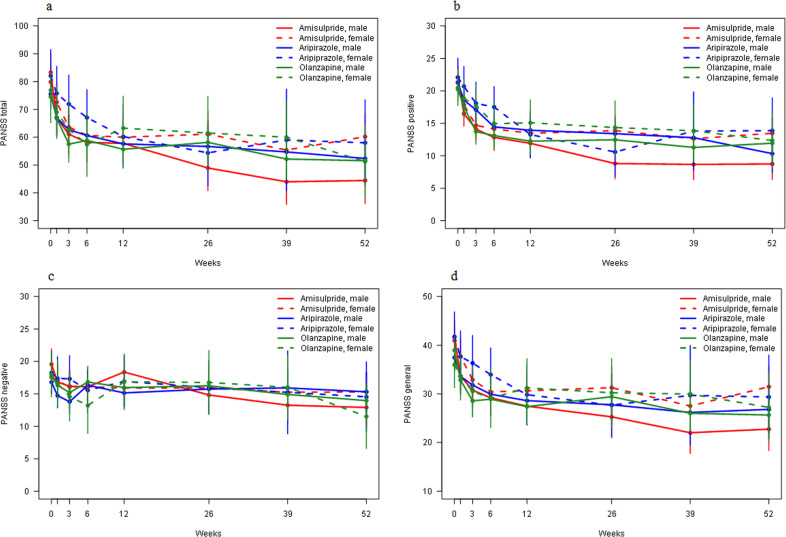
Current guidelines for patients with schizophrenia spectrum disease do not take sex differences into account, which may result in inappropriate sex-specific treatment. In the BeSt InTro study, a total of 144 patients (93 men and 51 women) with a schizophrenia spectrum diagnosis and ongoing psychosis were included and randomized to amisulpride, aripiprazole, or olanzapine in flexible dose. This trial is registered with ClinicalTrials.gov (NCT01446328). Primary outcomes were sex differences in dose, dose-corrected serum levels, efficacy, and tolerability. Dosing was higher for men than for women in the aripiprazole group (p = 0.025) and, at trend level, in the olanzapine group (p = 0.056). Dose-corrected serum levels were 71.9% higher in women than in men for amisulpride (p = 0.019) and 55.8% higher in women than in men for aripiprazole (p = 0.049). In the amisulpride group, men had a faster decrease in psychotic symptoms than women (p = 0.003). Moreover, amisulpride was more effective than the other medications in men but not in women. Prolactin levels were higher in women than in men, especially for amisulpride (p < 0.001). Also, women had higher BMI increase on amisulpride compared to the two other antipsychotics (p < 0.001). We conclude that clinicians should be aware of the risks of overdosing in women, especially for amisulpride and aripiprazole. Amisulpride is highly effective in men, but in women, amisulpride showed more severe side effects and may thus not be the drug of first choice. Our study shows that sex differences should be taken into account in future studies on antipsychotics. Future research is warranted to evaluate these preliminary results.
目前针对精神分裂症谱系疾病患者的指南未考虑性别差异,这可能导致针对性别的不恰当治疗。在BeSt InTro研究中,共有144例诊断为精神分裂症谱系且存在持续性精神病性症状的患者(93例男性和51例女性)被纳入,并随机分配至阿立哌唑、氨磺必利或奥氮平组,采用灵活剂量给药。该试验已在ClinicalTrials.gov注册(NCT01446328)。主要结局指标为剂量、剂量校正后的血清水平、疗效和耐受性方面的性别差异。在阿立哌唑组中,男性的给药剂量高于女性(p = 0.025),奥氮平组也呈趋势性差异(p = 0.056)。氨磺必利剂量校正后的血清水平女性比男性高71.9%(p = 0.019),阿立哌唑剂量校正后的血清水平女性比男性高55.8%(p = 0.049)。在氨磺必利组中,男性精神病性症状的缓解速度比女性快(p = 0.003)。此外,氨磺必利对男性的疗效优于其他药物,但对女性则不然。女性的催乳素水平高于男性,尤其是使用氨磺必利时(p < 0.001)。而且,与其他两种抗精神病药物相比,女性使用氨磺必利时体重指数增加更高(p < 0.001)。我们得出结论,临床医生应意识到女性尤其是使用氨磺必利和阿立哌唑时存在过量用药的风险。氨磺必利对男性疗效显著,但对女性而言,氨磺必利显示出更严重的副作用,因此可能不是首选药物。我们的研究表明,抗精神病药物的未来研究应考虑性别差异。有必要进行进一步研究以评估这些初步结果。