Yuan Linlin, Tian Xiufen, Zhang Yanfei, Huang Xinhui, Li Qing, Li Wencai, Li Shenglei
Department of Otorhinolaryngology Head and Neck Surgery, The First Affiliated Hospital of Zhengzhou University, 450052, Zhengzhou, People's Republic of China.
Department of Pathology, The Third Affiliated Hospital of Soochow University (Changzhou City No. 1 People's Hospital), 215006, Changzhou, People's Republic of China.
Exp Mol Med. 2021 Aug;53(8):1218-1228. doi: 10.1038/s12276-021-00647-2. Epub 2021 Aug 18.
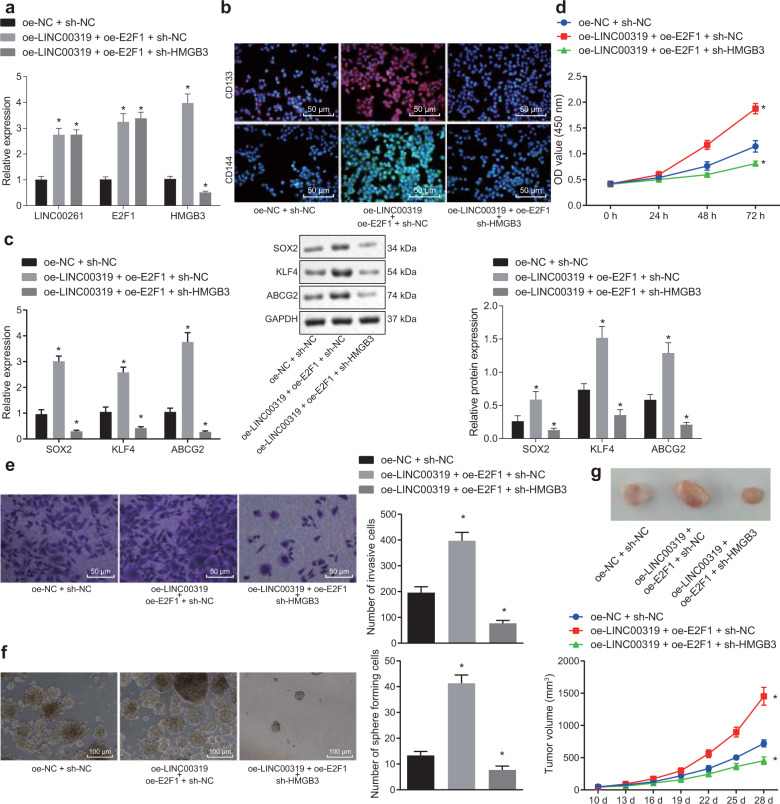
Laryngeal squamous cell carcinoma (LSCC) is one of the most common subtypes of head and neck malignancies worldwide. Long intervening/intergenic noncoding RNAs (LINCRNAs) have been recently implicated in various biological processes that take place in the setting of laryngeal cancer, but the regulatory role of LINC00319 in LSCC remains largely unknown. The current study aimed to elucidate the regulatory effect of LINC00319 on the development and progression of LSCC via high-mobility group box 3 (HMGB3). Microarray-based analysis was initially conducted to identify differentially expressed long noncoding RNAs, after which the expression of LINC00319 and HMGB3 in LSCC tissues and cells was determined accordingly. CD133CD144 TU177 cells were subsequently isolated and transfected with LINC00319 overexpression vector (oe-LINC00319), short hairpin RNA (sh)-LINC00319, sh-HMGB3, sh-E2F transcription factor 1 (E2F1), and oe-E2F1, as well as their corresponding controls. The proliferative, invasion, self-renewal, and tumorigenic abilities of CD133CD144 TU177 cells were then evaluated. Our in vitro findings were further confirmed following subcutaneous injection of cells expressing the corresponding plasmids into nude mice. LINC00319 and HMGB3 expressions were elevated in LSCC cells and tissues. LINC00319 increased HMGB3 expression by recruiting E2F1. Furthermore, the stimulatory role of LINC00319 on the proliferation, invasion, self-renewal ability, and tumorigenicity of CD133CD144 TU177 cells was achieved by upregulating HMGB3 via recruitment of E2F1. The in vitro findings were also confirmed by in vivo experiments. Taken together, these data show that downregulating LINC00319 in CD133CD144 TU177 cells may serve as a potential anticancer regimen by inhibiting the proliferation and invasion of cancer stem cells in LSCC.
喉鳞状细胞癌(LSCC)是全球范围内头颈部恶性肿瘤最常见的亚型之一。长链居间/基因间非编码RNA(LINC-RNAs)最近被认为参与了喉癌发生过程中的各种生物学过程,但LINC00319在LSCC中的调控作用仍 largely unknown。本研究旨在通过高迁移率族蛋白B3(HMGB3)阐明LINC00319对LSCC发生发展的调控作用。首先进行基于微阵列的分析以鉴定差异表达的长链非编码RNA,随后相应地测定LINC00319和HMGB3在LSCC组织和细胞中的表达。随后分离出CD133CD144 TU177细胞,并用LINC00319过表达载体(oe-LINC00319)、短发夹RNA(sh)-LINC00319、sh-HMGB3、sh-E2F转录因子1(E2F1)和oe-E2F1及其相应对照进行转染。然后评估CD133CD144 TU177细胞的增殖、侵袭、自我更新和致瘤能力。在将表达相应质粒的细胞皮下注射到裸鼠体内后,进一步证实了我们的体外研究结果。LINC00319和HMGB3在LSCC细胞和组织中表达升高。LINC00319通过招募E2F1增加HMGB3表达。此外,LINC00319对CD133CD144 TU177细胞增殖、侵袭、自我更新能力和致瘤性的刺激作用是通过招募E2F1上调HMGB3来实现的。体内实验也证实了体外研究结果。综上所述,这些数据表明,下调CD133CD144 TU177细胞中的LINC00319可能通过抑制LSCC中癌干细胞的增殖和侵袭而成为一种潜在的抗癌方案。