Piper Rory J, Tangwiriyasakul Chayanin, Shamshiri Elhum A, Centeno Maria, He Xiaosong, Richardson Mark P, Tisdall Martin M, Carmichael David W
Department of Neurosurgery, John Radcliffe Hospital, Oxford, United Kingdom.
Department of Neurosurgery, Great Ormond Street Hospital for Children, UCL Great Ormond Street Institute of Child Health, London, United Kingdom.
Front Neurol. 2021 Aug 2;12:670881. doi: 10.3389/fneur.2021.670881. eCollection 2021.
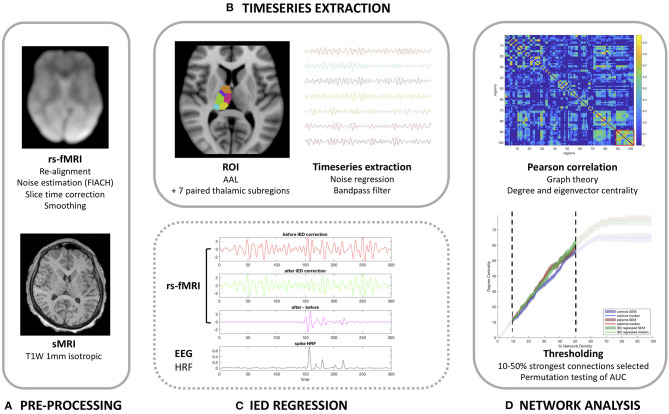
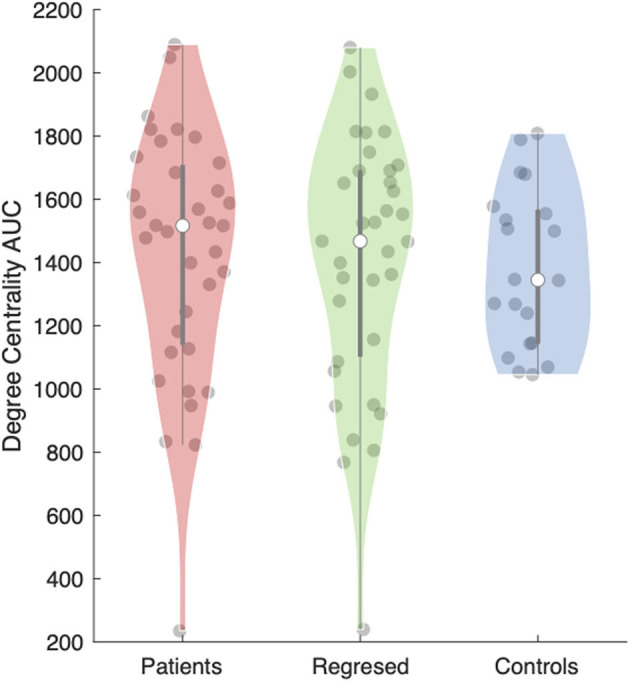
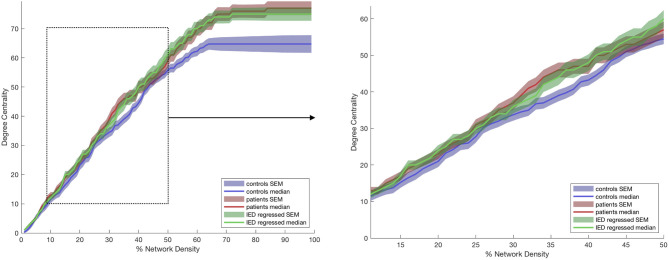
Whilst stimulation of the anterior nucleus of the thalamus has shown efficacy for reducing seizure frequency in adults, alterations in thalamic connectivity have not been explored in children. We tested the hypotheses that (a) the anterior thalamus has increased functional connectivity in children with focal epilepsy, and (b) this alteration in the connectome is a persistent effect of the disease rather than due to transient epileptiform activity. Data from 35 children (7-18 years) with focal, drug-resistant epilepsy and 20 healthy children (7-17 years) were analyzed. All subjects underwent functional magnetic resonance imaging (fMRI) whilst resting and were simultaneously monitored with scalp electroencephalography (EEG). The fMRI timeseries were extracted for each Automated Anatomical Labeling brain region and thalamic subregion. Graph theory metrics [degree (DC) and eigenvector (EC) centrality] were used to summarize the connectivity profile of the ipsilateral thalamus, and its thalamic parcellations. The effect of interictal epileptiform discharges (IEDs) captured on EEG was used to determine their effect on DC and EC. DC was significantly higher in the anterior nucleus ( = 0.04) of the thalamus ipsilateral to the epileptogenic zone in children with epilepsy compared to controls. On exploratory analyses, we similarly found a higher DC in the lateral dorsal nucleus ( = 0.02), but not any other thalamic subregion. No differences in EC measures were found between patients and controls. We did not find any significant difference in DC or EC in any thalamic subregion when comparing the results of children with epilepsy before, and after the removal of the effects of IEDs. Our data suggest that the anterior and lateral dorsal nuclei of the thalamus are more highly functionally connected in children with poorly controlled focal epilepsy. We did not detect a convincing change in thalamic connectivity caused by transient epileptiform activity, suggesting that it represents a persistent alteration to network dynamics.
虽然刺激丘脑前核已显示出对降低成人癫痫发作频率有效,但尚未在儿童中探索丘脑连接性的改变。我们检验了以下假设:(a) 局灶性癫痫患儿的丘脑前核功能连接性增加;(b) 这种连接组的改变是疾病的持续效应,而非由于短暂的癫痫样活动。分析了35名患有局灶性耐药癫痫的儿童(7 - 18岁)和20名健康儿童(7 - 17岁)的数据。所有受试者在静息状态下接受功能磁共振成像(fMRI),同时用头皮脑电图(EEG)进行监测。针对每个自动解剖标记脑区和丘脑亚区提取fMRI时间序列。使用图论指标[度中心性(DC)和特征向量中心性(EC)]来总结同侧丘脑及其丘脑分区的连接性概况。利用EEG捕捉到的发作间期癫痫样放电(IEDs)的效应来确定其对DC和EC的影响。与对照组相比,癫痫患儿致痫区同侧丘脑前核的DC显著更高( = 0.04)。在探索性分析中,我们同样发现外侧背核的DC更高( = 0.02),但在其他丘脑亚区未发现。患者与对照组之间在EC测量上未发现差异。在比较癫痫患儿去除IEDs影响前后的结果时,我们未在任何丘脑亚区的DC或EC中发现任何显著差异。我们的数据表明,在控制不佳的局灶性癫痫患儿中,丘脑前核和外侧背核的功能连接性更高。我们未检测到由短暂癫痫样活动引起的丘脑连接性的明显变化,这表明它代表了网络动力学的持续改变。