Hu Chao, Zhu Xiaobin, Zhang Taogen, Deng Zhouming, Xie Yuanlong, Yan Feifei, Cai Lin
Department of Spine Surgery and Musculoskeletal Tumor, Zhongnan Hospital of Wuhan University, No. 169th, Donghu Road, Wuchang District, Wuhan 430071, Hubei, China.
Department of Orthopedics, The Second Affiliated Hospital of Hubei Polytechnic College, Dongfeng Road, Daye 435100, Hubei, China.
Evid Based Complement Alternat Med. 2021 Jun 30;2021:5563691. doi: 10.1155/2021/5563691. eCollection 2021.
Osteosarcoma is a malignant tumor associated with high mortality rates due to the toxic side effects of current therapeutic methods. Tanshinone IIA can inhibit cell proliferation and promote apoptosis , but the exact mechanism is still unknown. The aims of this study are to explore the antiosteosarcoma effect of tanshinone IIA via Src kinase and demonstrate the mechanism of this effect.
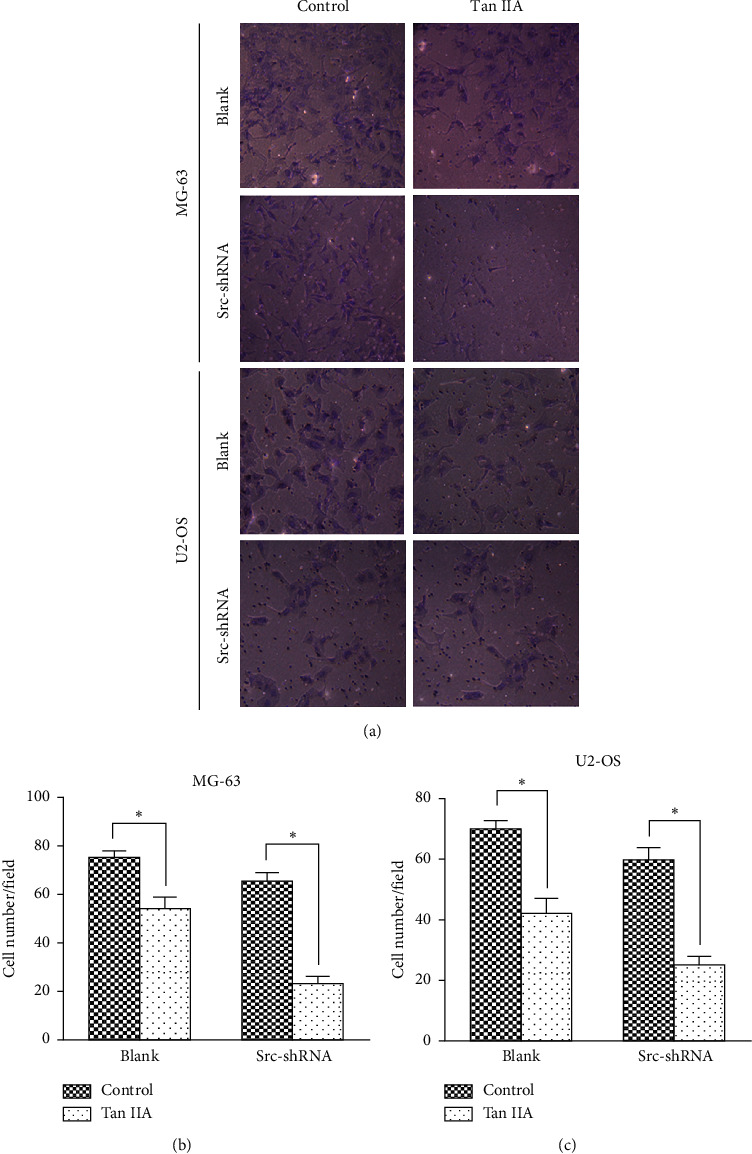
Osteosarcoma MG-63 and U2-OS cell lines were stable transfections with Src-shRNA. Then, the antiosteosarcoma effect of tanshinone IIA was tested The protein expression levels of Src, p-Src, p-ERK1/2, and p-AKt were detected by Western blot and RT-PCR. CCK-8 assay and BrdU immunofluorescence assay were used to detect cell proliferation. Transwell assay, cell scratch assay, and flow cytometry were used to detect cell invasion, migration, and cell cycle. Tumor-bearing nude mice with osteosarcoma were constructed. The effect of tanshinone IIA was detected by tumor HE staining, tumor inhibition rate, incidence of lung metastasis, and X-ray.
The oncogene role of Src kinase in osteosarcoma is reflected in promoting cell proliferation, invasion, and migration and in inhibiting apoptosis. However, Src has different effects on cell proliferation, apoptosis, and cell cycle regulation among cell lines. At a cellular level, the antiosteosarcoma effect of tanshinone IIA is mediated by Src downstream of the MAPK/ERK and PI3K/AKt signaling pathways. At the animal level, tanshinone IIA played a role in resisting osteosarcoma formation by Src downstream of the MAPK/ERK and PI3K/AKt signaling pathways.
Tanshinone IIA plays an antiosteosarcoma role and and inhibits the progression of osteosarcoma mediated by Src downstream of the MAPK/ERK and PI3K/AKt signaling pathways.
骨肉瘤是一种恶性肿瘤,由于当前治疗方法的毒副作用,其死亡率很高。丹参酮IIA可抑制细胞增殖并促进细胞凋亡,但其确切机制仍不清楚。本研究的目的是探讨丹参酮IIA通过Src激酶发挥的抗骨肉瘤作用,并阐明其作用机制。
用Src-shRNA对骨肉瘤MG-63和U2-OS细胞系进行稳定转染。然后,检测丹参酮IIA的抗骨肉瘤作用。通过蛋白质印迹法和逆转录-聚合酶链反应检测Src、p-Src、p-ERK1/2和p-Akt的蛋白表达水平。采用CCK-8法和BrdU免疫荧光法检测细胞增殖。采用Transwell法、细胞划痕法和流式细胞术检测细胞侵袭、迁移和细胞周期。构建荷骨肉瘤裸鼠模型。通过肿瘤苏木精-伊红染色、肿瘤抑制率、肺转移发生率和X线检测丹参酮IIA的作用。
Src激酶在骨肉瘤中的致癌作用体现在促进细胞增殖、侵袭和迁移以及抑制细胞凋亡。然而,Src对不同细胞系的细胞增殖、凋亡和细胞周期调控有不同影响。在细胞水平上,丹参酮IIA的抗骨肉瘤作用是由MAPK/ERK和PI3K/AKt信号通路下游的Src介导的。在动物水平上,丹参酮IIA通过MAPK/ERK和PI3K/AKt信号通路下游的Src发挥抗骨肉瘤形成的作用。
丹参酮IIA发挥抗骨肉瘤作用,抑制由MAPK/ERK和PI3K/AKt信号通路下游的Src介导的骨肉瘤进展。