Aslan Burcu, Kismali Gorkem, Chen Lisa S, Iles LaKesla R, Mahendra Mikhila, Peoples Michael, Gagea Mihai, Fowlkes Natalie W, Zheng Xiaofeng, Wang Jing, Vellano Christopher P, Marszalek Joseph R, Bertilaccio Maria Teresa Sabrina, Gandhi Varsha
Department of Experimental Therapeutics.
TRACTION Platform, Therapeutics Discovery Division.
Blood Adv. 2021 Aug 24;5(16):3134-3146. doi: 10.1182/bloodadvances.2020003821.
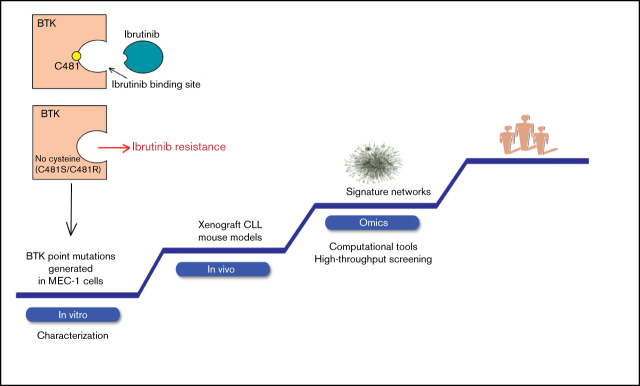
Although ibrutinib improves the overall survival of patients with chronic lymphocytic leukemia (CLL), some patients still develop resistance, most commonly through point mutations affecting cysteine residue 481 (C481) in Bruton's tyrosine kinase (BTKC481S and BTKC481R). To enhance our understanding of the biological impact of these mutations, we established cell lines that overexpress wild-type or mutant BTK in in vitro and in vivo models that mimic ibrutinib-sensitive and -resistant CLL. MEC-1 cell lines stably overexpressing wild-type or mutant BTK were generated. All cell lines coexpressed GFP, were CD19+ and CD23+, and overexpressed BTK. Overexpression of wild-type or mutant BTK resulted in increased signaling, as evidenced by the induction of p-BTK, p-PLCγ2, and p-extracellular signal-related kinase (ERK) levels, the latter further augmented upon IgM stimulation. In all cell lines, cell cycle profiles and levels of BTK expression were similar, but the RNA sequencing and reverse-phase protein array results revealed that the molecular transcript and protein profiles were distinct. To mimic aggressive CLL, we created xenograft mouse models by transplanting the generated cell lines into Rag2-/-γc-/- mice. Spleens, livers, bone marrow, and peripheral blood were collected. All mice developed CLL-like disease with systemic involvement (engraftment efficiency, 100%). We observed splenomegaly, accumulation of leukemic cells in the spleen and liver, and macroscopically evident necrosis. CD19+ cells accumulated in the spleen, bone marrow, and peripheral blood. The overall survival duration was slightly lower in mice expressing mutant BTK. Our cell lines and murine models mimicking ibrutinib-resistant CLL will serve as powerful tools to test reversible BTK inhibitors and novel, non-BTK-targeted therapeutics.
尽管伊布替尼可提高慢性淋巴细胞白血病(CLL)患者的总生存率,但仍有一些患者会产生耐药性,最常见的是通过影响布鲁顿酪氨酸激酶中半胱氨酸残基481(C481)的点突变(BTKC481S和BTKC481R)。为了加深我们对这些突变生物学影响的理解,我们在模拟伊布替尼敏感和耐药CLL的体外和体内模型中建立了过表达野生型或突变型BTK的细胞系。生成了稳定过表达野生型或突变型BTK的MEC-1细胞系。所有细胞系均共表达绿色荧光蛋白(GFP),为CD19+和CD23+,且过表达BTK。野生型或突变型BTK的过表达导致信号传导增加,p-BTK、p-PLCγ2和p-细胞外信号调节激酶(ERK)水平的诱导证明了这一点,后者在IgM刺激后进一步增强。在所有细胞系中,细胞周期谱和BTK表达水平相似,但RNA测序和反相蛋白质阵列结果显示分子转录本和蛋白质谱不同。为了模拟侵袭性CLL,我们通过将生成的细胞系移植到Rag2-/-γc-/-小鼠中创建了异种移植小鼠模型。收集脾脏组织、肝脏组织、骨髓和外周血。所有小鼠均发生了系统性累及的CLL样疾病(植入效率为100%)。我们观察到脾肿大、脾脏和肝脏中白血病细胞的积聚以及肉眼可见的坏死。CD19+细胞在脾脏、骨髓和外周血中积聚。表达突变型BTK的小鼠的总生存时间略短。我们模拟伊布替尼耐药CLL的细胞系和小鼠模型将成为测试可逆性BTK抑制剂和新型非BTK靶向治疗药物的有力工具。