Felber Veronika Barbara, Wester Hans-Jürgen
Chair of Pharmaceutical Radiochemistry, Technical University of Munich, Walther-Meißner-Str. 3, 85748, Garching, Germany.
EJNMMI Radiopharm Chem. 2021 Aug 25;6(1):29. doi: 10.1186/s41181-021-00136-x.
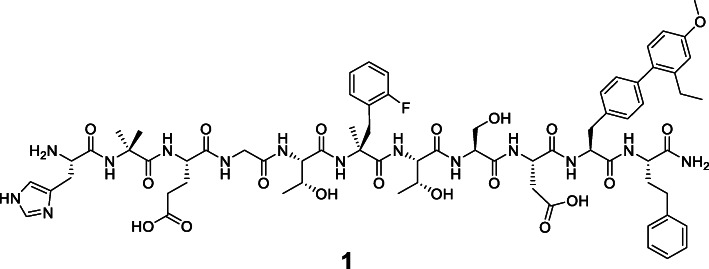
Elevated kidney uptake in insulinoma patients remains a major limitation of radiometallated exendin-derived ligands of the glucagon-like peptide 1 receptor (GLP-1R). Based on the previously published potent GLP-1R-activating undecapeptide 1, short-chained GLP-1R ligands were developed to investigate whether kidney uptake can be reduced by means of direct F-labeling (nuclide-based accelerated renal excretion) or the reduction of the overall ligand charge (ligand-based reduced kidney uptake).
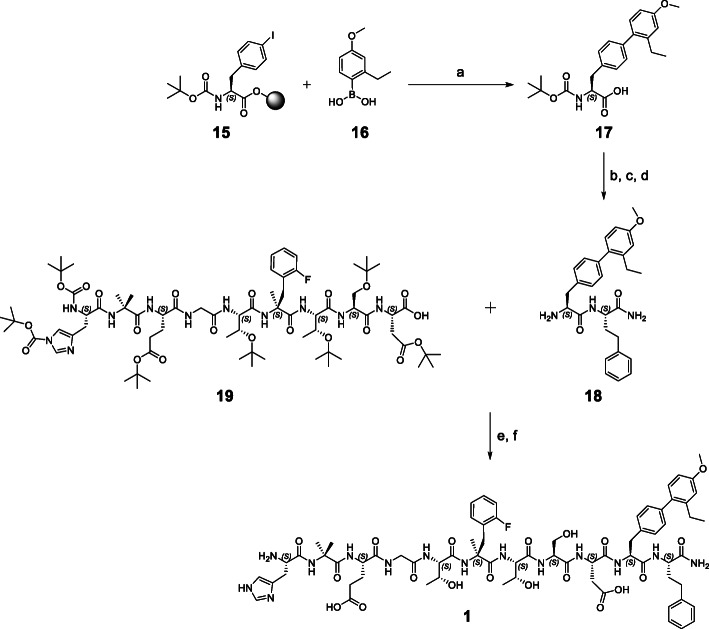
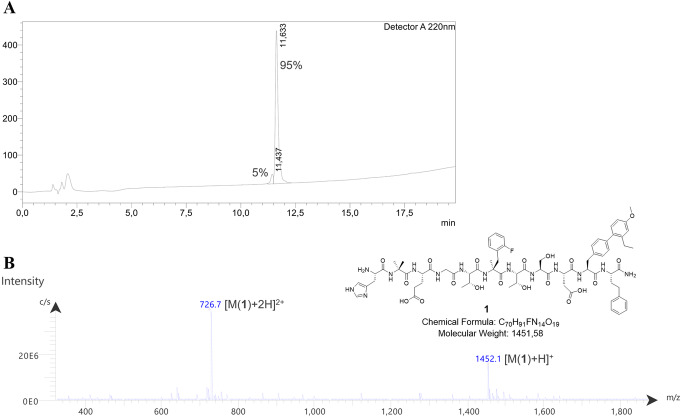
MATERIALS & METHODS: GLP-1R ligands were prepared according to optimized standard protocols via solid-phase peptide synthesis (SPPS) or, when not practicable, via fragment coupling in solution. Synthesis of (2'-Et, 4'-OMe)4, 4'-L-biphenylalanine ((2'-Et, 4'-OMe)BIP), required for the preparation of 1, was accomplished by Suzuki-Miyaura cross-coupling. In vitro experiments were performed using stably transfected GLP-1R HEK293-hGLP-1R cells.
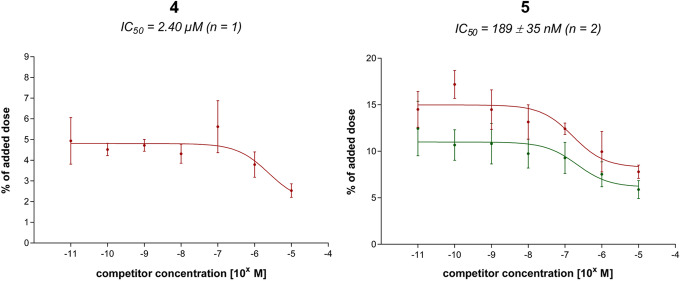
In contrast to the three reference ligands glucagon-like peptide 1 (GLP-1, IC = 23.2 ± 12.2 nM), [Nle, Tyr(3-I)]exendin-4 (IC = 7.63 ± 2.78 nM) and [Nle, Tyr]exendin-4 (IC = 9.87 ± 1.82 nM), the investigated GLP-1R-targeting small peptides (9-15 amino acids), including lead peptide 1, exhibited only medium to low affinities (IC > 189 nM). Only SiFA-tagged undecapeptide 5 (IC = 189 ± 35 nM) revealed a higher affinity than 1 (IC = 669 ± 242 nM).
The investigated small peptides, including lead peptide 1, could not compete with favorable in vitro characteristics of glucagon-like peptide 1 (GLP-1), [Nle, Tyr(3-I)]exendin-4 and [Nle, Tyr]exendin-4. The auspicious EC values of 1 provided by the literature could not be transferred to competitive binding experiments. Therefore, the use of 1 as a basic scaffold for the design of further GLP-1R-targeting radioligands cannot be recommended. Further investigations might include the scaffold of 5, although substantial optimizations concerning affinity and lipophilicity would be required. In sum, GLP-1R-targeting radioligands with reduced kidney uptake could not be obtained in this work, which emphasizes the need for further ligands addressing this particular issue.
胰岛素瘤患者中肾脏摄取增加仍然是胰高血糖素样肽1受体(GLP-1R)的放射性金属化艾塞那肽衍生配体的一个主要限制。基于先前发表的强效GLP-1R激活十一肽1,开发了短链GLP-1R配体,以研究是否可以通过直接F标记(基于核素的加速肾脏排泄)或降低配体总电荷(基于配体的降低肾脏摄取)来减少肾脏摄取。
GLP-1R配体根据优化的标准方案通过固相肽合成(SPPS)制备,若不可行,则通过溶液中的片段偶联制备。制备1所需的(2'-乙基,4'-甲氧基)4,4'-L-联苯丙氨酸((2'-乙基,4'-甲氧基)BIP)通过铃木-宫浦交叉偶联完成。使用稳定转染的GLP-1R HEK293-hGLP-1R细胞进行体外实验。
与三种参考配体胰高血糖素样肽1(GLP-1,IC = 23.2±12.2 nM)、[Nle,Tyr(3-I)]艾塞那肽-4(IC = 7.63±2.78 nM)和[Nle,Tyr]艾塞那肽-4(IC = 9.87±1.82 nM)相比,所研究的靶向GLP-1R的小肽(9 - 15个氨基酸),包括先导肽1,仅表现出中等至低亲和力(IC>189 nM)。只有SiFA标记的十一肽5(IC = 189±35 nM)显示出比1(IC = 669±242 nM)更高的亲和力。
所研究的小肽,包括先导肽1,无法与胰高血糖素样肽1(GLP-1)、[Nle,Tyr(3-I)]艾塞那肽-4和[Nle,Tyr]艾塞那肽-4良好的体外特性相竞争。文献中提供的1的良好EC值无法转化为竞争性结合实验。因此,不建议将1用作设计进一步的靶向GLP-1R放射性配体的基本支架。尽管需要对亲和力和亲脂性进行大量优化,但进一步的研究可能包括5的支架。总之,在这项工作中未能获得肾脏摄取减少的靶向GLP-1R的放射性配体,这强调了需要进一步的配体来解决这个特定问题。