Soumaoro Idrissa, Pitala Wéré, Gnandi Kissao, Kokou Tona
Regional Centre of Excellency on Avian Science, University of Lomé, Togo.
School of Agronomy, University of Lomé, Togo.
J Health Pollut. 2021 Aug 17;11(31):210911. doi: 10.5696/2156-9614-11.31.210911. eCollection 2021 Sep.
Heavy metals are persistent in the environment and can cause bioaccumulation in the food chain. Drinking water contamination by heavy metals can pose a risk to poultry and to human health. The need for affordable, reliable and effective methods of water treatment has led to the use of plants materials, including coagulants such as seeds, to ensure poultry products are safe for consumers.
The aim of the present study was to investigate the effects of drinking water treatment by seed on the concentration and distribution of metals such as arsenic (As), cadmium (Cd), chromium (Cr), copper (Cu), nickel (Ni), lead (Pb) in different parts of broilers chickens and theirs effects on consumer health.
A total number of 264 one-day old chickens (Cobb-500) were assigned to three treatments, with 22 birds in each treatment and replicated four times: untreated well water (UW), well water treated with seeds and filtered (MOF) and well water treated with seeds but unfiltered (MOU). Thirty birds were randomly chosen from different treatments and slaughtered at day 45 of the experiment and samples of livers, kidneys, gizzards and breasts were obtained and analyzed for toxic metals concentrations using atomic absorption spectrophotometry.
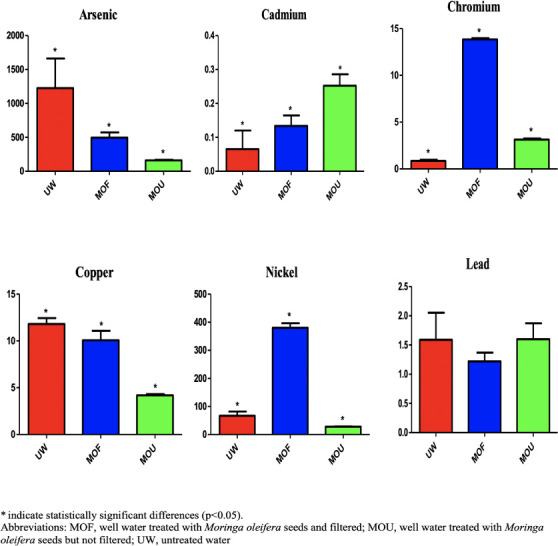
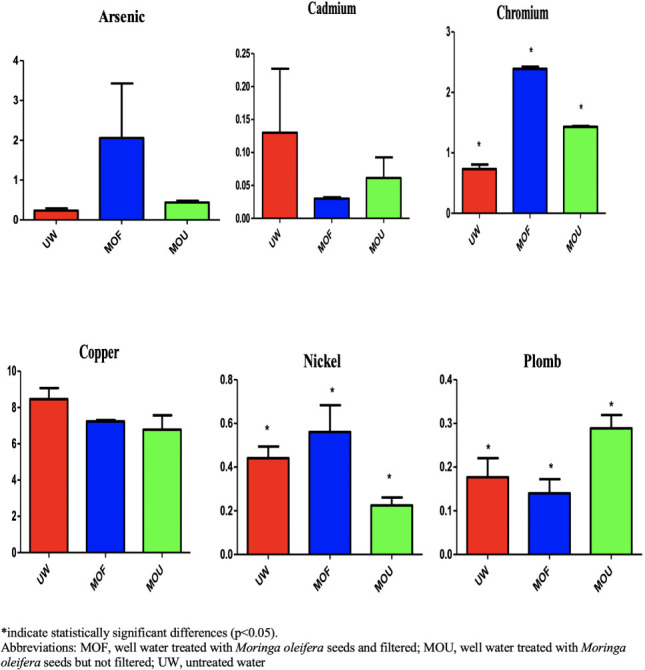
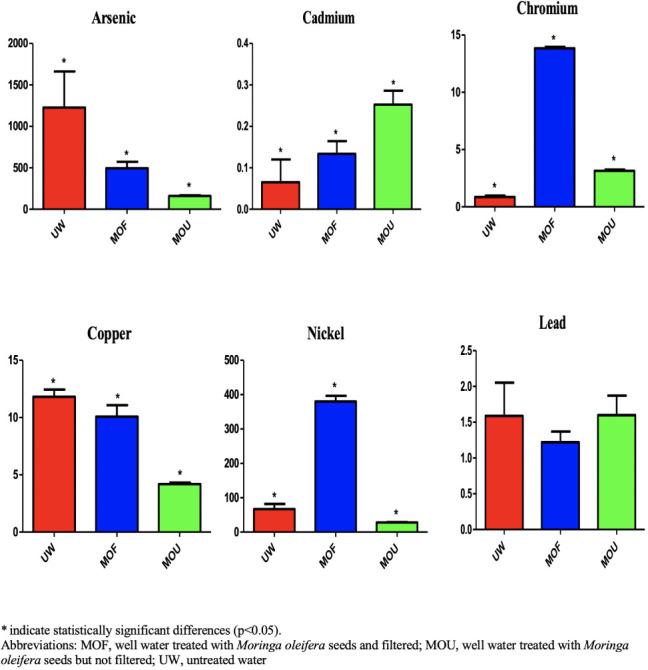
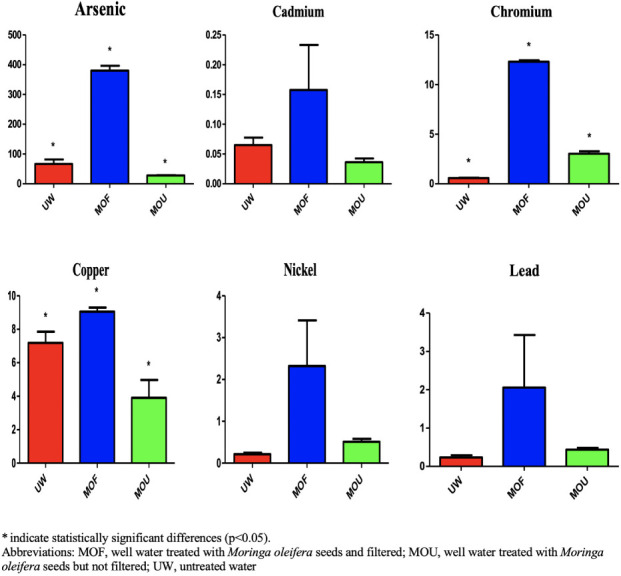
The results indicated that the bioaccumulation of heavy metals was lower in MOF than those in UW and MOU. The target hazard quotient (THQ) for individual metals was below acceptable limits except for As and Pb in UW and MOU. The carcinogenic risk (TR) was estimated for each metal due to consumption of different types of chicken.
seeds are an environmentally friendly natural coagulant and able to treat water containing undesirable heavy metal concentrations and ensure that poultry meat is safe for consumers.
The authors declare no competing financial interests.
This study was approved by the ethics Committee of the University of Lomé-Togo.
重金属在环境中具有持久性,可在食物链中生物累积。重金属污染饮用水会对家禽和人类健康构成风险。对经济实惠、可靠且有效的水处理方法的需求促使人们使用包括种子等植物材料作为混凝剂,以确保家禽产品对消费者安全。
本研究旨在调查种子处理饮用水对肉鸡不同部位中砷(As)、镉(Cd)、铬(Cr)、铜(Cu)、镍(Ni)、铅(Pb)等金属浓度和分布的影响及其对消费者健康的影响。
总共264只一日龄雏鸡(科宝500)被分配到三种处理组,每组22只,重复四次:未处理的井水(UW)、经种子处理并过滤的井水(MOF)和经种子处理但未过滤的井水(MOU)。在实验第45天,从不同处理组中随机选取30只鸡进行屠宰,获取肝脏、肾脏、砂囊和胸肉样本,并使用原子吸收分光光度法分析有毒金属浓度。
结果表明,MOF组中重金属的生物累积低于UW组和MOU组。除UW组和MOU组中的As和Pb外,各金属的目标危害商(THQ)均低于可接受限值。因食用不同类型鸡肉,对每种金属的致癌风险(TR)进行了估算。
种子是一种环保的天然混凝剂,能够处理含有不良重金属浓度的水,并确保禽肉对消费者安全。
作者声明无竞争财务利益。
本研究经多哥洛美大学伦理委员会批准。