Division of Marine Ecosystems Functioning, Institute of Oceanography, University of Gdańsk, Piłsudskiego 46, P-81-378 Gdynia, Poland.
Division of Marine Chemistry and Environmental Protection, Institute of Oceanography, University of Gdańsk, Piłsudskiego 46, P-81-378 Gdynia, Poland.
Toxins (Basel). 2021 Aug 23;13(8):589. doi: 10.3390/toxins13080589.
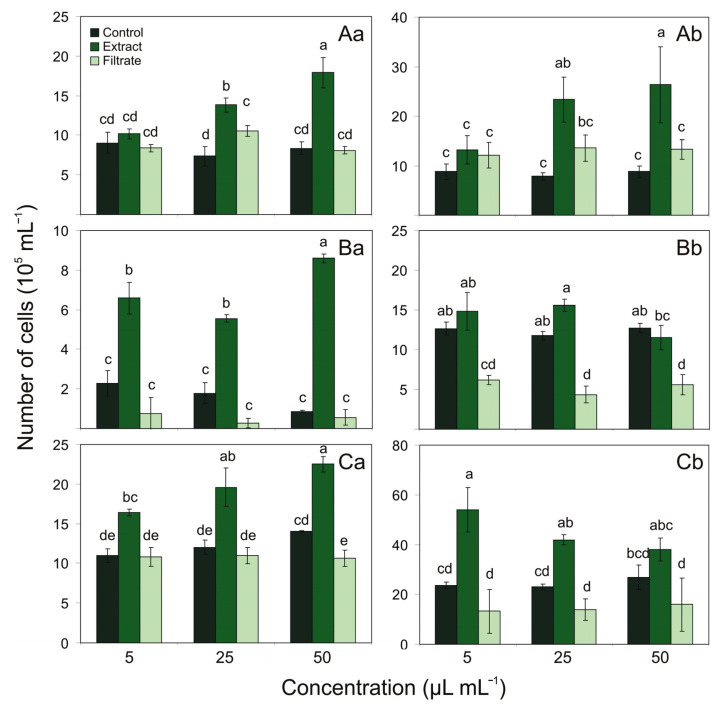
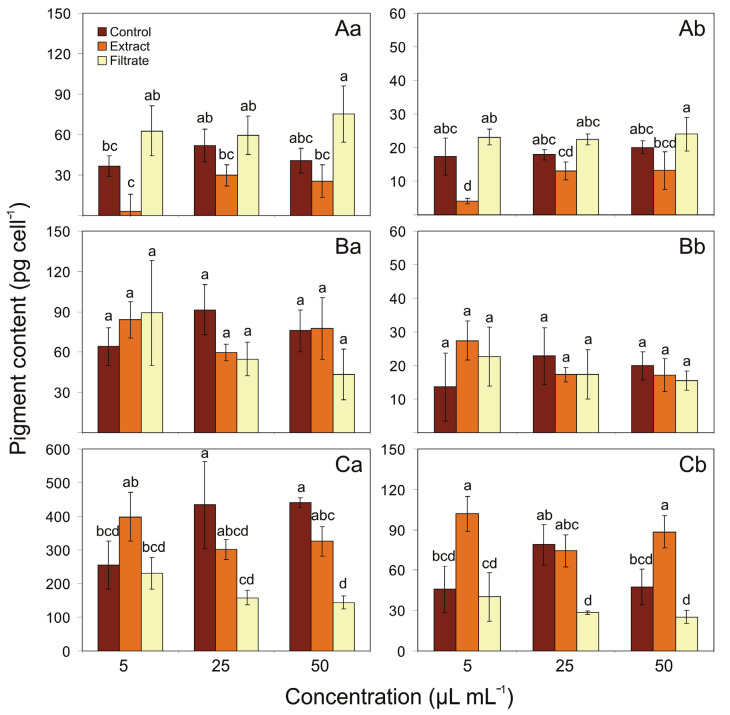
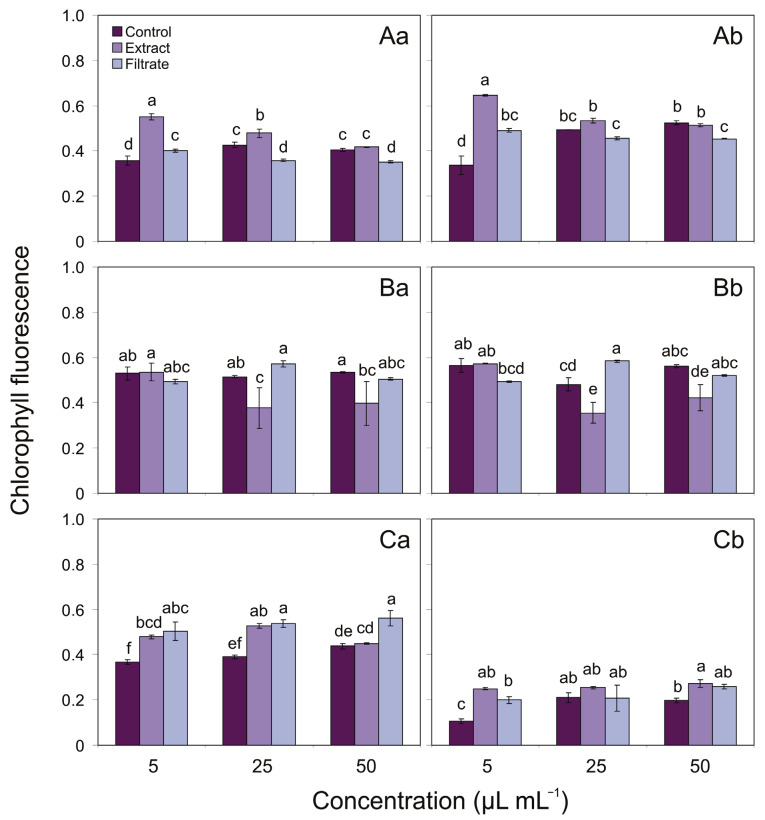
Macroalgae can directly restrict the growth of various phytoplankton species by releasing allelopathic compounds; therefore, considerable attention should be paid to the allelopathic potential of these organisms against harmful and bloom-forming cyanobacteria. The main aim of this study was to demonstrate for the first time the allelopathic activity of on the growth, the fluorescence parameters: the maximum PSII quantum efficiency (/) and the effective quantum yield of PSII photochemistry (ΦPSII), the chlorophyll (Chl ) and carotenoid (Car) content, and the microcystin-LR (MC-LR) and phenol content of three bloom-forming cyanobacteria, sp., , and sp. We found both negative and positive allelopathic effects of on tested cyanobacteria. The study clearly showed that the addition of the filtrate of significantly inhibited growth, decreased pigment content and / and ΦPSII values of and sp., and stimulated sp. The addition of different concentrations of aqueous extract also stimulated the cyanobacterial growth. It was also shown that the addition of extract obtained from caused a significant decrease in the MC-LR content in sp. cells. Moreover, it the phenol content in cells was increased. On the other hand, the cell-specific phenol content for sp. decreased due to the addition of the filtrate. In this work, we demonstrated that the allelopathic effect of depends on the target species' identity as well as the type of allelopathic method used. The study of the allelopathic Baltic macroalgae may help to identify their possible role as a significant biological factor influencing harmful cyanobacterial blooms in brackish ecosystems.
大型藻类可以通过释放化感化合物直接限制各种浮游植物的生长;因此,应该高度关注这些生物体对有害和形成水华的蓝藻的化感潜力。本研究的主要目的是首次证明对三种形成水华的蓝藻,即 sp.、 sp. 和 sp. 的生长、荧光参数:最大 PSII 量子效率(/)和 PSII 光化学的有效量子产量(ΦPSII)、叶绿素(Chl)和类胡萝卜素(Car)含量以及微囊藻-LR(MC-LR)和酚含量的化感活性。我们发现了对测试蓝藻的化感的正负效应。研究清楚地表明,添加的滤液显著抑制了 sp. 和 sp. 的生长,降低了色素含量和 / 和 ΦPSII 值,并刺激了 sp. 的生长。添加不同浓度的水提取物也刺激了蓝藻的生长。还表明,添加自 中提取的提取物导致 sp. 细胞中 MC-LR 含量显著下降。此外,细胞中的酚含量增加。另一方面,由于添加滤液, sp. 细胞的特定细胞酚含量降低。在这项工作中,我们证明了化感效应取决于目标物种的身份以及使用的化感方法的类型。对波罗的海大型藻类的化感研究可能有助于确定它们作为影响咸水生生态系统中有害蓝藻水华的重要生物因素的可能作用。