Institute of Animal Breeding and Genetics, Justus-Liebig-University of Gießen, 35390 Gießen, Germany.
Albrecht Daniel Thaer-Institute for Agricultural and Horticultural Sciences, Animal Breeding Biology and Molecular Genetics, Humboldt-Universität of Berlin, 10115 Berlin, Germany.
Genes (Basel). 2021 Jul 28;12(8):1163. doi: 10.3390/genes12081163.
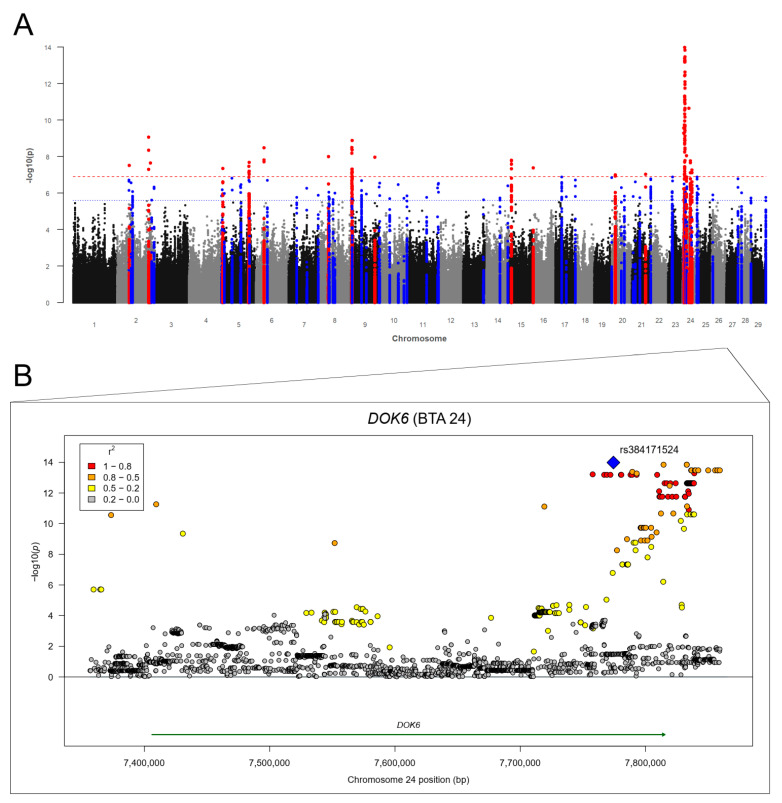
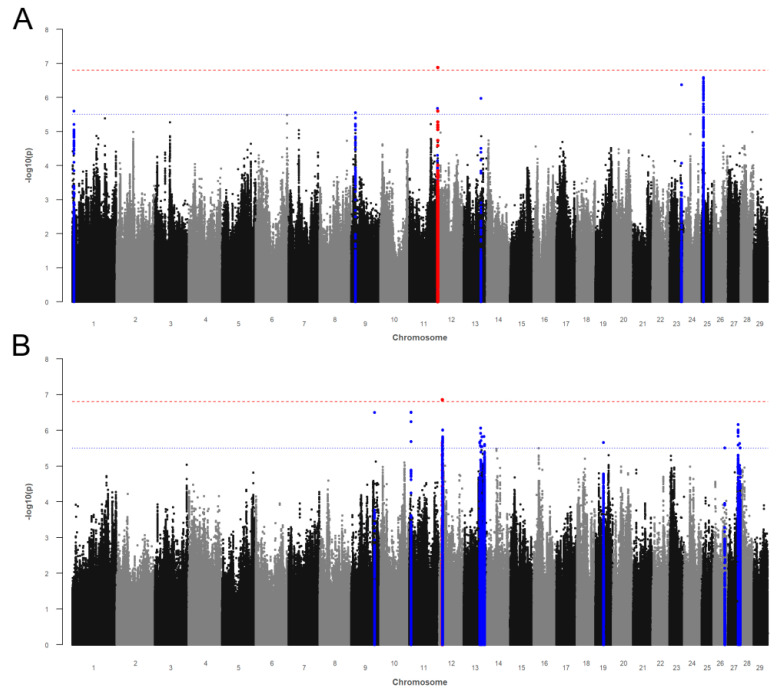
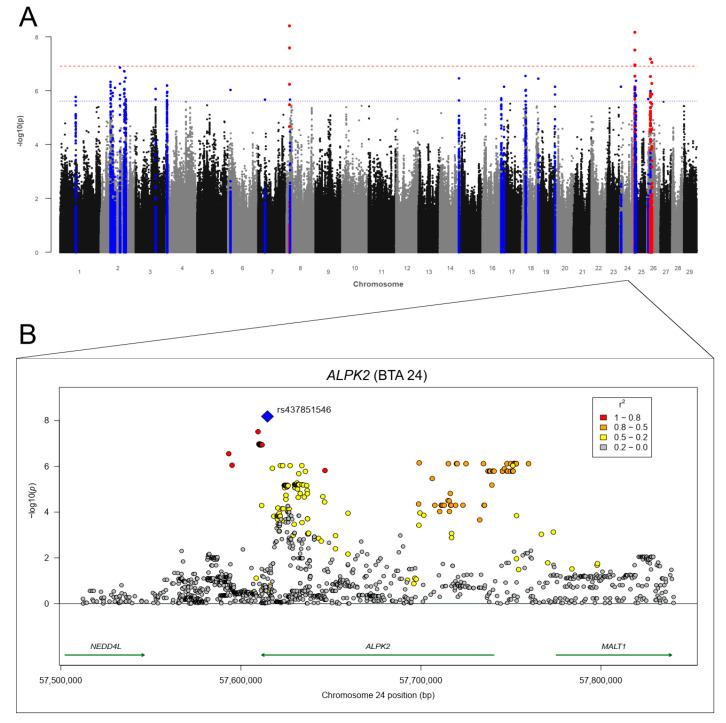
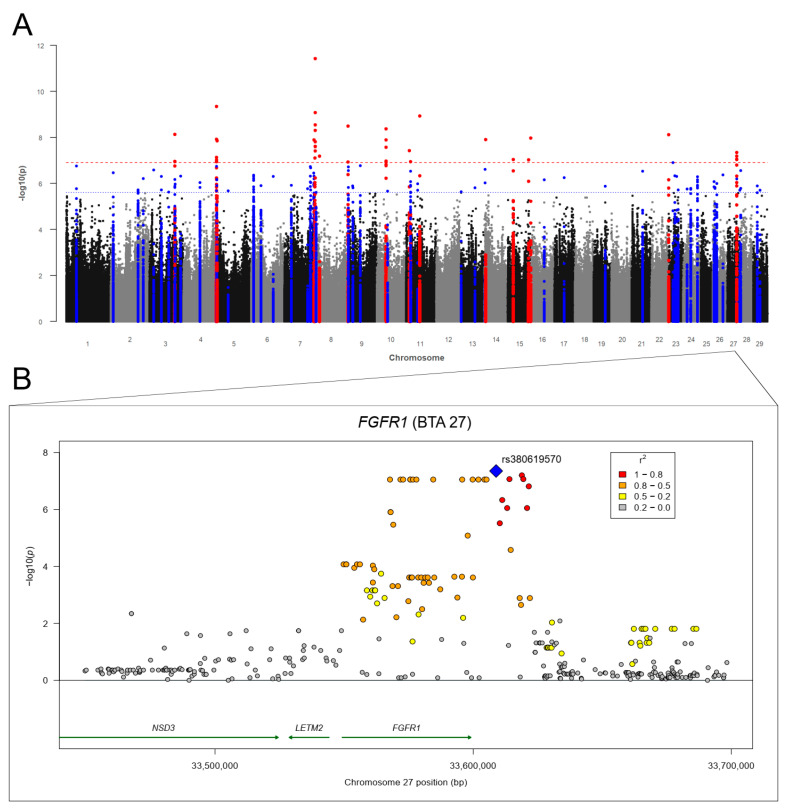
This genome-wide association study (GWAS) aimed to identify sequence variants (SVs) and candidate genes associated with fertility and health in endangered German Black Pied cattle (DSN) based on whole-genome sequence (WGS) data. We used 304 sequenced DSN cattle for the imputation of 1797 genotyped DSN to WGS. The final dataset included 11,413,456 SVs of 1886 cows. Cow traits were calving-to-first service interval (CTFS), non-return after 56 days (NR56), somatic cell score (SCS), fat-to-protein ratio (FPR), and three pre-corrected endoparasite infection traits. We identified 40 SVs above the genome-wide significance and suggestive threshold associated with CTFS and NR56, and three important potential candidate genes (, , and ). For SCS, most associations were observed on BTA 25. The GWAS revealed 61 SVs, a cluster of 10 candidate genes on BTA 13, and 7 pathways for FPR, including key mediators involved in milk fat synthesis. The strongest associations for gastrointestinal nematode and infections were detected on BTA 8 and 24, respectively. For infections, the strongest associated SVs were located on BTA 4 and 7. We detected 200 genes for endoparasite infection traits, related to 16 pathways involved in host immune response during infection.
本全基因组关联研究(GWAS)旨在基于全基因组序列(WGS)数据,鉴定与濒危德国黑花斑牛(DSN)生育力和健康相关的序列变异(SV)和候选基因。我们使用 304 头测序的 DSN 牛对 1797 头已分型的 DSN 牛进行 WGS 数据的推断。最终数据集包括 1886 头奶牛的 11,413,456 个 SV。牛的性状有产犊至第一次配种间隔(CTFS)、56 天后不发情(NR56)、体细胞评分(SCS)、脂肪-蛋白比(FPR)和三个预先校正的内寄生虫感染性状。我们鉴定出了 40 个与 CTFS 和 NR56 相关的全基因组显著和提示性阈值的 SV,以及三个重要的潜在候选基因(、和)。对于 SCS,大多数关联都发生在 BTA 25 上。GWAS 揭示了 61 个 SV、BTA 13 上的 10 个候选基因簇,以及 FPR 的 7 条途径,包括参与乳脂合成的关键介质。胃肠道线虫和绦虫感染的最强关联分别检测到在 BTA 8 和 24 上。对于绦虫感染,最强相关的 SV 位于 BTA 4 和 7 上。我们检测到 200 个与内寄生虫感染性状相关的基因,涉及感染过程中宿主免疫反应的 16 条途径。