Huang Jinrui, Cegla Frederic, Wickenden Andy, Coomber Mike
NDE Group, Department of Mechanical Engineering, Imperial College London, London SW7 2AZ, UK.
Rivertrace Ltd., Unit P, Kingsfield Business Centre, Philanthropic Road, Redhill RH1 4DP, UK.
Sensors (Basel). 2021 Aug 18;21(16):5543. doi: 10.3390/s21165543.
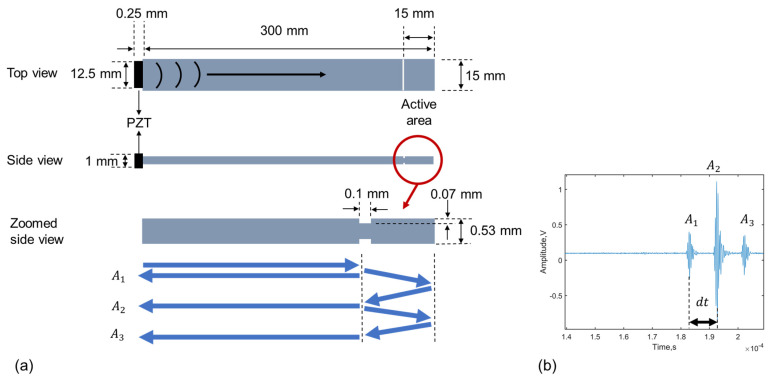
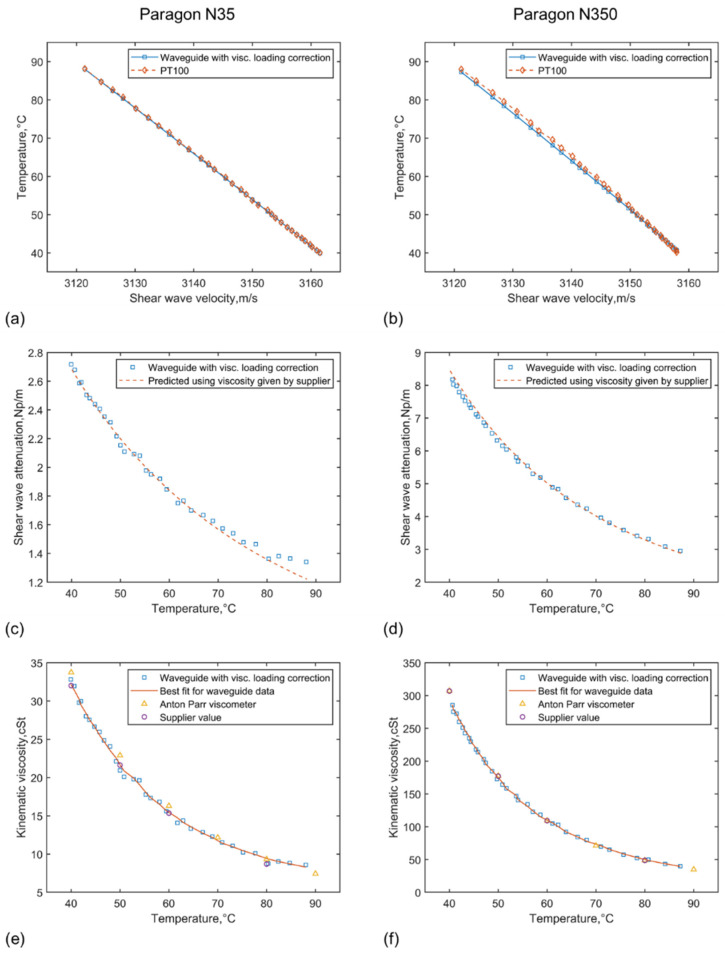
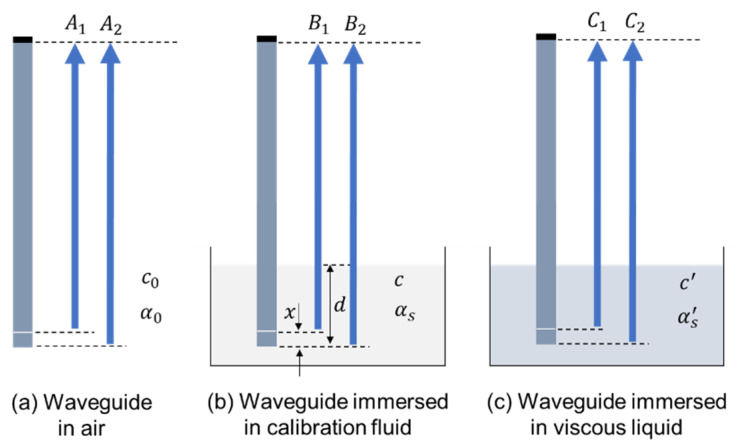
The characterisation and monitoring of viscous fluids have many important applications. This paper reports a refined 'dipstick' method for ultrasonic measurement of the properties of viscous fluids. The presented method is based on the comparison of measurements of the ultrasonic properties of a waveguide that is immersed in a viscous liquid with the properties when it is immersed in a reference liquid. We can simultaneously determine the temperature and viscosity of a fluid based on the changes in the velocity and attenuation of the elastic shear waves in the waveguide. Attenuation is mainly dependent on the viscosity of the fluid that the waveguide is immersed in and the speed of the wave mainly depends on the surrounding fluid temperature. However, there is a small interdependency since the mass of the entrained viscous liquid adds to the inertia of the system and slows down the wave. The presented measurements have unprecedented precision so that the change due to the added viscous fluid mass becomes important and we propose a method to model such a 'viscous effect' on the wave propagation velocity. Furthermore, an algorithm to correct the velocity measurements is presented. With the proposed correction algorithm, the experimental results for kinematic viscosity and temperature show excellent agreement with measurements from a highly precise in-lab viscometer and a commercial resistance temperature detector (RTD) respectively. The measurement repeatability of the presented method is better than 2.0% in viscosity and 0.5% in temperature in the range from 8 to 300 cSt viscosity and 40 to 90 °C temperature.
粘性流体的表征与监测具有许多重要应用。本文报道了一种经过改进的“试纸”方法,用于超声测量粘性流体的特性。所提出的方法基于对浸入粘性液体中的波导超声特性测量结果与浸入参考液体时的特性进行比较。我们可以根据波导中弹性剪切波速度和衰减的变化同时确定流体的温度和粘度。衰减主要取决于波导所浸入流体的粘度,而波速主要取决于周围流体的温度。然而,存在较小的相互依赖性,因为夹带的粘性液体质量增加了系统的惯性并使波减速。所呈现的测量具有前所未有的精度,以至于由于添加的粘性流体质量引起的变化变得很重要,并且我们提出了一种对波传播速度上的这种“粘性效应”进行建模的方法。此外,还提出了一种校正速度测量的算法。使用所提出的校正算法,运动粘度和温度的实验结果分别与高精度实验室粘度计和商用电阻温度探测器(RTD)的测量结果显示出极好的一致性。在所提出的方法中,在粘度范围为8至300厘沲且温度范围为40至90°C时,测量重复性在粘度方面优于2.0%,在温度方面优于0.5%。