
一种使用信道栅格对水下无线声学传感器网络的频率进行标准化的研究。
A Study of Standardizing Frequencies Using Channel Raster for Underwater Wireless Acoustic Sensor Networks.
作者信息
Yun Changho, Choi Suhan
机构信息
Korea Research Institute of Ships & Ocean Engineering (KRISO), Daejeon 34103, Korea.
Department of Mobile Systems Engineering, Dankook University, Yong-In 16890, Korea.
出版信息
Sensors (Basel). 2021 Aug 23;21(16):5669. doi: 10.3390/s21165669.
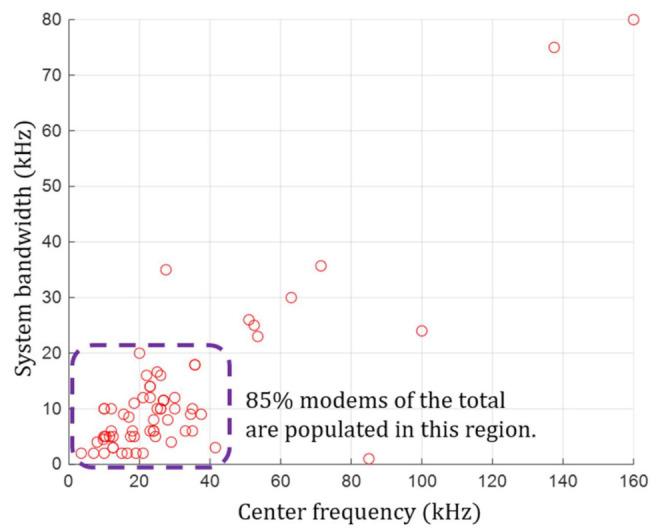
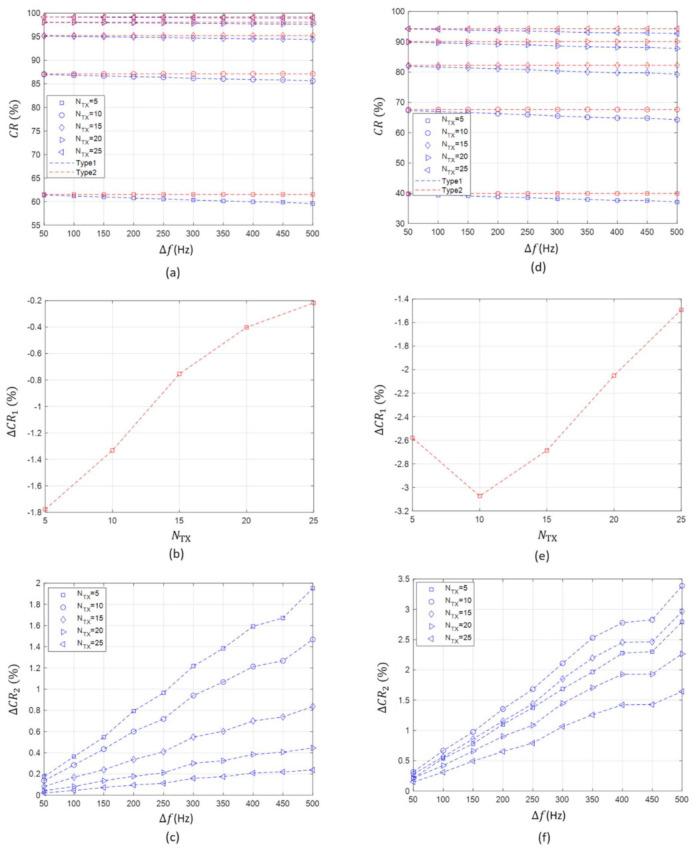
In this paper, we propose the method to standardize acoustic frequencies for underwater wireless acoustic sensor networks (UWASNs) by applying the channel raster used in the terrestrial mobile communications. The standardization process includes: (1) Setting the available acoustic frequency band where a channel raster is employed via the frequency specification analysis of the state-of-the art underwater acoustic communication modems. (2) Defining the center frequencies and the channel numbers as a function of channel raster, and the upper limit of the value of channel raster. (3) Determining the value of the channel raster suitable for the available acoustic frequency band via simulations. To set the value, three performance metrics are considered: the collision rate, the idle spectrum rate, and the receiver computational complexity. The simulation results show that the collision rate and the idle spectrum rate according to the value of channel raster have a trade-off relationship, but the influence of channel raster on the two performance metrics is insignificant. However, the receiver computational complexity is enhanced remarkably as the value of channel raster increases. Therefore, setting the value of channel raster close to its upper limit is the most adequate in respect of mitigating the occurrence of a collision and enhancing the reception performance. The standardized frequencies based on channel raster can guarantee the frequency compatibility required for the emerging technologies like the Internet of Underwater Things (IoUT) or the underwater cognitive radio, but also improves the network performance by avoiding the arbitrary use of frequencies.
在本文中,我们提出了一种方法,通过应用陆地移动通信中使用的信道光栅来规范水下无线声学传感器网络(UWASN)的声学频率。标准化过程包括:(1)通过对现有水下声学通信调制解调器的频率规格分析,设置采用信道光栅的可用声学频段。(2)根据信道光栅定义中心频率和信道数量,以及信道光栅值的上限。(3)通过仿真确定适合可用声学频段的信道光栅值。为了设置该值,考虑了三个性能指标:冲突率、空闲频谱率和接收器计算复杂度。仿真结果表明,根据信道光栅值的冲突率和空闲频谱率存在权衡关系,但信道光栅对这两个性能指标的影响不显著。然而,随着信道光栅值的增加,接收器计算复杂度显著提高。因此,将信道光栅值设置接近其上限在减轻冲突发生和提高接收性能方面是最适当的。基于信道光栅的标准化频率不仅可以保证水下物联网(IoUT)或水下认知无线电等新兴技术所需的频率兼容性,还可以通过避免频率的任意使用来提高网络性能。





 Zotero 插件