
用于分布式水声网络的基于认知声学的水下多信道介质访问控制
Underwater Multi-Channel MAC with Cognitive Acoustics for Distributed Underwater Acoustic Networks.
作者信息
Yun Changho
机构信息
Korea Research Institute of Ships & Ocean Engineering (KRISO), Daejeon 34103, Republic of Korea.
出版信息
Sensors (Basel). 2024 May 10;24(10):3027. doi: 10.3390/s24103027.
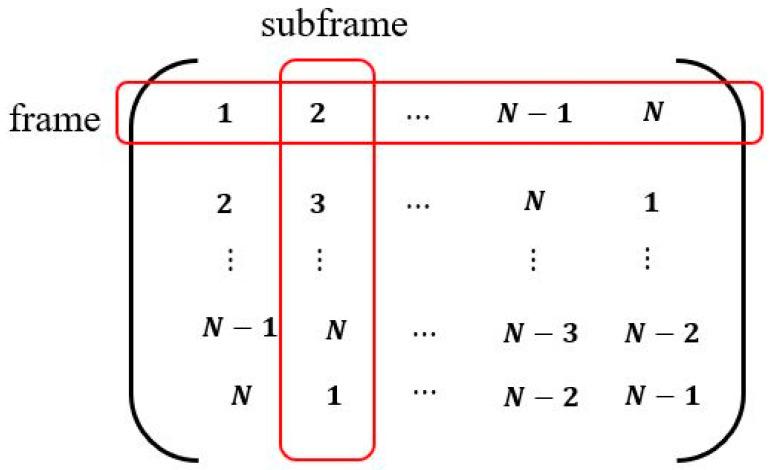
The advancement of underwater cognitive acoustic network (UCAN) technology aims to improve spectral efficiency and ensure coexistence with the underwater ecosystem. As the demand for short-term underwater applications operated under distributed topologies, like autonomous underwater vehicle cluster operations, continues to grow, this paper presents Underwater Multi-channel Medium Access Control with Cognitive Acoustics (UMMAC-CA) as a suitable channel access protocol for distributed UCANs. UMMAC-CA operates on a per-frame basis, similar to the Multi-channel Medium Access Control with Cognitive Radios (MMAC-CR) designed for distributed cognitive radio networks, but with notable differences. It employs a pre-determined data transmission matrix to allow all nodes to access the channel without contention, thus reducing the channel access overhead. In addition, to mitigate the communication failures caused by randomly occurring interferers, UMMAC-CA allocates at least 50% of frame time for interferer sensing. This is possible because of the fixed data transmission scheduling, which allows other nodes to sense for interferers simultaneously while a specific node is transmitting data. Simulation results demonstrate that UMMAC-CA outperforms MMAC-CR across various metrics, including those of the sensing time rate, controlling time rate, and throughput. In addition, except for in the case where the data transmission time coefficient equals 1, the message overhead performance of UMMAC-CA is also superior to that of MMAC-CR. These results underscore the suitability of UMMAC-CA for use in challenging underwater applications requiring multi-channel cognitive communication within a distributed network architecture.
水下认知声学网络(UCAN)技术的进步旨在提高频谱效率,并确保与水下生态系统共存。随着对分布式拓扑结构下的短期水下应用(如自主水下航行器集群作业)的需求持续增长,本文提出了具有认知声学的水下多信道介质访问控制(UMMAC-CA),作为适用于分布式UCAN的信道访问协议。UMMAC-CA以每帧为基础运行,类似于为分布式认知无线电网络设计的具有认知无线电的多信道介质访问控制(MMAC-CR),但存在显著差异。它采用预先确定的数据传输矩阵,使所有节点能够无竞争地访问信道,从而减少信道访问开销。此外,为了减轻由随机出现的干扰源导致的通信故障,UMMAC-CA为干扰源感知分配至少50%的帧时间。这是可行的,因为固定的数据传输调度允许在特定节点传输数据时,其他节点同时感知干扰源。仿真结果表明,在包括感知时间率、控制时间率和吞吐量等各种指标上,UMMAC-CA的性能优于MMAC-CR。此外,除了数据传输时间系数等于1的情况外,UMMAC-CA的消息开销性能也优于MMAC-CR。这些结果强调了UMMAC-CA适用于在分布式网络架构中需要多信道认知通信的具有挑战性的水下应用。




 Zotero 插件