
瑞德西韦治疗新冠肺炎的数学模型:给药方案能否优化?
Mathematical Modeling of Remdesivir to Treat COVID-19: Can Dosing Be Optimized?
作者信息
Conway Jessica M, Abel Zur Wiesch Pia
机构信息
Department of Mathematics and Center for Infectious Disease Dynamics, Pennsylvania State University, University Park, PA 16801, USA.
Department of Biology and Center for Infectious Disease Dynamics, Pennsylvania State University, University Park, PA 16801, USA.
出版信息
Pharmaceutics. 2021 Jul 31;13(8):1181. doi: 10.3390/pharmaceutics13081181.
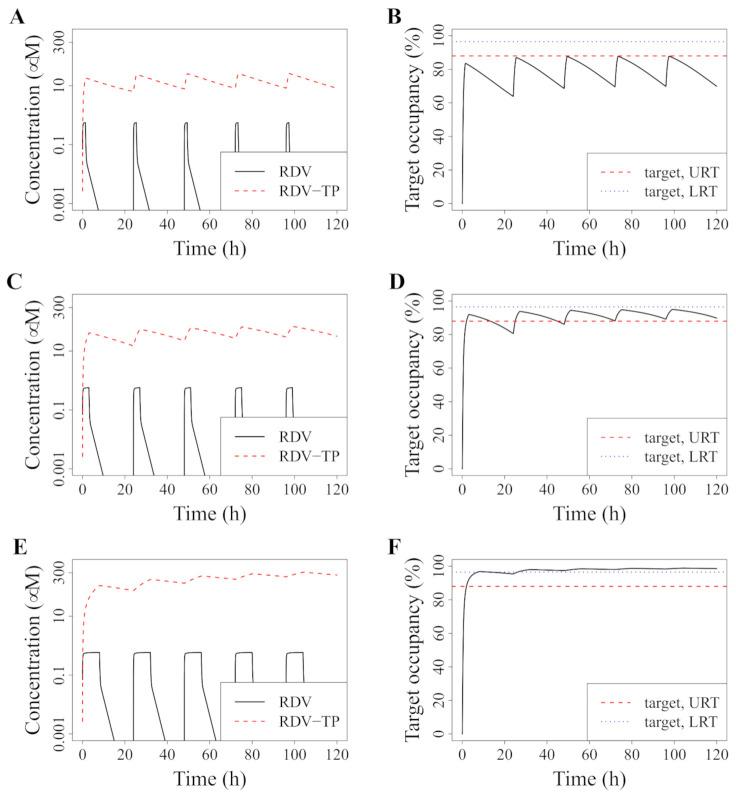
The antiviral remdesivir has been approved by regulatory bodies such as the European Medicines Agency (EMA) and the US Food and Drug administration (FDA) for the treatment of COVID-19. However, its efficacy is debated and toxicity concerns might limit the therapeutic range of this drug. Computational models that aid in balancing efficacy and toxicity would be of great help. Parametrizing models is difficult because the prodrug remdesivir is metabolized to its active form (RDV-TP) upon cell entry, which complicates dose-activity relationships. Here, we employ a computational model that allows drug efficacy predictions based on the binding affinity of RDV-TP for its target polymerase in SARS-CoV-2. We identify an optimal infusion rate to maximize remdesivir efficacy. We also assess drug efficacy in suppressing both wild-type and resistant strains, and thereby describe a drug regimen that may select for resistance. Our results differ from predictions using prodrug dose-response curves (pseudo-EC50s). We expect that reaching 90% inhibition (EC90) is insufficient to suppress SARS-CoV-2 in the lungs. While standard dosing mildly inhibits viral polymerase and therefore likely reduces morbidity, we also expect selection for resistant mutants for most realistic parameter ranges. To increase efficacy and safeguard against resistance, we recommend more clinical trials with dosing regimens that substantially increase the levels of RDV-TP and/or pair remdesivir with companion antivirals.
抗病毒药物瑞德西韦已获得欧洲药品管理局(EMA)和美国食品药品监督管理局(FDA)等监管机构的批准,用于治疗新型冠状病毒肺炎(COVID-19)。然而,其疗效存在争议,且毒性问题可能会限制该药物的治疗范围。有助于平衡疗效和毒性的计算模型将大有帮助。对模型进行参数化很困难,因为前药瑞德西韦在进入细胞后会代谢为其活性形式(RDV-TP),这使得剂量-活性关系变得复杂。在此,我们采用一种计算模型,该模型能够根据RDV-TP与其在严重急性呼吸综合征冠状病毒2(SARS-CoV-2)中的靶标聚合酶的结合亲和力来预测药物疗效。我们确定了一个最佳输注速率,以使瑞德西韦的疗效最大化。我们还评估了该药物在抑制野生型和耐药菌株方面的疗效,从而描述了一种可能会导致耐药性产生的给药方案。我们的结果与使用前药剂量反应曲线(伪EC50)的预测结果不同。我们预计达到90%抑制率(EC90)不足以抑制肺部的SARS-CoV-2。虽然标准剂量会轻微抑制病毒聚合酶,因此可能会降低发病率,但我们也预计在大多数实际参数范围内会出现耐药突变体的选择。为了提高疗效并预防耐药性,我们建议进行更多的临床试验,采用能大幅提高RDV-TP水平的给药方案,和/或将瑞德西韦与辅助抗病毒药物联合使用。



 Zotero 插件