Plant Health and Environment Laboratory, Ministry for Primary Industries, P.O. Box 2095, Auckland 1140, New Zealand.
Viruses. 2021 Jul 22;13(8):1424. doi: 10.3390/v13081424.
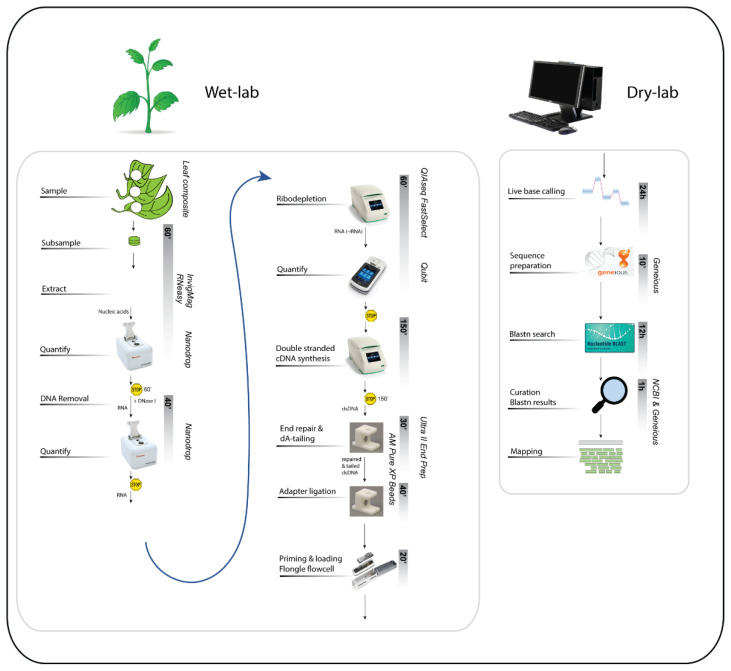
The adoption of Oxford Nanopore Technologies (ONT) sequencing as a tool in plant virology has been relatively slow despite its promise in more recent years to yield large quantities of long nucleotide sequences in real time without the need for prior amplification. The portability of the MinION and Flongle platforms combined with lowering costs and continued improvements in read accuracy make ONT an attractive method for both low- and high-scale virus diagnostics. Here, we provide a detailed step-by-step protocol using the ONT Flongle platform that we have developed for the routine application on a range of symptomatic post-entry quarantine and domestic surveillance plant samples. The aim of this methods paper is to highlight ONT's feasibility as a valuable component to the diagnostician's toolkit and to hopefully stimulate other laboratories towards the eventual goal of integrating high-throughput sequencing technologies as validated plant virus diagnostic methods in their own right.
尽管近年来牛津纳米孔技术(ONT)测序在实时提供大量长核苷酸序列方面具有很大的潜力,且无需事先扩增,但该技术在植物病毒学中的应用相对缓慢。MinION 和 Flongle 平台的便携性,加上成本的降低和读长准确性的持续提高,使得 ONT 成为低规模和高规模病毒诊断的一种有吸引力的方法。在这里,我们提供了一个详细的分步协议,使用我们为一系列入境后检疫和国内监测植物样本的常规应用开发的 ONT Flongle 平台。本方法论文的目的是强调 ONT 作为诊断工具包的有价值组成部分的可行性,并希望鼓励其他实验室最终将高通量测序技术作为经过验证的植物病毒诊断方法纳入其自身的诊断方法中。