Department of Lymphoma and Myeloma, The University of Texas, MD Anderson Cancer Center, 1515 Holcombe Blvd., Houston, TX, USA.
VelosBio Inc., San Diego, CA, USA.
J Hematol Oncol. 2021 Aug 28;14(1):132. doi: 10.1186/s13045-021-01143-w.
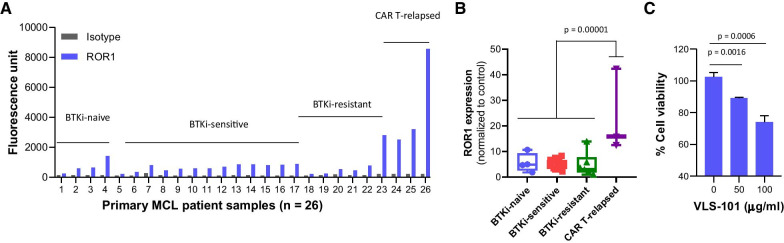
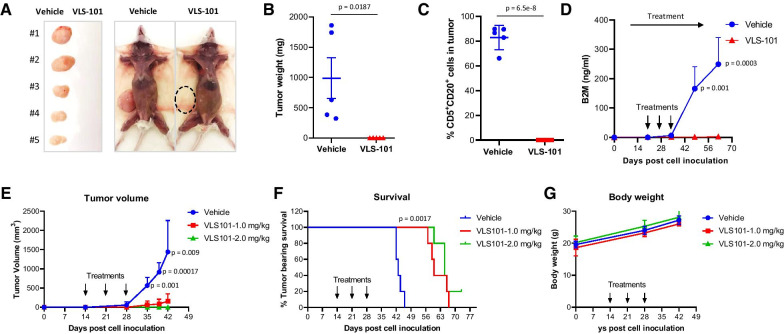
Mantle cell lymphoma (MCL) is a rare, aggressive and incurable subtype of non-Hodgkin's B-cell lymphoma. The principal barrier is frequent clinical relapse to multiple lines of therapies, including new FDA-approved biologics and cell therapy. Brexucabtagene autoleucel, the first and only FDA approved chimeric antigen receptor (CAR) T product in MCL, demonstrated unprecedented efficacy in overcoming resistance to Bruton's tyrosine kinase inhibitors. However, relapses have inevitably occurred and once relapsed these patients display a very poor clinical outcome. Currently, there is no optional therapy specifically designed for these patients. The development of tailored and more efficacious therapies is therefore critical and represents a new medical need. We found that while the receptor tyrosine kinase-like orphan receptor 1 (ROR1) is expressed across most of the MCL cells, it is significantly elevated in CAR T-relapsed MCL tumors. To see whether this aberrant ROR1 expression contributed to CAR T resistance, we targeted ROR1 using VLS-101, a monomethyl auristatin E conjugated anti-ROR1 antibody. VLS-101 showed potent anti-MCL activity in vitro in ROR1-expressing MCL cell lines and ex vivo in primary patient samples. Importantly, VLS-101 safely induced tumor regression in PDX models resistant to CAR T-cell therapy, ibrutinib and/or venetoclax. These data advocate for targeting ROR1 as a viable approach in the treatment of ROR1-positive MCL tumors, especially those with failure to prior therapies. These data also provide strong evidence for future enrollment of post-CD19 CAR T-cell relapsed MCL patients in a first in-human phase 1b VLS-101 trial. The upcoming testing in a clinical setting will provide important insights on this new therapeutic development aiming to overcome the CAR T resistance via targeting ROR1, which is a rising unmet clinical need in MCL.
套细胞淋巴瘤(MCL)是一种罕见的侵袭性和不可治愈的非霍奇金 B 细胞淋巴瘤亚型。主要障碍是频繁的临床复发,包括新的美国食品和药物管理局批准的生物制剂和细胞治疗。Brexucabtagene autoleucel 是首个也是唯一一个获得美国食品和药物管理局批准的 MCL 嵌合抗原受体(CAR)T 产品,在克服布鲁顿酪氨酸激酶抑制剂耐药方面显示出前所未有的疗效。然而,复发不可避免地发生了,一旦复发,这些患者的临床预后非常差。目前,没有专门为这些患者设计的可选治疗方法。因此,开发量身定制的更有效的治疗方法至关重要,这代表了新的医疗需求。我们发现,虽然受体酪氨酸激酶样孤儿受体 1(ROR1)在大多数 MCL 细胞中表达,但在 CAR T 复发的 MCL 肿瘤中显著升高。为了研究这种异常的 ROR1 表达是否导致 CAR T 耐药,我们使用 VLS-101(一种单甲基奥瑞他汀 E 连接的抗 ROR1 抗体)靶向 ROR1。VLS-101 在体外表达 ROR1 的 MCL 细胞系和体外原发性患者样本中表现出强大的抗 MCL 活性。重要的是,VLS-101 在对 CAR T 细胞治疗、伊布替尼和/或维奈托克耐药的 PDX 模型中安全地诱导肿瘤消退。这些数据表明,针对 ROR1 是治疗 ROR1 阳性 MCL 肿瘤的一种可行方法,特别是那些先前治疗失败的肿瘤。这些数据还为 CD19 CAR T 细胞复发的 MCL 患者在 VLS-101 的首次人体 1b 期试验中进行首次人体试验提供了有力证据。即将在临床环境中的测试将为这一新的治疗开发提供重要的见解,旨在通过靶向 ROR1 克服 CAR T 耐药,这是 MCL 中一个新的未满足的临床需求。