
锁核酸抗 miR-132 疗法对小鼠肝纤维化的保护作用。
Protective effect of LNA-anti-miR-132 therapy on liver fibrosis in mice.
作者信息
Momen-Heravi Fatemeh, Catalano Donna, Talis Austin, Szabo Gyongyi, Bala Shashi
机构信息
Cancer Biology and Immunology Laboratory, College of Dental Medicine, Columbia University Irving Medical Center, New York, NY, USA.
Division of Periodontics, Section of Oral, Diagnostic, and Rehabilitation Sciences, Columbia University College of Dental Medicine, New York, NY, USA.
出版信息
Mol Ther Nucleic Acids. 2021 May 14;25:155-167. doi: 10.1016/j.omtn.2021.05.007. eCollection 2021 Sep 3.
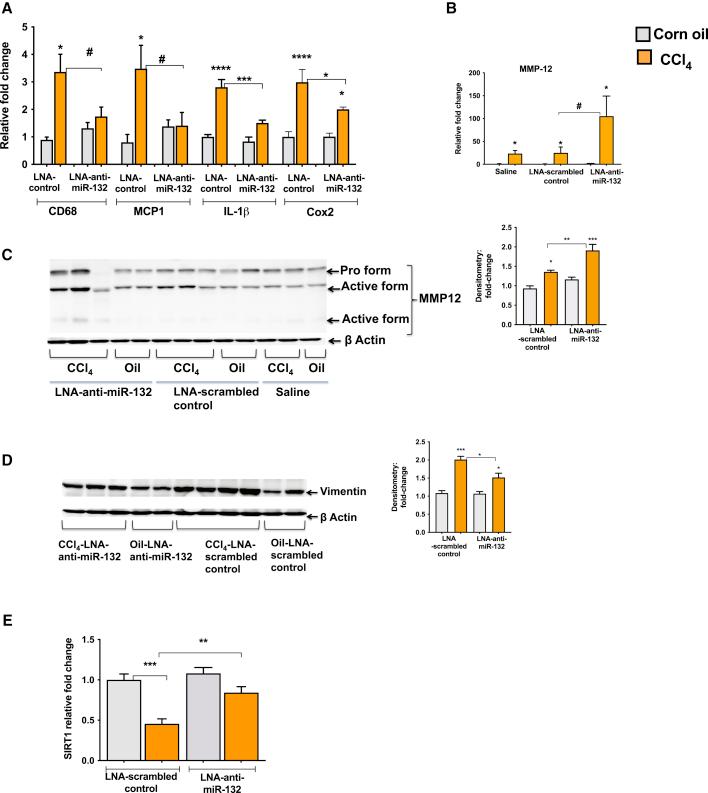
microRNAs (miRs) are small regulatory RNAs that are frequently deregulated in liver disease. Liver fibrosis is characterized by excessive scarring caused by chronic inflammatory processes. In this study, we determined the functional role of miR-132 using a locked nucleic acid (LNA)-anti-miR approach in liver fibrosis. A significant induction in miR-132 levels was found in mice treated with CCl and in patients with fibrosis/cirrhosis. Inhibition of miR-132 in mice with LNA-anti-miR-132 caused decreases in CCl-induced fibrogenesis and inflammatory phenotype. An attenuation in collagen fibers, α SMA, MCP1, IL-1β, and Cox2 was found in LNA-anti-miR-132-treated mice. CCl treatment increased caspase 3 activity and extracellular vesicles (EVs) in control but not in anti-miR-132-treated mice. Inhibition of miR-132 was associated with augmentation of MMP12 in the liver and Kupffer cells. and studies suggest miR-132 targets SIRT1 and inflammatory genes. Using tumor cancer genome atlas data, an increase in miR-132 was found in hepatocellular carcinoma (HCC). Increased miR-132 levels were associated with fibrogenic genes, higher tumor grade and stage, and unfavorable survival in HCC patients. Therapeutic inhibition of miR-132 might be a new approach to alleviate liver fibrosis, and treatment efficacy can be monitored by observing EV shedding.
微小RNA(miRs)是一类小的调节性RNA,在肝脏疾病中经常发生失调。肝纤维化的特征是由慢性炎症过程导致的过度瘢痕形成。在本研究中,我们使用锁核酸(LNA)-抗miR方法确定了miR-132在肝纤维化中的功能作用。在用四氯化碳处理的小鼠以及纤维化/肝硬化患者中发现miR-132水平显著升高。用LNA-抗miR-132抑制小鼠体内的miR-132可导致四氯化碳诱导的纤维化形成和炎症表型降低。在LNA-抗miR-132处理的小鼠中发现胶原纤维、α平滑肌肌动蛋白(α-SMA)、单核细胞趋化蛋白1(MCP1)、白细胞介素-1β(IL-1β)和环氧化酶2(Cox2)减少。四氯化碳处理可增加对照小鼠而非抗miR-132处理小鼠体内的半胱天冬酶3活性和细胞外囊泡(EVs)。miR-132的抑制与肝脏和库普弗细胞中基质金属蛋白酶12(MMP12)的增加有关。 和 研究表明miR-132靶向沉默信息调节因子1(SIRT1)和炎症基因。使用肿瘤癌症基因组图谱数据,在肝细胞癌(HCC)中发现miR-132增加。miR-132水平升高与纤维化基因、更高的肿瘤分级和分期以及HCC患者的不良生存相关。对miR-132的治疗性抑制可能是缓解肝纤维化的一种新方法,并且可以通过观察EV释放来监测治疗效果。



 Zotero 插件