Ting Darren Shu Jeng, Cairns Jessica, Gopal Bhavesh P, Ho Charlotte Shan, Krstic Lazar, Elsahn Ahmad, Lister Michelle, Said Dalia G, Dua Harminder S
Academic Ophthalmology, Division of Clinical Neuroscience, School of Medicine, University of Nottingham, Nottingham, United Kingdom.
Department of Ophthalmology, Queen's Medical Centre, Nottingham, United Kingdom.
Front Med (Lausanne). 2021 Aug 11;8:715118. doi: 10.3389/fmed.2021.715118. eCollection 2021.
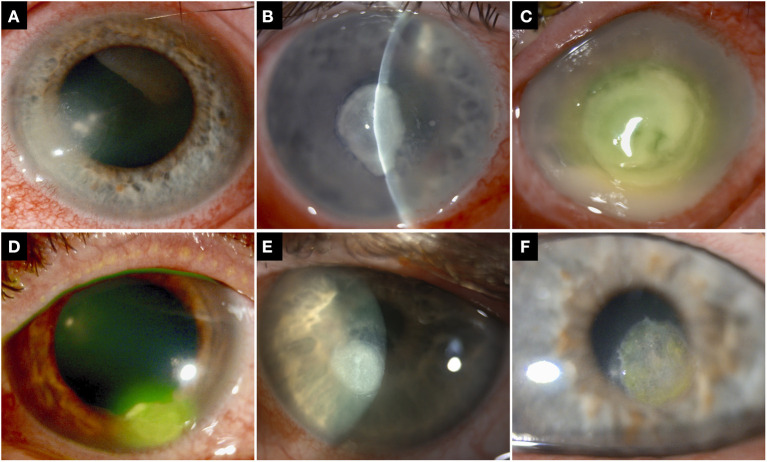
To examine the risk factors, clinical characteristics, outcomes, and prognostic factors of bacterial keratitis (BK) in Nottingham, UK. This was a retrospective study of patients who presented to the Queen's Medical Centre, Nottingham, with suspected BK during 2015-2019. Relevant data, including the demographic factors, risk factors, clinical outcomes, and potential prognostic factors, were analysed. A total of 283 patients ( = 283 eyes) were included; mean age was 54.4 ± 21.0 years and 50.9% were male. Of 283 cases, 128 (45.2%) cases were culture-positive. Relevant risk factors were identified in 96.5% patients, with ocular surface diseases (47.3%), contact lens wear (35.3%) and systemic immunosuppression (18.4%) being the most common factors. Contact lens wear was most commonly associated with whereas spp. were most commonly implicated in non-contact lens-related BK cases ( = 0.017). At presentation, culture-positive cases were associated with older age, worse presenting corrected-distance-visual-acuity (CDVA), use of topical corticosteroids, larger epithelial defect and infiltrate, central location and hypopyon (all < 0.01), when compared to culture-negative cases. Hospitalisation was required in 57.2% patients, with a mean length of stay of 8.0 ± 8.3 days. Surgical intervention was required in 16.3% patients. Significant complications such as threatened/actual corneal perforation (8.8%), loss of perception of light vision (3.9%), and evisceration/enucleation (1.4%) were noted. Poor visual outcome (final corrected-distance-visual-acuity of <0.6 logMAR) and delayed corneal healing (>30 days from initial presentation) were significantly affected by age >50 years, infiltrate size >3 mm, and reduced presenting vision (all < 0.05). BK represents a significant ocular morbidity in the UK, with ocular surface diseases, contact lens wear, and systemic immunosuppression being the main risk factors. Older age, large infiltrate, and poor presenting vision were predictive of poor visual outcome and delayed corneal healing, highlighting the importance of prevention and early intervention for BK.
为研究英国诺丁汉细菌性角膜炎(BK)的危险因素、临床特征、转归及预后因素。这是一项对2015 - 2019年期间在诺丁汉女王医疗中心就诊的疑似BK患者的回顾性研究。分析了相关数据,包括人口统计学因素、危险因素、临床转归及潜在的预后因素。共纳入283例患者(283只眼);平均年龄为54.4±21.0岁,男性占50.9%。283例病例中,128例(45.2%)培养阳性。96.5%的患者确定了相关危险因素,其中眼表疾病(47.3%)、佩戴隐形眼镜(35.3%)和全身免疫抑制(18.4%)是最常见的因素。佩戴隐形眼镜最常与 相关,而 菌属在非隐形眼镜相关的BK病例中最常被涉及( = 0.017)。就诊时,与培养阴性病例相比,培养阳性病例与年龄较大、就诊时矫正远视力(CDVA)较差、使用局部皮质类固醇、上皮缺损和浸润较大、位于中央以及前房积脓有关(均 < 0.01)。57.2%的患者需要住院治疗,平均住院时间为8.0±8.3天。16.3%的患者需要手术干预。记录到了严重并发症,如威胁性/实际角膜穿孔(8.8%)、光感丧失(3.9%)和眼球内容剜除术/眼球摘除术(1.4%)。年龄>50岁、浸润大小>3 mm和就诊时视力下降均显著影响视力预后不良(最终矫正远视力<0.6 logMAR)和角膜愈合延迟(自初次就诊起>30天)(均 < 0.05)。在英国,BK是一种重要的眼部疾病,眼表疾病、佩戴隐形眼镜和全身免疫抑制是主要危险因素。年龄较大、浸润较大和就诊时视力较差预示着视力预后不良和角膜愈合延迟,凸显了预防和早期干预BK的重要性。