
就医及诊断延误及其相关因素:中国陕西省新冠肺炎感染病例研究
Health-seeking and diagnosis delay and its associated factors: a case study on COVID-19 infections in Shaanxi Province, China.
作者信息
Zheng Wenyuan, Kämpfen Fabrice, Huang Zhiyong
机构信息
School of Insurance, Southwestern University of Finance and Economics, Chengdu, 611130, China.
Population Studies Center, University of Pennsylvania, Philadelphia, PA, 19104, USA.
出版信息
Sci Rep. 2021 Aug 30;11(1):17331. doi: 10.1038/s41598-021-96888-2.
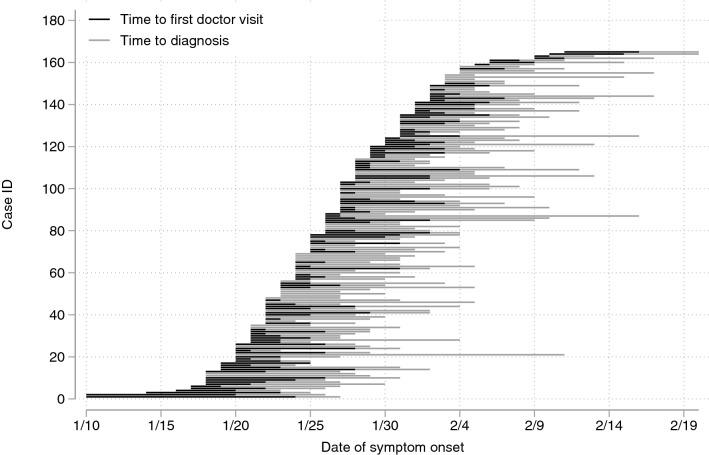
This time-to-event study examines social factors associated with health-seeking and diagnosis of 165 COVID-19 cases in response to the pandemic spread in Shaanxi Province, China. In particular, we investigate the differential access to healthcare in terms of delayed time from symptom onset to first medical visit and subsequently to diagnosis by factors such as sex, age, travel history, and type of healthcare utilization. We show that it takes more time for patients older than 60 (against those under 30) to seek healthcare after developing symptoms (+ 2.5 days, [Formula: see text]), surveillance on people with living or travel history to Wuhan helps shorten the time to the first doctor visit (- 0.8 days) and diagnosis (- 2.2 days, [Formula: see text]). A delay cut is associated with the adoption of intermediary and large hospitals rather than community-based care as primary care choices (- 1.6 days, [Formula: see text] and - 2.2 days, [Formula: see text]). One unit increase of healthcare workers per 1000 people saves patients 0.5 days ([Formula: see text]) for diagnosis from the first doctor visit and 0.6 days ([Formula: see text]) in total. Our analysis of factors associated with the time delay for diagnosis may provide a better understanding of the health-seeking behaviors of patients and the diagnosis capacity of healthcare providers during the COVID-19 pandemic.
这项事件发生时间研究调查了与陕西省165例新冠肺炎病例寻求医疗和诊断相关的社会因素,以应对新冠疫情在中国的传播。具体而言,我们根据从症状出现到首次就医以及随后到诊断的延迟时间,研究了性别、年龄、旅行史和医疗保健利用类型等因素在获得医疗保健方面的差异。我们发现,60岁以上患者(与30岁以下患者相比)在出现症状后寻求医疗保健的时间更长(多2.5天,[公式:见原文]),对有武汉居住或旅行史的人员进行监测有助于缩短首次就医时间(少0.8天)和诊断时间(少2.2天,[公式:见原文])。与选择社区医疗服务作为初级医疗保健相比,选择中级和大型医院作为初级医疗保健会减少延迟时间(分别少1.6天,[公式:见原文]和少2.2天,[公式:见原文])。每1000人中有一名医护人员增加一个单位,可使患者从首次就医到诊断节省0.5天([公式:见原文]),总共节省0.6天([公式:见原文])。我们对与诊断延迟时间相关因素的分析,可能有助于更好地理解新冠疫情期间患者的就医行为和医疗保健提供者的诊断能力。

 Zotero 插件