Hasan Md Zabir, Story William T, Bishai David M, Ahuja Akshay, Rao Krishna D, Gupta Shivam
School of Population and Public Health, University of British Columbia, Vancouver, British Columbia, Canada.
Department of International Health, Johns Hopkins Bloomberg School of Public Health, Baltimore, MD, USA.
SSM Popul Health. 2021 Aug 21;15:100901. doi: 10.1016/j.ssmph.2021.100901. eCollection 2021 Sep.
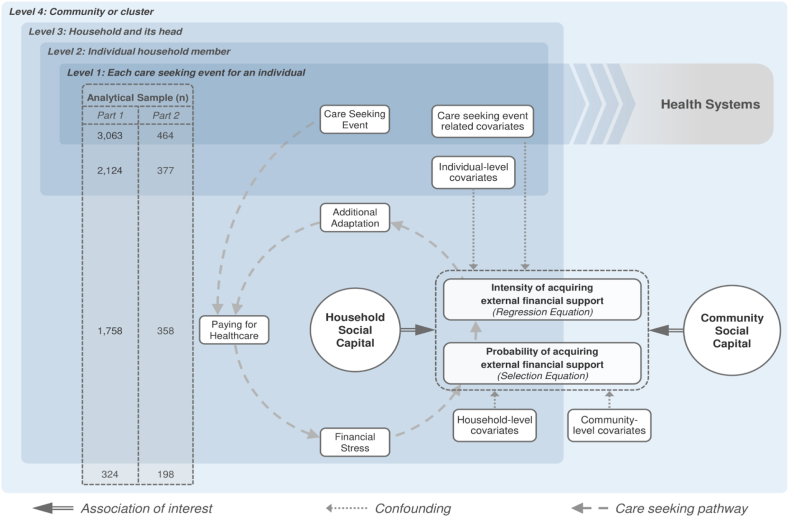
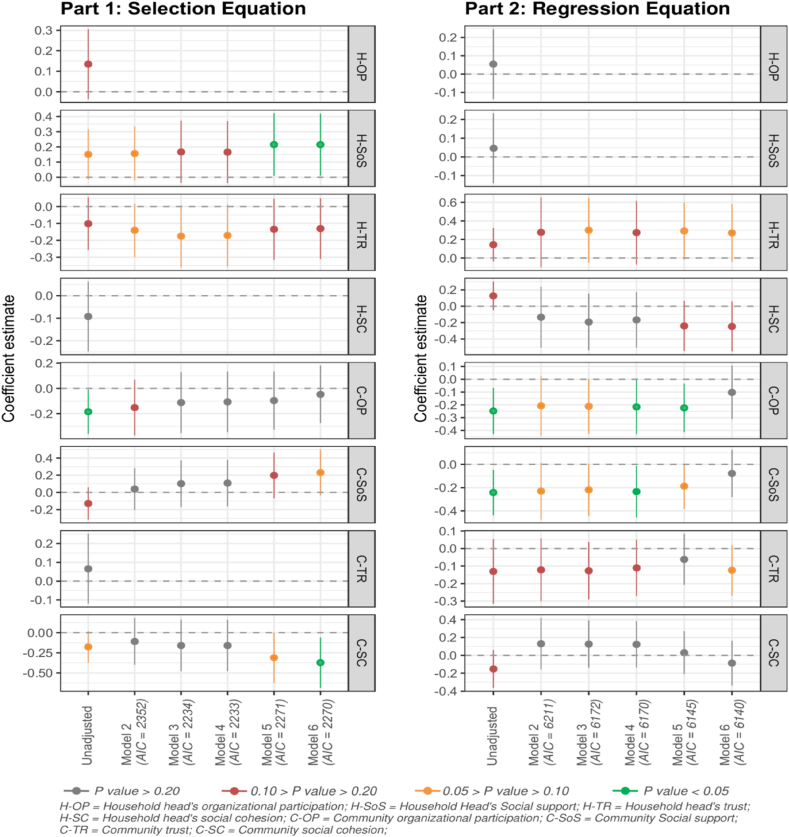
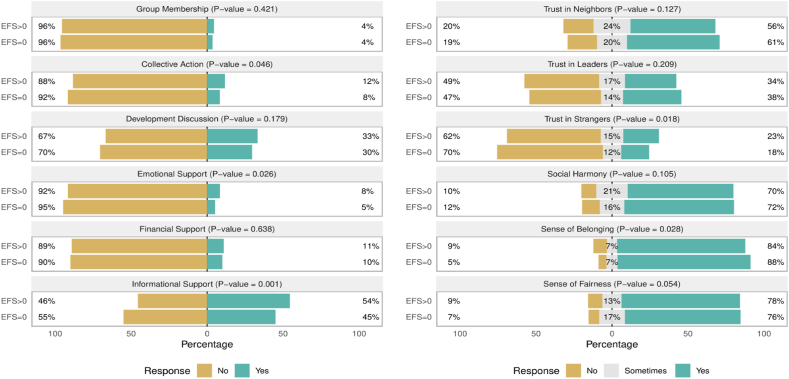
In the absence of adequate social security, out-of-pocket health expenditure compels households to adopt coping strategies, such as utilizing savings, selling assets, or acquiring external financial support (EFS) by borrowing with interest. Households' probability of acquiring EFS and its amount (intensity) depends on its social capital - the nature of social relationships and resources embedded within social networks. This study examines the effect of social capital on the probability and intensity of EFS during health events in Uttar Pradesh (UP), India. The analysis used data from a cross-sectional survey of 6218 households, reporting 3066 healthcare events, from two districts of UP. Household heads (HH) reported demographic, socioeconomic, and health-related information, including EFS, for each household member. Self-reported data from Shortened and Adapted Social Capital Assessment Tool in India (SASCAT-I) was used to generate four unique social capital measures (organizational participation, social support, trust, and social cohesion) at HH and community-level, using multilevel confirmatory factor analysis. After descriptive analysis, two-part mixed-effect models were implemented to estimate the probability and intensity of EFS as a function of social capital measures, where multilevel mixed-effects probit regression was used as the first-part and multilevel mixed-effects linear model with log link and gamma distribution as the second-part. Controlling for all covariates, the probability of acquiring EFS significantly increased (p = 0.04) with higher social support of the HH and significantly decreased (p = 0.02) with higher community social cohesion. Conditional to receiving any EFS, higher social trust of the HH resulted in higher intensity of EFS (p = 0.09). Social support and trust may enable households to cope up with financial stress. However, controlling for the other dimensions of social capital, high cohesiveness with the community might restrict a household's access to external resources demonstrating the unintended effect of social capital exerted by formal or informal social control.
在缺乏充足社会保障的情况下,自付医疗费用迫使家庭采取应对策略,比如动用储蓄、变卖资产,或者通过付息借贷获取外部经济支持(EFS)。家庭获取EFS的可能性及其数额(强度)取决于其社会资本——社会关系的性质以及社会网络中蕴含的资源。本研究考察了印度北方邦(UP)健康事件期间社会资本对EFS可能性和强度的影响。分析使用了来自UP两个地区6218户家庭的横断面调查数据,这些家庭报告了3066起医疗事件。户主报告了每个家庭成员的人口统计学、社会经济和健康相关信息,包括EFS。印度缩短版和改编版社会资本评估工具(SASCAT-I)的自我报告数据用于通过多水平验证性因素分析,在户主和社区层面生成四种独特的社会资本指标(组织参与、社会支持、信任和社会凝聚力)。经过描述性分析后,实施了两部分混合效应模型来估计作为社会资本指标函数的EFS可能性和强度,其中多水平混合效应概率回归用作第一部分,具有对数链接和伽马分布的多水平混合效应线性模型用作第二部分。在控制所有协变量的情况下,户主获得更高社会支持时,获取EFS的可能性显著增加(p = 0.04),而社区社会凝聚力更高时则显著降低(p = 0.02)。在获得任何EFS的条件下,户主更高的社会信任导致EFS强度更高(p = 0.09)。社会支持和信任可能使家庭能够应对财务压力。然而,在控制社会资本的其他维度时,与社区的高度凝聚力可能会限制家庭获取外部资源,这表明了正式或非正式社会控制所施加的社会资本的意外影响。