Ajou University College of Nursing and Research Institute of Nursing Science, Suwon, 16499, Republic of Korea.
Department of Thoracic and Cardiovascular Surgery, Chung-Ang University, Seoul, 06974, Republic of Korea.
BMC Cardiovasc Disord. 2021 Sep 3;21(1):418. doi: 10.1186/s12872-021-02224-x.
Postoperative atrial fibrillation (POAF) is the most common cardiac dysrhythmia to occur after coronary artery bypass grafting (CABG). However, the risk factors for new-onset POAF after CABG during the perioperative period have yet to be clearly defined. Accordingly, the aim of our systematic review was to evaluate the perioperative predictors of new-onset POAF after isolated CABG.
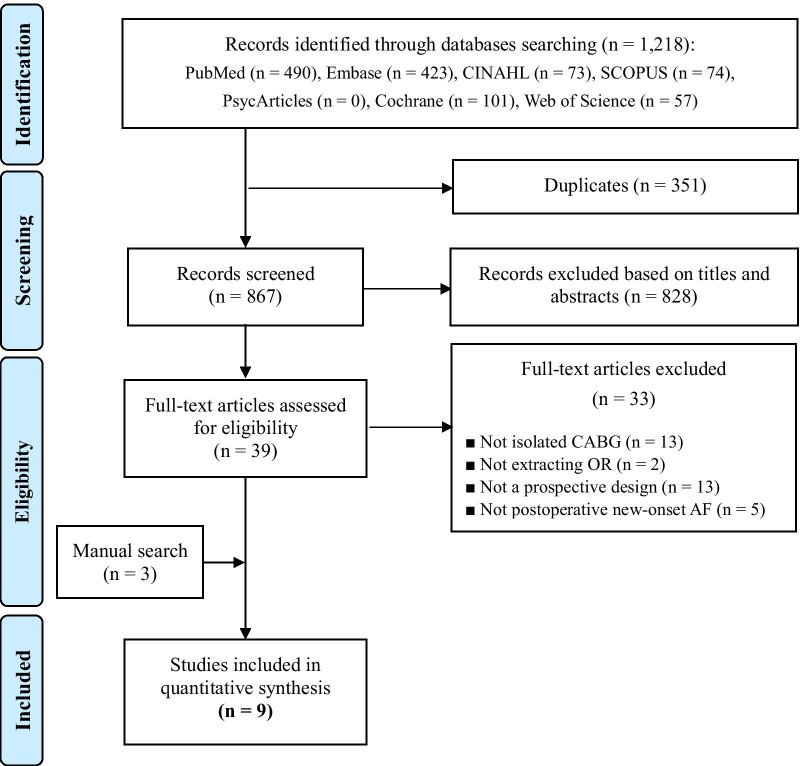
Our review methods adhered to the Preferred Reporting Items for Systematic Reviews and Meta-Analyses guideline. We searched seven electronic databases (PubMed, Embase, CINAHL, PsycArticles, Cochrane, Web of Science, and SCOPUS) to identify all relevant English articles published up to January 2020. Identified studies were screened independently by two researchers for selection, according to predefined criteria. The Newcastle-Ottawa Scale was used to evaluate the quality of studies retained.
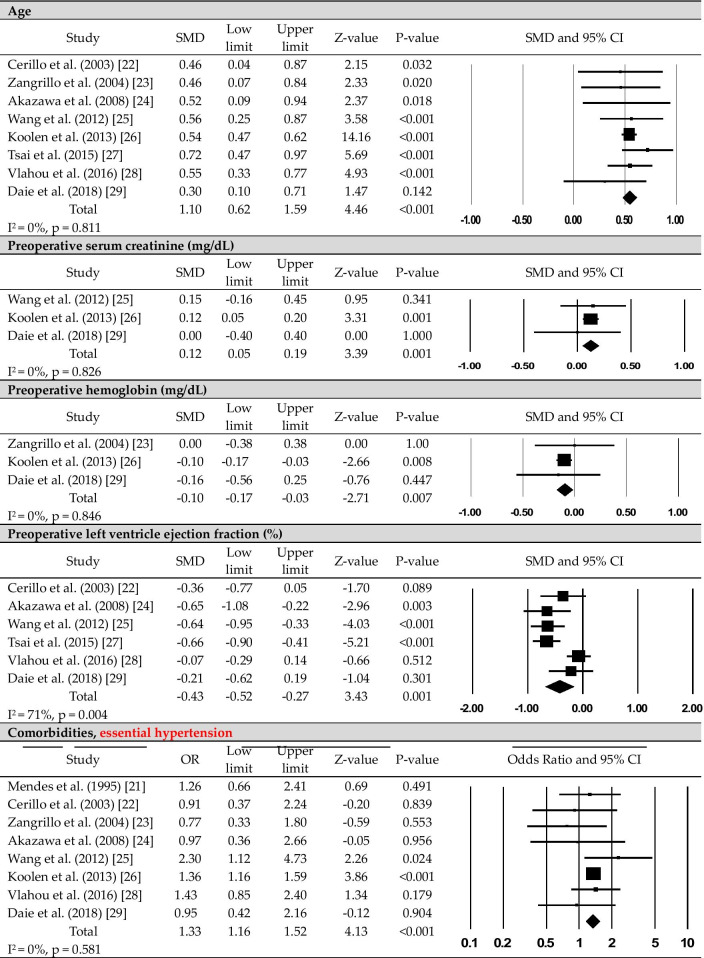
After screening, nine studies were retained for analysis, including 4798 patients, of whom 1555 (32.4%) experienced new-onset POAF after CABG. The incidence rate of new-onset POAF ranged between 17.3% and 47.4%. The following risk factors were identified: old age (p < 0.001), a high preoperative serum creatinine level (p = 0.001), a low preoperative hemoglobin level (p = 0.007), a low left ventricle ejection fraction in Asian patients (p = 0.001), essential hypertension (p < 0.001), chronic obstructive pulmonary disease (p = 0.010), renal failure (p = 0.009), cardiopulmonary bypass use (p = 0.002), perfusion time (p = 0.017), postoperative use of inotropes (p < 0.001), postoperative renal failure (p = 0.001), and re-operation (p = 0.005). All studies included in the analysis were of good quality.
The risk factors identified in our review could be used to improve monitoring of at-risk patients for early detection and treatment of new-onset POAF after CABG, reducing the risk of other complications and negative clinical outcomes.
术后心房颤动(POAF)是冠状动脉旁路移植术(CABG)后最常见的心律失常。然而,CABG 围手术期新发 POAF 的危险因素尚未明确。因此,我们的系统评价旨在评估单纯 CABG 后新发 POAF 的围手术期预测因素。
我们的综述方法遵循系统评价和荟萃分析的首选报告项目。我们检索了七个电子数据库(PubMed、Embase、CINAHL、PsycArticles、Cochrane、Web of Science 和 SCOPUS),以查找截至 2020 年 1 月发表的所有相关英文文章。根据预设标准,两名研究人员独立筛选确定的研究进行选择。使用纽卡斯尔-渥太华量表评估保留研究的质量。
经过筛选,共有 9 项研究被保留用于分析,共纳入 4798 例患者,其中 1555 例(32.4%)在 CABG 后出现新发 POAF。新发 POAF 的发生率在 17.3%至 47.4%之间。确定了以下危险因素:年龄较大(p<0.001)、术前血清肌酐水平较高(p=0.001)、术前血红蛋白水平较低(p=0.007)、亚洲患者左心室射血分数较低(p=0.001)、高血压(p<0.001)、慢性阻塞性肺疾病(p=0.010)、肾衰竭(p=0.009)、体外循环使用(p=0.002)、灌注时间(p=0.017)、术后使用正性肌力药(p<0.001)、术后肾衰竭(p=0.001)和再次手术(p=0.005)。分析中纳入的所有研究均为高质量研究。
我们的综述确定的危险因素可用于改善对高危患者的监测,以便早期发现和治疗 CABG 后新发 POAF,降低其他并发症和负面临床结局的风险。