Lian Xinrong, Zhu Qianmei, Sun Li, Cheng Yaozhong
Department of Anesthesiology, National Cancer Center/National Clinical Research Center for Cancer/Cancer Hospital, Chinese Academy of Medical Sciences and Peking Union Medical College, Beijing, China.
National Cancer Center/National Clinical Research Center for Cancer/Cancer Hospital & Shenzhen Hospital, Chinese Academy of Medical Sciences and Peking Union Medical College, Shenzhen, China.
Front Syst Neurosci. 2021 Aug 17;15:655695. doi: 10.3389/fnsys.2021.655695. eCollection 2021.
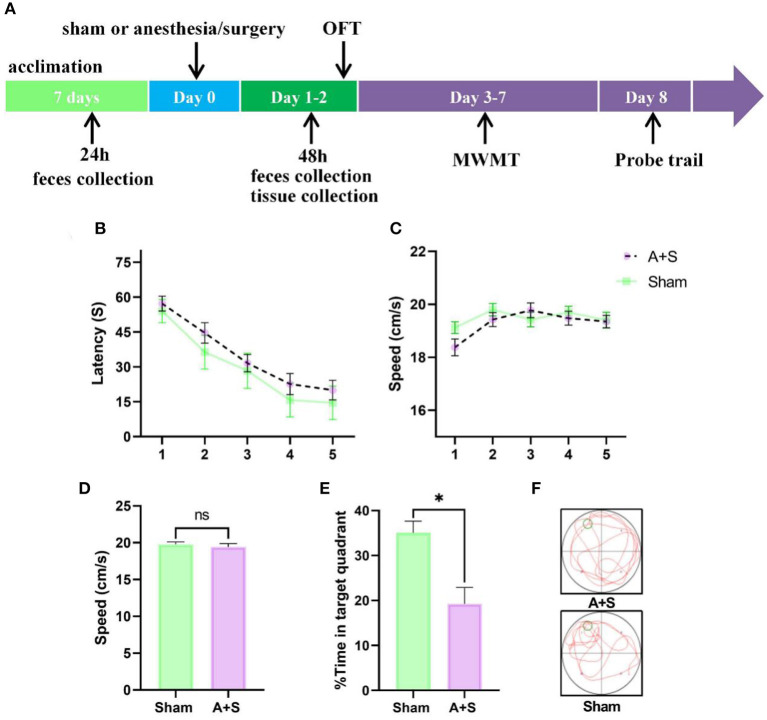
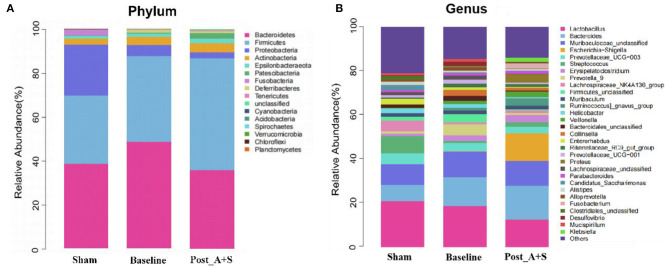
Post-operative cognitive dysfunction (POCD) is the decline in cognitive function of the central nervous system (CNS) after anesthesia/surgery. The present study explored whether anesthesia/surgery altered gut microbiota and fecal metabolites, examining their associations with risk factors of cognitive dysfunction in aged mice. Sixteen-month-old C57BL/6 mice underwent abdominal surgery under isoflurane anesthesia to establish an animal model of POCD. The Morris water maze test (MWMT) was used as an indicator of memory after surgery. The effects of anesthesia/surgical interventions on gut microbiota, fecal metabolites, hippocampus, and serum levels of inflammatory factors were examined. The anesthesia/surgery induced more serious POCD behavior, increasing brain interleukin (IL)-6, and IL-1β levels than sham control mice. The relative abundance of bacterial genera , and declined, whereas that of -, and were enriched after anesthesia/surgery compared to the baseline controls. Liquid chromatography-mass spectrometry (LC-MS) showed that the metabolites differed between post-anesthesia+surgery (post_A + S) and baseline samples and were associated with the fecal metabolism of tryptophan, kynurenic acid, N-oleoyl γ-aminobutyric acid (GABA), 2-indolecarboxylic acid, and glutamic acid. Furthermore, the differential metabolites were associated with alterations in the abundance of specific bacteria. These results indicate that the POCD intervention may be achieved by targeting specific bacteria associated with neurotransmitter metabolism. A transient cognitive disturbance induced by anesthesia/surgery may be associated with unfavorable alterations in gut microbiota and fecal metabolites, thereby contributing to the POCD development.
术后认知功能障碍(POCD)是指麻醉/手术后中枢神经系统(CNS)认知功能的下降。本研究探讨了麻醉/手术是否改变肠道微生物群和粪便代谢产物,并研究了它们与老年小鼠认知功能障碍风险因素的关联。16个月大的C57BL/6小鼠在异氟烷麻醉下接受腹部手术,以建立POCD动物模型。莫里斯水迷宫试验(MWMT)用作术后记忆的指标。检测了麻醉/手术干预对肠道微生物群、粪便代谢产物、海马体和血清炎症因子水平的影响。与假手术对照组小鼠相比,麻醉/手术诱导了更严重的POCD行为,增加了脑内白细胞介素(IL)-6和IL-1β水平。与基线对照组相比,麻醉/手术后细菌属、的相对丰度下降,而、和的相对丰度增加。液相色谱-质谱联用(LC-MS)显示,麻醉后+手术(post_A + S)样本与基线样本之间的代谢产物存在差异,且与色氨酸、犬尿酸、N-油酰基γ-氨基丁酸(GABA)、2-吲哚羧酸和谷氨酸的粪便代谢有关。此外,差异代谢产物与特定细菌丰度的改变有关。这些结果表明,针对与神经递质代谢相关的特定细菌可能实现对POCD的干预。麻醉/手术引起的短暂认知障碍可能与肠道微生物群和粪便代谢产物的不良改变有关,从而促进POCD的发展。