Rustgi Sheila D, Bijlani Priyesha, Shah Shailja C
Vagelos College of Physicians and Surgeons, Columbia University, New York, NY, USA; Division of Digestive and Liver Diseases, Columbia University Irving Medical Center, New York, NY, USA.
Department of Medicine, University of California, San Diego, La Jolla, CA, USA.
Therap Adv Gastroenterol. 2021 Aug 31;14:17562848211038771. doi: 10.1177/17562848211038771. eCollection 2021.
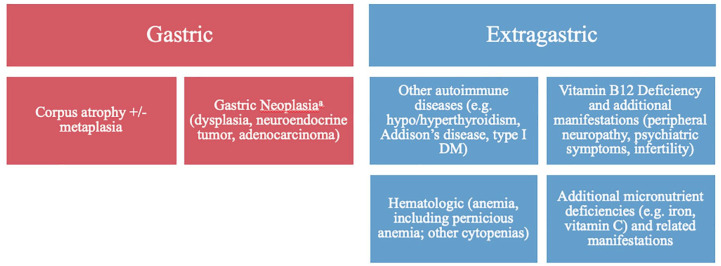
Autoimmune gastritis (AIG) is a chronic immune-mediated, inflammatory condition that involves the destruction of the gastric oxyntic mucosa through the autoimmune-mediated loss of parietal cells, with replacement by atrophic and metaplastic tissue. Diagnosing AIG is important, given the need for ongoing clinical management and vigilance with respect to downstream complications, the most serious of which is gastric adenocarcinoma. Other clinical consequences include gastric neuroendocrine tumors, consequences related to decreased gastric acid and decreased intrinsic factor due to parietal cell destruction and antibodies against intrinsic factor (e.g. micronutrient deficiencies), as well as concomitant autoimmune disorders. Considering the prevalence of AIG and the potential for severe clinical outcomes, it is important to engage in efforts to reduce practice pattern variability related to diagnosis and management. Accordingly, herein, we review of the epidemiology, pathogenesis, clinical presentation of AIG, including both gastric and extragastric manifestations, and provide an overview of clinical management.
自身免疫性胃炎(AIG)是一种慢性免疫介导的炎症性疾病,通过自身免疫介导的壁细胞丢失导致胃泌酸黏膜破坏,继而被萎缩和化生组织替代。鉴于对AIG进行持续临床管理以及警惕其下游并发症(其中最严重的是胃腺癌)的必要性,诊断AIG很重要。其他临床后果包括胃神经内分泌肿瘤、由于壁细胞破坏和抗内因子抗体导致胃酸和内因子减少相关的后果(如微量营养素缺乏)以及并发的自身免疫性疾病。考虑到AIG的患病率和严重临床后果的可能性,努力减少与诊断和管理相关的实践模式差异很重要。因此,本文将对AIG的流行病学、发病机制、临床表现(包括胃部和胃外表现)进行综述,并概述临床管理。