Gaida Razia, Truter Ilse, Peters Charles A
Drug Utilization Research Unit (DURU), Department of Pharmacy, Faculty of Health Sciences, Nelson Mandela University, Port Elizabeth, South Africa.
Social Aspects of Public Health Unit, Human Sciences Research Council, Port Elizabeth, South Africa.
S Afr J Infect Dis. 2020 Oct 14;35(1):23. doi: 10.4102/sajid.v35i1.23. eCollection 2020.
The World Health Organisation (WHO) guidelines recommend that, because of the resistance patterns of extensively drug-resistant (XDR) tuberculosis (TB) and its unique mechanism of action, bedaquiline be included in the regimen. Although the results of clinical trials have shown bedaquiline to be beneficial, it also carries the risk of adverse effects, some potentially life-threatening. The aim of the study was to determine the incidence of adverse effects caused by bedaquiline in patients diagnosed with XDR-TB. The subsequent management of these adverse effects was also analysed.
The medical records of patients aged 18 years or older living with XDR-TB who were prescribed bedaquiline in combination with a background regimen at a public-sector drug-resistant TB hospital in the Eastern Cape were reviewed.
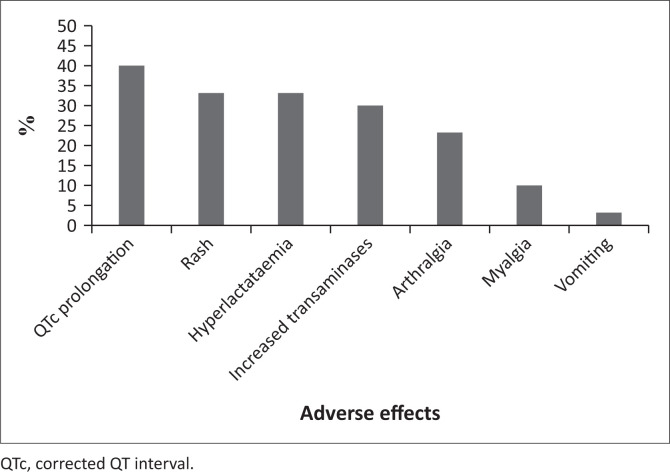
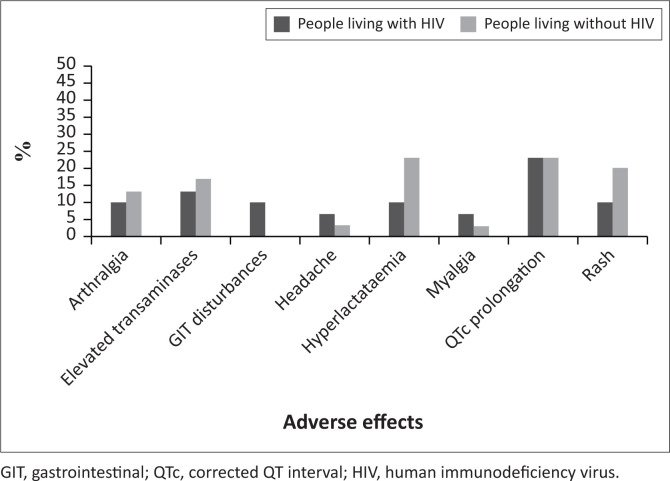
Thirty records were reviewed in September 2016. Female patients constituted 66.67% ( = 20) of the sample. Nearly half (46.67%; = 14) of the patients were living with human immunodeficiency virus, and six (42.86%) of them were female. Adverse effects were recorded for 26 patients (86.67%) including corrected QT prolongation (40%; = 12), skin rash (33.33%; = 10) and hyperlactataemia (33.33%; = 10) as the most common. There were no treatment discontinuations or deaths. The management of adverse effects varied from omitting doses of bedaquiline to pharmacological intervention.
All patients completed bedaquiline treatment, indicating that the adverse effects did not require discontinuation of the drug. However, when pharmacological intervention is required for the management of adverse effects, care should be taken to ensure that there is minimal interaction with other TB drugs and a low risk of further adverse effects.
世界卫生组织(WHO)指南建议,鉴于广泛耐药(XDR)结核病的耐药模式及其独特的作用机制,应将贝达喹啉纳入治疗方案。尽管临床试验结果显示贝达喹啉有益,但它也有产生不良反应的风险,有些不良反应可能危及生命。本研究的目的是确定确诊为XDR-TB的患者中由贝达喹啉引起的不良反应发生率。同时也分析了这些不良反应的后续管理情况。
回顾了东开普省一家公立耐药结核病医院中年龄在18岁及以上、被处方使用贝达喹啉并联合背景治疗方案的XDR-TB患者的病历。
2016年9月回顾了30份病历。女性患者占样本的66.67%(n = 20)。近一半(46.67%;n = 14)的患者感染了人类免疫缺陷病毒,其中6名(42.86%)为女性。26名患者(86.67%)记录有不良反应,最常见的是校正QT间期延长(40%;n = 12)、皮疹(33.33%;n = 10)和高乳酸血症(33.33%;n = 10)。没有出现治疗中断或死亡情况。不良反应的管理从省略贝达喹啉剂量到进行药物干预不等。
所有患者均完成了贝达喹啉治疗,这表明不良反应并不需要停药。然而,当需要进行药物干预来管理不良反应时,应注意确保与其他结核病药物的相互作用最小,且进一步产生不良反应的风险较低。