Adegboye Dolapo, Williams Ffion, Collishaw Stephan, Shelton Katherine, Langley Kate, Hobson Christopher, Burley Daniel, van Goozen Stephanie
Department of Psychology Cardiff University Cardiff South Glamorgan UK.
Department of Psychological Medicine and Neurology Cardiff University School of Medicine Cardiff South Glamorgan Wales.
JCPP Adv. 2021 Apr;1(1):e12005. doi: 10.1111/jcv2.12005. Epub 2021 Apr 7.
The mental health consequences of school closure, social isolation, increased financial and emotional stress, and greater exposure to family conflicts are likely to be pronounced for primary school children who are known to be vulnerable. Data from prior to the pandemic are needed to provide robust assessments of the impact of COVID-19 on vulnerable children.
The present study capitalises on an ongoing study of primary school children (4-8 years) identified as 'at-risk' for mental health problems by teachers. We collected mental health and socio-economic data prior to the pandemic and re-assessed this cohort ( = 142) via researcher-led video calls during the pandemic to evaluate the social and emotional impacts of COVID-19 for these families.
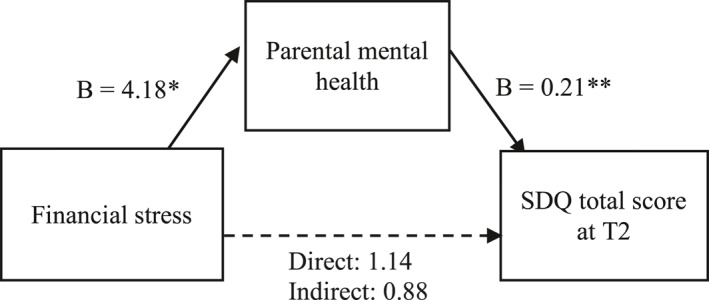
Mental health problems, particularly anxiety, increased significantly in these children. Parental mental health difficulties (anxiety and depression) were also prevalent. There were higher reports of financial stress during lockdown amongst low-income families previously identified as living in poverty, prior to the COVID-19 pandemic. Financial strain was found to indirectly predict increases in child mental health problems through parental mental health.
These findings show that the pandemic exacerbated mental health problems in already vulnerable children. These negative outcomes were explained by financial stress (e.g., lost employment, loss of income and inability to pay bills), which was negatively linked to parental mental health.
学校关闭、社会隔离、经济和情感压力增加以及更多地暴露于家庭冲突之中,对于那些已知较为脆弱的小学生而言,其心理健康后果可能会很明显。需要大流行之前的数据来对新冠疫情对脆弱儿童的影响进行有力评估。
本研究利用了一项正在进行的针对被教师认定为有心理健康问题“风险”的小学生(4至8岁)的研究。我们在大流行之前收集了心理健康和社会经济数据,并在大流行期间通过研究人员主导的视频通话对这个队列(n = 142)进行了重新评估,以评估新冠疫情对这些家庭的社会和情感影响。
这些儿童的心理健康问题,尤其是焦虑,显著增加。父母的心理健康问题(焦虑和抑郁)也很普遍。在新冠疫情大流行之前就被认定生活贫困的低收入家庭中,封锁期间财务压力的报告更多。发现经济压力通过父母的心理健康间接预测儿童心理健康问题的增加。
这些发现表明,疫情加剧了本就脆弱的儿童的心理健康问题。这些负面结果可由经济压力(如失业、收入损失和无力支付账单)来解释,而经济压力与父母的心理健康呈负相关。