Sivaraman Gopalan Krishnan, Rajan Vineeth, Vijayan Ardhra, Elangovan Ravikrishnan, Prendiville Alison, Bachmann Till T
Microbiology, Fermentation and Biotechnology Division, ICAR-Central Institute of Fisheries Technology, Kochi, India.
Department of Biochemical Engineering and Biotechnology, Indian Institute of Technology Delhi, New Delhi, India.
Front Microbiol. 2021 Aug 19;12:622891. doi: 10.3389/fmicb.2021.622891. eCollection 2021.
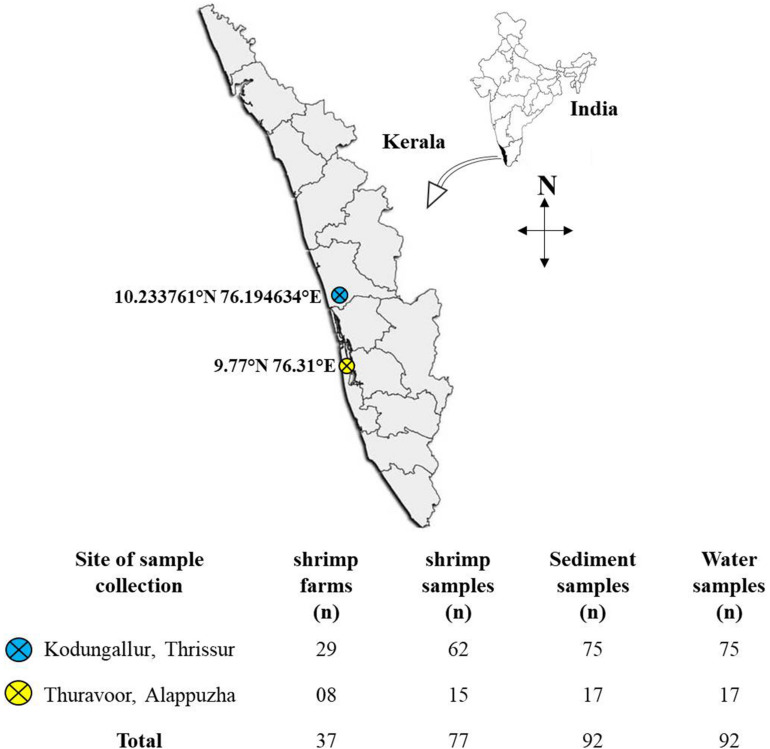
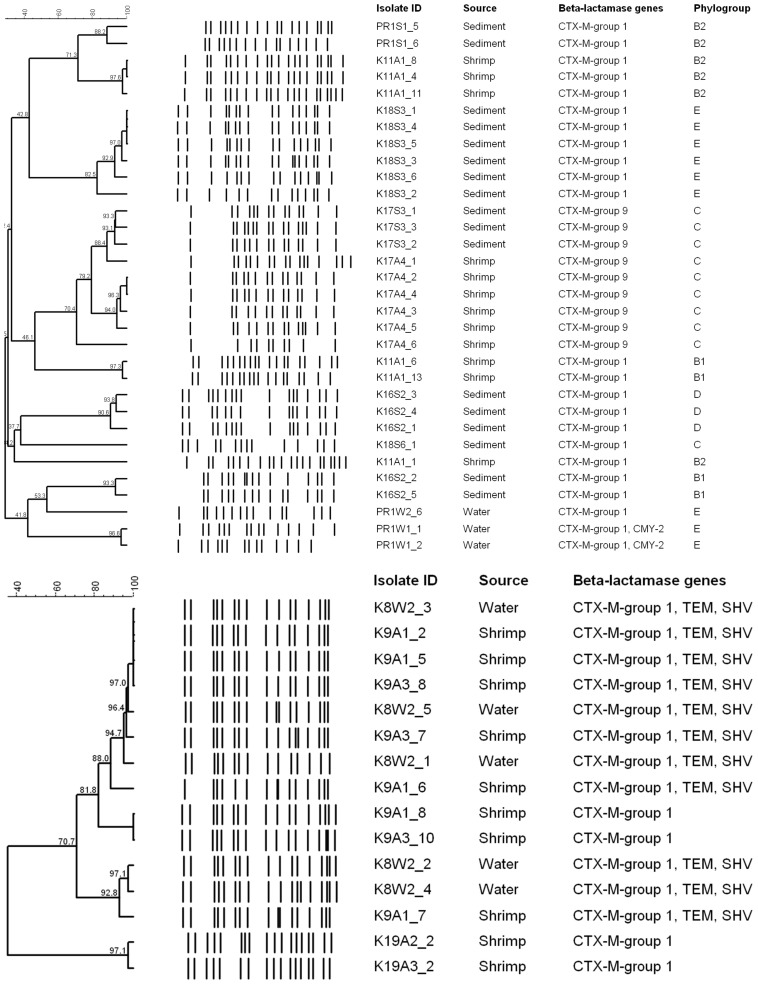
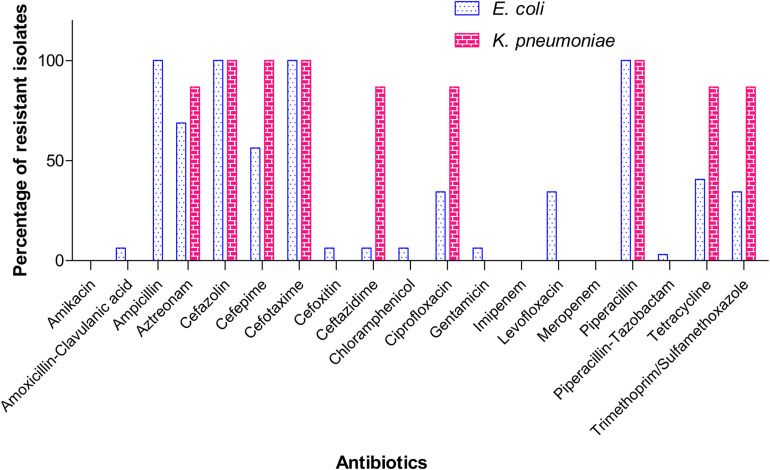
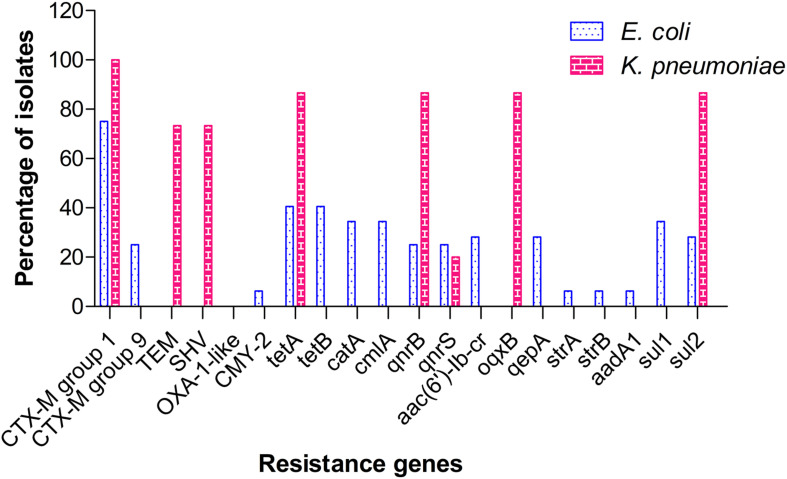
This study was undertaken to evaluate the prevalence of extended-spectrum beta-lactamase (ESBL)-producing and in selected shrimp aquaculture farms ( = 37) in Kerala, South India and to characterize the isolates using molecular tools. Overall, a low prevalence of ESBL-producers was found in the farms, most likely due to the reduced antibiotic usage in the shrimp farming sector. Out of the 261 samples (77 shrimp and 92 each of water and sediment), 14 (5.4%) tested positive for ESBL- or ESBL-. A total of 32 ESBL- and 15 ESBL- were recovered from these samples. All ESBL isolates were cefotaxime-resistant with minimal inhibitory concentration (MIC) ≥32 μg/ml. Of all isolates, 9 (28.1%) and 13 (86.7%) showed simultaneous resistance to tetracycline, ciprofloxacin, and trimethoprim-sulfamethoxazole. PCR analysis identified CTX-M group 1 ( ) as the predominant ESBL genotype in both (23, 71.9%) and (15, 100%). Other beta-lactamase genes detected were as follows: and (11 ), (9 ), and (2 ). Further screening for AMR genes identified and (13, 40.6%), (11, 34.4%), (9, 28.1%), and (11, 34.4%), and ' (9, 28.1%) and and (2, 6.3%) in , and (13, 86.7%), (3, 20%), (13, 86.7%), (13, 86.7%), and (13, 86.7%) in isolates. Phylogenetic groups identified among isolates included B1 (4, 12.5%), B2 (6, 18.8%), C (10, 31.3%), D (3, 9.4%), and E (9, 28.1%). PCR-based replicon typing (PBRT) showed the predominance of IncFIA and IncFIB plasmids in ; however, in , the major replicon type detected was IncHI1. Invariably, all isolates of harbored virulence-associated genes viz., , , and . Epidemiological typing by pulsed-field gel electrophoresis (PFGE) revealed that isolates recovered from different farms were genetically unrelated, whereas isolates of showed considerable genetic relatedness. In conclusion, our findings provide evidence that shrimp aquaculture environments can act as reservoirs of multi-drug resistant and
本研究旨在评估印度南部喀拉拉邦选定的37个对虾养殖场中产超广谱β-内酰胺酶(ESBL)的情况,并使用分子工具对分离株进行特征分析。总体而言,养殖场中ESBL产生菌的流行率较低,这很可能是由于对虾养殖部门抗生素使用量减少所致。在261份样本(77份对虾样本以及各92份水样和沉积物样本)中,14份(5.4%)ESBL或ESBL检测呈阳性。从这些样本中共分离出32株ESBL和15株ESBL。所有ESBL分离株对头孢噻肟耐药,最低抑菌浓度(MIC)≥32μg/ml。在所有分离株中,9株(28.1%)和13株(86.7%)对四环素、环丙沙星和甲氧苄啶-磺胺甲恶唑同时耐药。PCR分析确定CTX-M-1组()为和中主要的ESBL基因型(分别为23株,71.9%;15株,100%)。检测到的其他β-内酰胺酶基因如下:和(11株)、(9株)以及(2株)。对AMR基因的进一步筛查发现,中存在和(13株,40.6%)、(11株,34.4%)、(9株,28.1%)、和(11株,34.4%)、以及'(9株,28.1%)和和(2株,6.3%);中存在(13株,86.7%)、(3株,20%)、(13株,86.7%)、(13株,86.7%)以及(13株,86.7%)。在分离株中鉴定出的系统发育群包括B1(4株,12.5%)、B2(6株,18.8%)、C(10株,31.3%)、D(3株,9.4%)和E(9株,28.1%)。基于PCR的复制子分型(PBRT)显示,中IncFIA和IncFIB质粒占主导;然而,中检测到的主要复制子类型是IncHI1。无一例外,所有分离株都携带毒力相关基因,即、和。通过脉冲场凝胶电泳(PFGE)进行的流行病学分型显示,从不同养殖场分离出的菌株在基因上不相关,而分离株显示出相当程度的基因相关性。总之,我们的研究结果证明,对虾养殖环境可作为多重耐药菌的储存库。