Wu Shafei, Shi Xiaohua, Ren Xinyu, Li Kaimi, Pang Junyi, Liang Zhiyong
Department of Pathology, State Key Laboratory of Complex Severe and Rare Disease, Molecular Pathology Research Center, Peking Union Medical College Hospital, Chinese Academy of Medical Sciences and Peking Union Medical College, Beijing, China.
Front Mol Biosci. 2021 Aug 19;8:654387. doi: 10.3389/fmolb.2021.654387. eCollection 2021.
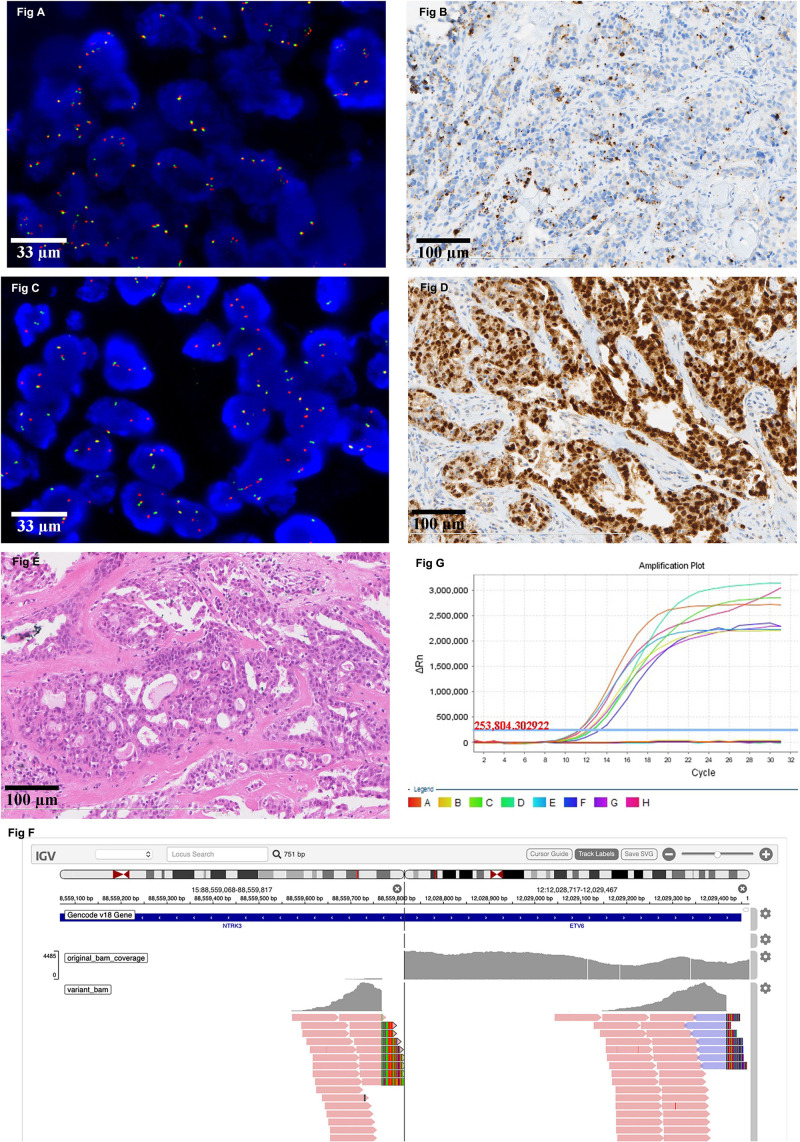
Triple-negative breast carcinoma (TNBC) is an aggressive disease that has a poor prognosis since it lacks effective treatment methods. Neurotrophic tyrosine receptor kinase (NTRK) fusion genes are excellent candidates for targeted RTK inhibitor therapies and there are available targeted therapy drugs for the treatment of TRK fusion-positive tumors in a tumor agnostic pattern. Our study was designed to investigate the NTRK gene fusion status in TNBC patients and to determine whether RTK-targeted therapies are suitable for TNBC patients. A total of 305 TNBC patients were enrolled in our study. IHC was employed as a prescreening method, and IHC positive cases were further submitted for evaluation by FISH, RT-PCR, and NGS methods. NTRK IHC was evaluated successfully in 287 of the 305 cases, and there were 32 (11.15%) positive cases. FISH was carried out in the 32 IHC positive cases. There were 13 FISH-positive cases if the threshold was set as >15% of the 100 counted tumor cells having a split orange and green signal with more than one signal diameter. There were only 2 FISH-positive cases if the cutoff value was defined as >15% of the counted tumor cells having a split signal with more than two signal diameter widths. One of the FISH-positive cases had a separate NTRK3 FISH signal in 88% of the tumor cells, and its IHC result was strong nuclear staining in all the tumor cells. After evaluation of the morphology, it was re-diagnosed as secretory breast carcinoma, and the NGS result confirmed that it had a NTRK3-ETV6 fusion gene. The other FISH-positive cases were all negative for NTRK gene fusion in the NGS or RT-PCR examination. The NTRK gene fusion rate was low in our TNBC cohort. NTRK gene fusion may be a rare event in TNBC. The high false-positive rate of NTRK gene fusion detected by IHC questions its role as a prescreening method in TNBC. More data may be needed to determine a suitable threshold for NTRK FISH in TNBC in the future. More studies are needed to confirm whether RTK-targeted therapies are appropriate treatments for TNBC patients.
三阴性乳腺癌(TNBC)是一种侵袭性疾病,由于缺乏有效的治疗方法,其预后较差。神经营养性酪氨酸受体激酶(NTRK)融合基因是靶向RTK抑制剂治疗的理想候选基因,并且有可用的靶向治疗药物以肿瘤agnostic模式治疗TRK融合阳性肿瘤。我们的研究旨在调查TNBC患者中NTRK基因融合状态,并确定RTK靶向治疗是否适用于TNBC患者。共有305例TNBC患者纳入我们的研究。免疫组化(IHC)用作预筛选方法,IHC阳性病例进一步通过荧光原位杂交(FISH)、逆转录聚合酶链反应(RT-PCR)和二代测序(NGS)方法进行评估。305例病例中的287例成功进行了NTRK IHC评估,其中32例(11.15%)为阳性病例。对32例IHC阳性病例进行了FISH检测。如果阈值设定为在计数的100个肿瘤细胞中,有超过15%的细胞出现橙色和绿色信号分裂且信号直径不止一个,则有13例FISH阳性病例。如果将截断值定义为在计数的肿瘤细胞中,有超过15%的细胞出现信号分裂且信号直径宽度超过两个,则只有2例FISH阳性病例。其中1例FISH阳性病例在88%的肿瘤细胞中有单独的NTRK3 FISH信号,其IHC结果为所有肿瘤细胞均呈强核染色。经形态学评估后,重新诊断为分泌性乳腺癌,NGS结果证实其具有NTRK3-ETV6融合基因。其他FISH阳性病例在NGS或RT-PCR检测中NTRK基因融合均为阴性。在我们的TNBC队列中,NTRK基因融合率较低。NTRK基因融合在TNBC中可能是罕见事件。IHC检测到的NTRK基因融合高假阳性率质疑了其在TNBC中作为预筛选方法的作用。未来可能需要更多数据来确定TNBC中NTRK FISH的合适阈值。需要更多研究来确认RTK靶向治疗是否是TNBC患者合适的治疗方法。