Division of Immunogenetics, Department of Immunobiology and Neuroscience, Medical Institute of Bioregulation, Kyushu University, 3-1-1 Maidashi, Higashi-ku, Fukuoka 812-8582, Japan.
Int Immunol. 2021 Nov 25;33(12):731-736. doi: 10.1093/intimm/dxab065.
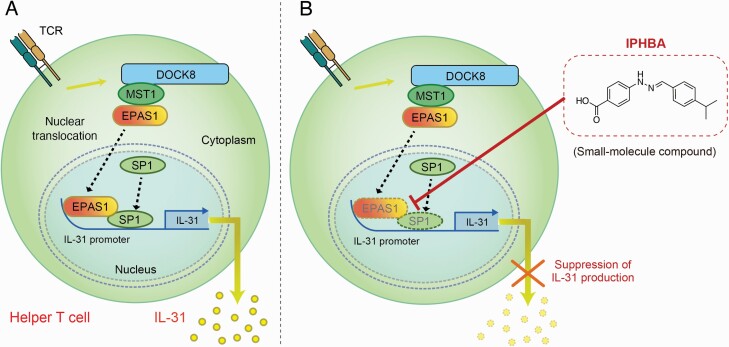
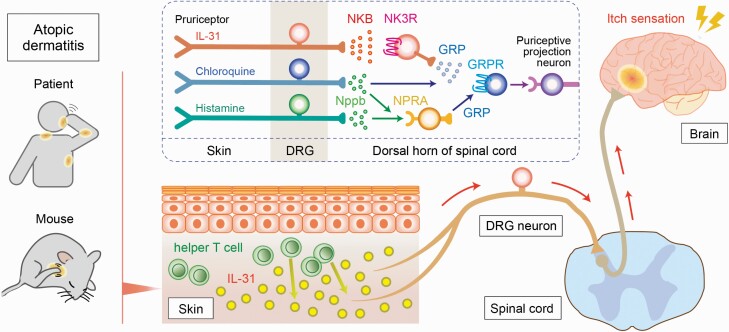
Atopic dermatitis (AD) is one of the most prevalent chronic inflammatory skin diseases in the world. It is characterized by recurrent eczematous lesions and intense itch, and many cytokines are involved in the pathogenesis of AD. Among them, much attention has been paid to interleukin 31 (IL-31) as an AD-associated itch mediator. IL-31 is mainly produced by CD4+ helper T cells and transmits the signals via a heterodimeric receptor composed of IL-31 receptor A (IL-31RA) and oncostatin M receptor (OSMR), both of which are expressed in dorsal root ganglion (DRG) neurons. However, the molecular mechanisms of how IL-31 is produced in helper T cells upon stimulation and transmits the itch sensation to the brain were largely unknown. Recently, by using original mouse models of AD, we have identified endothelial PAS domain 1 (EPAS1) and neurokinin B (NKB) as key molecules critical for IL-31 production and IL-31-mediated itch transmission, respectively. These molecules could be novel drug targets for AD-associated itch. This review highlights our recent findings, which show the functional significance of these molecules in the IL-31-induced itch sensation, referring to their application to drug development.
特应性皮炎(AD)是世界上最常见的慢性炎症性皮肤病之一。其特征为反复发作的湿疹样皮损和剧烈瘙痒,许多细胞因子参与 AD 的发病机制。其中,白细胞介素 31(IL-31)作为一种与 AD 相关的瘙痒介质受到了广泛关注。IL-31 主要由 CD4+辅助 T 细胞产生,并通过由白细胞介素 31 受体 A(IL-31RA)和肿瘤坏死因子受体超家族成员 11(OSMR)组成的异二聚体受体传递信号,这两种受体均在背根神经节(DRG)神经元中表达。然而,IL-31 在辅助 T 细胞受到刺激时产生以及将瘙痒感传递到大脑的分子机制在很大程度上是未知的。最近,通过使用 AD 的原始小鼠模型,我们确定了内皮 PAS 结构域蛋白 1(EPAS1)和神经激肽 B(NKB)分别是 IL-31 产生和 IL-31 介导的瘙痒传递的关键分子。这些分子可能是 AD 相关瘙痒的新型药物靶点。本综述强调了我们最近的发现,这些发现显示了这些分子在 IL-31 诱导的瘙痒感中的功能意义,并提到了它们在药物开发中的应用。