Department of Laboratory Medicine, Wuxi Second People's Hospital, Jiangsu, China.
Department of Laboratory Medicine, Taizhou Second People's Hospital, Taizhou, Jiangsu, China.
Bosn J Basic Med Sci. 2022 Jun 1;22(3):453-459. doi: 10.17305/bjbms.2021.6404.
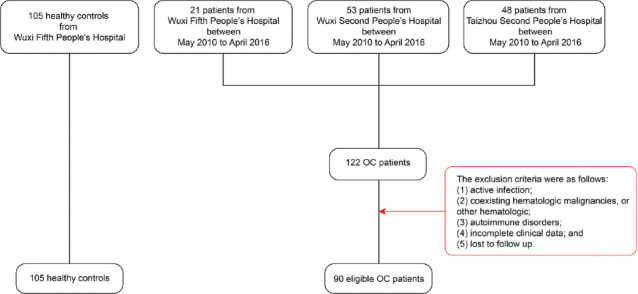
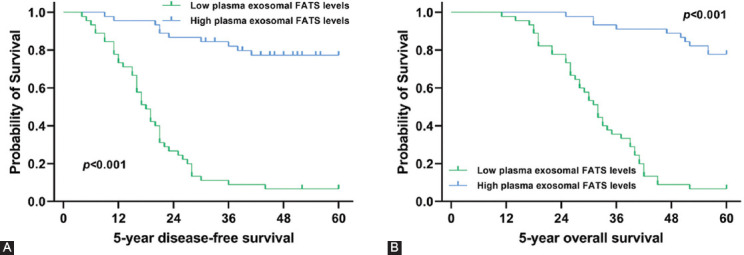
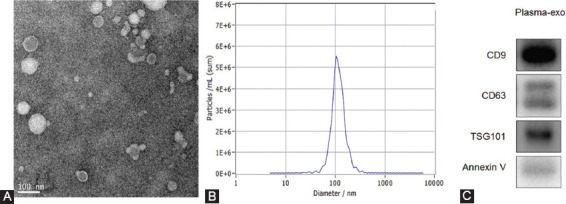
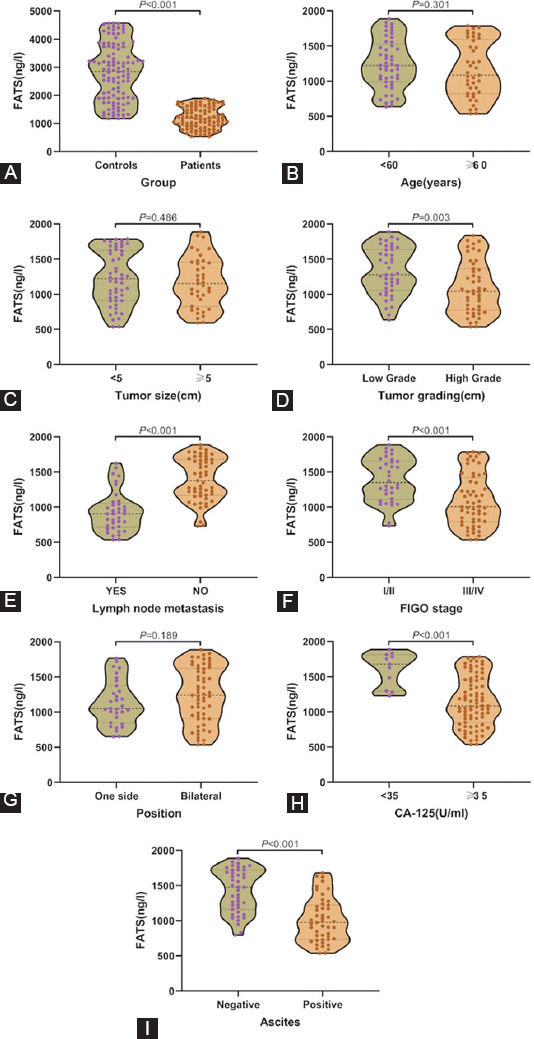
The objective of the study was to investigate the levels of plasma exosome-derived fragile site-associated tumor suppressor (FATS) and evaluate its prognostic predictive ability in ovarian cancer (OC) patients. Exosome-rich fractions were isolated from the plasma of 90 patients with OC enrolled in this study. The levels of plasma exosome-derived FATS were detected by ELISA. The levels of exosome-derived FATS in OC patients were significantly lower as compared to the healthy controls (P < 0.001). The levels of plasma exosome-derived FATS were higher in OC patients with low grade (1/2), and Federation International of Gynecology and Obstetrics (FIGO) Stages I/II than those in high grade (3/4) and Stages III/IV of the disease (p = 0.003; p < 0.001), respectively. The levels of plasma exosome-derived FATS were significantly higher in OC patients with no lymph node metastasis or no ascites as compared to those with lymph node metastasis or ascites, respectively (both p < 0.001). The levels of plasma exosome-derived FATS were higher in OC patients having CA-125 below 35 U/ml as compared to those with CA-125 greater than 35 U/ml (p < 0.001). Among all enrolled OC patients, both 5-DFS and 5-OS were shorter in patients with lower plasma exosome-derived FATS levels than those with higher levels (both p < 0.001). The area under the receiver operating characteristic curve of plasma exosome-derived FATS was 0.85 (95% CI: 0.76-0.91) for 5-DFS and 0.91 (95% CI: 0.83-0.96) for 5-OS prediction in patients with OC. Plasma exosome-derived FATS levels in OC patients were significantly downregulated. Low levels of plasma exosome-derived FATS had a significant relationship with FIGO Stages III/IV, high grade, ascites, higher levels of CA-125, lymph node metastasis, and prognosis of OC patients. Thus, our findings may provide insights for the development of a new strategy OC treatment.
本研究的目的是探讨血浆外泌体衍生脆弱部位相关肿瘤抑制因子(FATS)的水平,并评估其在卵巢癌(OC)患者中的预后预测能力。从本研究纳入的 90 例 OC 患者的血浆中分离出外泌体丰富的级分。通过 ELISA 检测血浆外泌体衍生 FATS 的水平。OC 患者的血浆外泌体衍生 FATS 水平明显低于健康对照组(P<0.001)。低级别(1/2)和国际妇产科联合会(FIGO)I/II 期 OC 患者的血浆外泌体衍生 FATS 水平高于高级别(3/4)和疾病 III/IV 期的患者(p=0.003;p<0.001)。无淋巴结转移或无腹水的 OC 患者的血浆外泌体衍生 FATS 水平明显高于有淋巴结转移或腹水的患者(均 p<0.001)。CA-125 低于 35U/ml 的 OC 患者的血浆外泌体衍生 FATS 水平高于 CA-125 大于 35U/ml 的患者(p<0.001)。在所有纳入的 OC 患者中,血浆外泌体衍生 FATS 水平较低的患者的 5 年无病生存率(DFS)和 5 年总生存率(OS)均短于水平较高的患者(均 p<0.001)。OC 患者的血浆外泌体衍生 FATS 的受试者工作特征曲线下面积为 5 年 DFS(0.85;95%CI:0.76-0.91)和 5 年 OS(0.91;95%CI:0.83-0.96)预测。OC 患者的血浆外泌体衍生 FATS 水平明显下调。血浆外泌体衍生 FATS 水平低与 FIGO 分期 III/IV、高级别、腹水、CA-125 水平较高、淋巴结转移和 OC 患者的预后显著相关。因此,我们的发现可能为开发新的 OC 治疗策略提供思路。