Genesis Laboratories, Inc., Wellington, CO, USA.
Parasit Vectors. 2021 Sep 7;14(1):459. doi: 10.1186/s13071-021-04930-z.
Lyme disease, caused primarily by Borrelia burgdorferi sensu stricto, is the most prevalent vector-borne disease in the United States. Treatment of rodent pathogen reservoirs with an oral acaricide may suppress the production of infected host-seeking ticks posing a risk for human infection. A previous study showed that an oral fipronil bait effectively controlled larval Ixodes scapularis ticks on white-footed mice (Peromyscus leucopus) up to 15 days post-bait exposure. The present study expands upon this finding by exposing group-housed white-footed mice to fipronil bait under simulated field conditions prior to tick infestation.
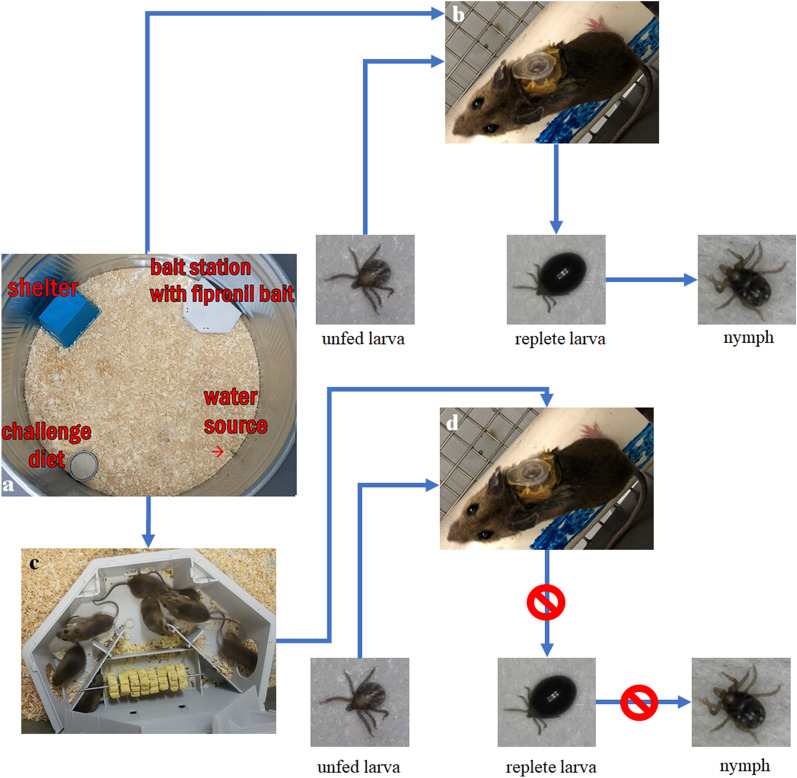
Mice (n = 80) were housed in groups of 10 within large enclosures and offered a choice between fipronil bait within a commercial bait station and an alternative diet. The mice were assigned to two treatment groups and two control groups to undergo bait exposure durations of either 24 h (reduced) or 168 h (extended). Groups were further differentiated by the time point post-bait exposure when larval ticks were applied to mice within feeding capsules (reduced day 1, day 15; extended day 21, day 35). For 4 days post-tick introduction, attached larvae were observed by microscopy and replete larvae were recovered. Replete larvae were monitored for molting success. Plasma was collected from all treatment group mice to obtain fipronil plasma concentrations (CP).
The fipronil bait (0.005% fipronil) was palatable and controlled larval ticks on white-footed mice when presented under simulated field conditions. Efficacy in preventing attached larvae from feeding to repletion was 100% (day 1), 89.0% (day 15), 85.8% (day 21), and 75.2% (day 35). When also considering molting success, the fipronil bait prevented 100% (day 1), 91.1% (day 15), 91.7% (day 21), and 82.5% (day 35) of larvae attaching to mice from molting. The mean CP per mouse was 191.5 ng/ml (day 1), 29.4 ng/ml (day 15), 10.6 ng/ml (day 21), and 1.0 ng/ml (day 35).
The results suggest that fipronil bait will be consumed by white-footed mice in the presence of an alternative diet, and effectively control larval ticks on treated mice. A field trial is needed to confirm the results of this study. Low-dose fipronil bait may provide a cost-effective means of controlling blacklegged ticks to be integrated into tick management programs.
莱姆病主要由伯氏疏螺旋体严格种引起,是美国最常见的虫媒病。用口服杀螨剂治疗啮齿动物病原体库可能会抑制产生感染宿主的蜱,从而降低人类感染的风险。先前的研究表明,一种口服氟虫腈诱饵有效地控制了白足鼠(Peromyscus leucopus)上的幼虫伊西克斯蜱长达 15 天诱饵暴露后。本研究在白足鼠受到蜱感染之前,在模拟野外条件下用氟虫腈诱饵暴露于组群饲养的白足鼠,进一步扩展了这一发现。
将 80 只老鼠(n=80)饲养在大围栏中,每 10 只一组,可选择在商业诱饵站中的氟虫腈诱饵和替代饮食。将老鼠分为两组治疗组和两组对照组,接受 24 小时(减少)或 168 小时(延长)的诱饵暴露时间。组进一步通过幼虫在喂食胶囊中应用于老鼠后的诱饵暴露时间点(减少第 1 天,第 15 天;延长第 21 天,第 35 天)进行区分。在引入蜱后 4 天,通过显微镜观察附着的幼虫并回收饱满的幼虫。监测饱满的幼虫蜕皮成功。从所有治疗组的老鼠收集血浆以获得氟虫腈血浆浓度(CP)。
在模拟野外条件下,氟虫腈诱饵(0.005%氟虫腈)可食用,并控制白足鼠上的幼虫蜱。预防附着幼虫进食至饱满的功效为 100%(第 1 天),89.0%(第 15 天),85.8%(第 21 天)和 75.2%(第 35 天)。当还考虑到蜕皮成功率时,氟虫腈诱饵阻止了 100%(第 1 天),91.1%(第 15 天),91.7%(第 21 天)和 82.5%(第 35 天)的幼虫从老鼠身上蜕皮。每只老鼠的平均 CP 为 191.5ng/ml(第 1 天),29.4ng/ml(第 15 天),10.6ng/ml(第 21 天)和 1.0ng/ml(第 35 天)。
结果表明,在有替代饮食的情况下,白足鼠会消耗氟虫腈诱饵,并有效地控制处理过的老鼠上的幼虫蜱。需要进行现场试验来证实本研究的结果。低剂量的氟虫腈诱饵可能是一种具有成本效益的控制黑腿蜱的方法,可以纳入蜱管理计划。