Delvaux Joke, John Alexandra, Wedderburn Lucy, Morris Jacqui
School of Health Sciences, University of Dundee, Dundee, Scotland, UK.
Scottish Improvement Science Collaborating Centre, University of Dundee, UK.
Rehabil Process Outcome. 2020 Aug 31;9:1179572720950210. doi: 10.1177/1179572720950210. eCollection 2020.
To explore how non-research funded rehabilitation practitioners implemented dynamic Lycra orthoses for arm recovery after stroke into rehabilitation practice, as part of a feasibility randomised controlled trial.
Qualitative interview study.
Two in-patient stroke units and associated rehabilitation units.
Fifteen purposefully selected stroke rehabilitation practitioners involved in delivery of dynamic Lycra orthoses as part of a feasibility randomised controlled trial.
Semi-structured interviews conducted at the end of the trial. Interviews examined their experiences of orthosis implementation. Normalisation Process Theory structured the interview guide and informed data analysis. NVivo software supported data analysis.
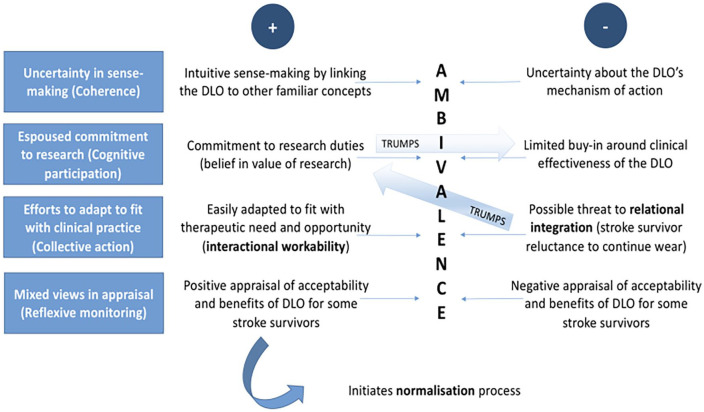
Practitioners intuitively made sense of the intervention in the face of uncertainty about its precise mechanisms of action (Normalisation Process Theory construct: coherence) and espoused commitment to the research, despite uncertainty about orthosis effectiveness (cognitive participation). They did however adapt the intervention based on perceived therapeutic need, their own skillsets and stroke survivor preference (collective action). They were uncertain about benefits (reflexive monitoring). Across the 4 theoretical constructs, ambivalence about the intervention was detected.
Ambivalence interfered with implementation - but only to an extent. 'Good-enough' coherence, cognitive participation, collective action and reflexive monitoring were sufficient to initiate normalisation - as long as implementation did not undermine the relationship between practitioner and stroke survivor. Ambivalence stemmed from practitioners' uncertainty about the intervention theory and mechanisms of action. Making intervention mechanisms of action more explicit to practitioners may influence how they implement and adapt a research intervention, and may determine whether those processes undermine or enhance outcomes.
作为一项可行性随机对照试验的一部分,探讨非研究资助的康复治疗师如何将用于中风后手臂恢复的动态莱卡矫形器应用于康复实践。
定性访谈研究。
两个住院中风单元及相关康复单元。
15名经过有目的选择的中风康复治疗师,他们参与了一项可行性随机对照试验,负责提供动态莱卡矫形器。
在试验结束时进行半结构化访谈。访谈考察了他们在矫形器应用方面的经验。正常化过程理论构建了访谈指南并为数据分析提供了依据。NVivo软件支持数据分析。
尽管对矫形器的有效性存在不确定性(认知参与),但面对其确切作用机制的不确定性(正常化过程理论构建:连贯性),治疗师们凭直觉理解了该干预措施,并对研究表示支持(认知参与)。然而,他们确实根据感知到的治疗需求、自身技能和中风幸存者的偏好对干预措施进行了调整(集体行动)。他们对益处并不确定(反思性监测)。在这4个理论构建方面,发现了对该干预措施的矛盾态度。
矛盾态度对实施产生了干扰——但只是在一定程度上。只要实施过程不破坏治疗师与中风幸存者之间的关系,“足够好”的连贯性、认知参与、集体行动和反思性监测就足以启动正常化。矛盾态度源于治疗师对干预理论和作用机制的不确定性。向治疗师更明确地阐述干预的作用机制可能会影响他们实施和调整研究干预措施的方式,并可能决定这些过程是会破坏还是增强治疗效果。