Department of Chemistry, University of Turin, Via Pietro Giuria 5, 10125 Turin, Italy.
Molecules. 2021 Aug 28;26(17):5223. doi: 10.3390/molecules26175223.
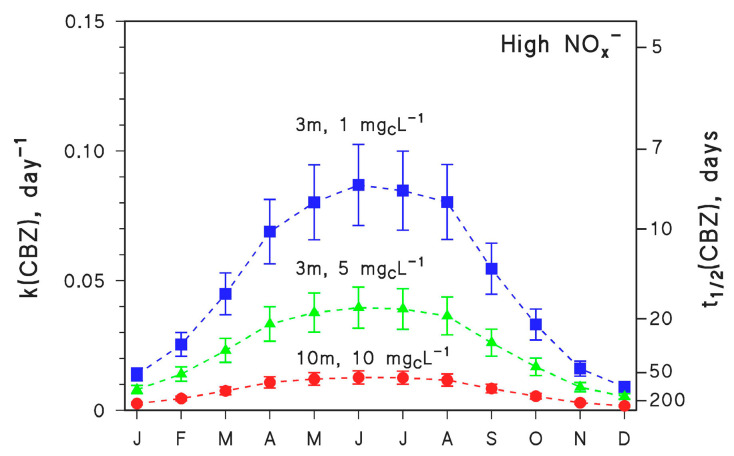
Photochemical degradation plays an important role in the attenuation of many recalcitrant pollutants in surface freshwaters. Photoinduced transformation kinetics are strongly affected by environmental conditions, where sunlight irradiance plays the main role, followed by water depth and dissolved organic carbon (DOC). Apart from poorly predictable weather-related issues, fair-weather irradiance has a seasonal trend that results in the fastest photodegradation in June and the slowest in December (at least in temperate areas of the northern hemisphere). Pollutants that have first-order photochemical lifetimes longer than a week take more than one month to achieve 95% photodegradation. Consequently, they may experience quite different irradiance conditions as their photodegradation goes on. The relevant time trend can be approximated as a series of first-order kinetic tracts, each lasting for one month. The trend considerably departs from an overall exponential decay, if degradation takes long enough to encompass seasonally varying irradiance conditions. For instance, sunlight irradiance is higher in July than in April, but increasing irradiance after April and decreasing irradiance after July ensure that pollutants emitted in either month undergo degradation with very similar time trends in the first 3-4 months after emission. If photodegradation takes longer, pollutants emitted in July experience a considerable slowdown in photoreaction kinetics as winter is approached. Therefore, if pollutants are photostable enough that their photochemical time trend evolves over different seasons, degradation acquires some peculiar features than cannot be easily predicted from a mere analysis of lifetimes in the framework of simple first-order kinetics. Such features are here highlighted with a modelling approach, taking the case of carbamazepine as the main example. This contaminant is almost totally biorecalcitrant, and it is also quite resistant to photodegradation.
光化学降解在地表水许多难降解污染物的衰减中起着重要作用。光诱导转化动力学受环境条件的强烈影响,其中阳光辐照度起着主要作用,其次是水深和溶解有机碳(DOC)。除了难以预测的与天气有关的问题外,晴天辐照度还有季节性趋势,导致 6 月光降解最快,12 月最慢(至少在北半球温带地区)。具有一级光化学半衰期超过一周的污染物需要一个月以上的时间才能达到 95%的光降解。因此,随着它们的光降解继续进行,它们可能会经历相当不同的辐照度条件。相关的时间趋势可以近似为一系列一阶动力学轨迹,每个轨迹持续一个月。如果降解时间足够长,以包含季节性变化的辐照度条件,这种趋势与整体指数衰减有很大的不同。例如,7 月的阳光辐照度高于 4 月,但 4 月后辐照度增加和 7 月后辐照度减少,确保在排放后前 3-4 个月内,无论是哪个月排放的污染物,其降解时间趋势都非常相似。如果光降解时间更长,随着冬季的临近,7 月排放的污染物的光反应动力学会显著减缓。因此,如果污染物具有足够的光稳定性,使其光化学时间趋势在不同季节演变,那么降解就会具有一些无法从简单一级动力学框架内的寿命分析中轻易预测的特殊特征。本文采用卡马西平作为主要示例,通过建模方法突出了这些特征。这种污染物几乎完全是生物难降解的,而且对光降解也有很强的抵抗力。