Herrera Sabina, Bernal-Maurandi Javier, Cofan Frederic, Ventura Pedro, Marcos Maria Angeles, Linares Laura, Cuesta Genoveva, Diekmann Fritz, Moreno Asunción, Bodro Marta
Infectious Diseases Department, Institut d'Investigacions Biomèdiques August Pi i Sunyer (IDIBAPS), University of Barcelona and Hospital Clinic, 08036 Barcelona, Spain.
Facultad de Medicina, Universidad de Alcalá, Alcalá de Henares, 28805 Madrid, Spain.
J Clin Med. 2021 Aug 24;10(17):3779. doi: 10.3390/jcm10173779.
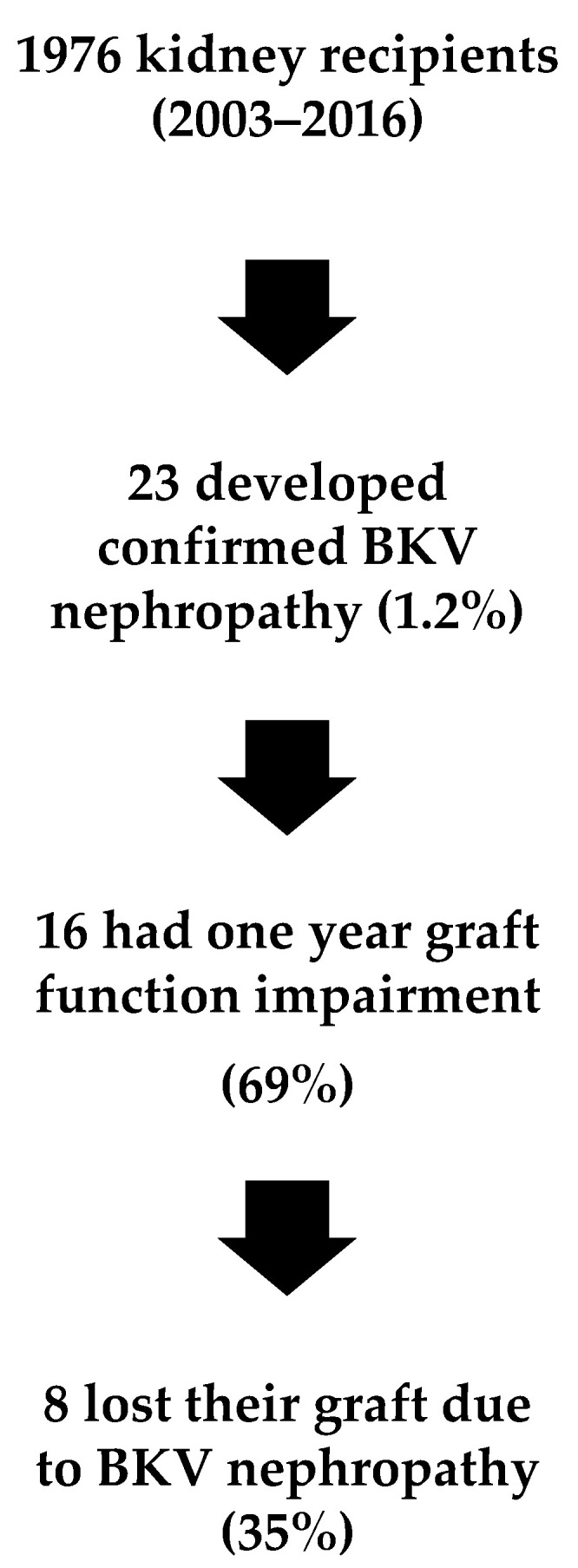
We aimed to ascertain the interaction and effects of combined reactivations of BK virus and cytomegalovirus on kidney graft function. All consecutive kidney transplant recipients (KTR) between 2003 and 2016 were included. Of 1976 patients who received a kidney transplant, 23 (1.2%) presented BKV-associated nephropathy (BKVAN). Factors independently associated with BKVAN were diabetes mellitus (odds ratios (OR) 3.895%, confidence intervals (CI) (1.4-10.5)), acute allograft rejection (OR 2.8 95%, CI (1.1-7.6)) and nephrostomy requirement (OR 4.195%, CI (1.3-13)). Cytomegalovirus infection was diagnosed in 19% of KTR patients. Recipients with BKVAN presented more frequently with cytomegalovirus (CMV) infection compared to patients without BKVAN (39% vs. 19%, = 0.02). Acute allograft rejection (OR 2.95%, CI (1.4-2.4)) and nephrostomy requirement (OR 2.95%, CI (1.2-3)) were independently associated with CMV infection. Sixteen patients (69%) with BKVAN had graft dysfunction at one-year post-transplant and eight of them (35%) lost their graft. Patients presenting with BKVAN and graft loss presented more frequently a cytomegalovirus infection (OR 2.295%, CI (1.3-4.3)). In conclusion, we found a relation between CMV infection and graft loss in patients presenting BKVAN, suggesting that patients with CMV reactivation should be actively screened for BKV.
我们旨在确定BK病毒和巨细胞病毒联合再激活对肾移植功能的相互作用及影响。纳入了2003年至2016年间所有连续的肾移植受者(KTR)。在1976例接受肾移植的患者中,23例(1.2%)出现BK病毒相关性肾病(BKVAN)。与BKVAN独立相关的因素有糖尿病(比值比(OR)3.895%,置信区间(CI)(1.4 - 10.5))、急性移植肾排斥反应(OR 2.8 95%,CI(1.1 - 7.6))和肾造瘘需求(OR 4.195%,CI(1.3 - 13))。19%的KTR患者被诊断为巨细胞病毒感染。与无BKVAN的患者相比,BKVAN患者更常出现巨细胞病毒(CMV)感染(39%对19%,P = 0.02)。急性移植肾排斥反应(OR 2.95%,CI(1.4 - 2.4))和肾造瘘需求(OR 2.95%,CI(1.2 - 3))与CMV感染独立相关。16例(69%)BKVAN患者在移植后1年出现移植肾功能障碍,其中8例(35%)移植肾丢失。出现BKVAN和移植肾丢失的患者更常出现巨细胞病毒感染(OR 2.295%,CI(1.3 - 4.3))。总之,我们发现出现BKVAN的患者中CMV感染与移植肾丢失之间存在关联,提示CMV再激活的患者应积极筛查BK病毒。