Division of Radiation Bioscience, Korea Institute of Radiological & Medical Sciences, Seoul 01812, Korea.
Division of Life Sciences, Korea University, Seoul 02841, Korea.
Int J Mol Sci. 2021 Aug 29;22(17):9374. doi: 10.3390/ijms22179374.
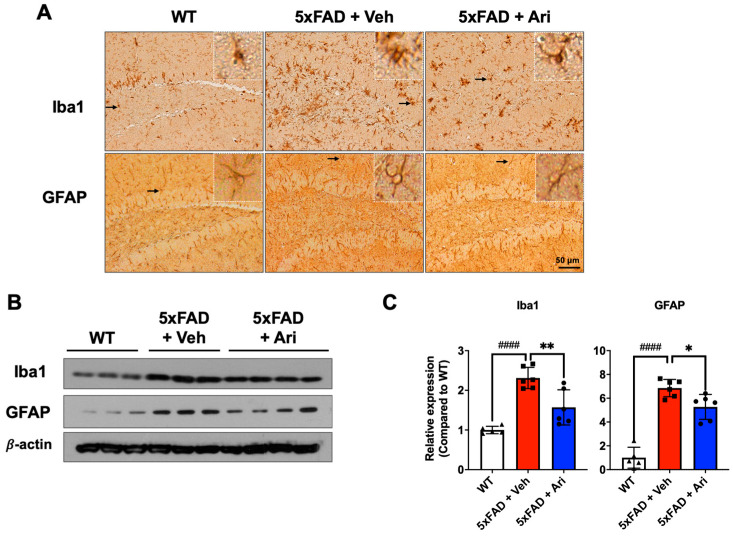
Global aging has led to growing health concerns posed by Alzheimer's disease (AD), the most common type of dementia. Aripiprazole is an atypical FDA-approved anti-psychotic drug with potential against AD. To investigate its therapeutic effects on AD pathology, we administered aripiprazole to 5xFAD AD model mice and examined beta-amyloid (βA)-induced AD-like phenotypes, including βA production, neuroinflammation, and cerebral glucose metabolism. Aripiprazole administration significantly decreased βA accumulation in the brains of 5xFAD AD mice. Aripiprazole significantly modified amyloid precursor protein processing, including carboxyl-terminal fragment β and βA, a disintegrin and metalloproteinase domain-containing protein 10, and beta-site APP cleaving enzyme 1, as determined by Western blotting. Neuroinflammation, as evidenced by ionized calcium binding adapter molecule 1 and glial fibrillary acidic protein upregulation was dramatically inhibited, and the neuron cell layer of the hippocampal CA1 region was preserved following aripiprazole administration. In 18F-fluorodeoxyglucose positron emission tomography, after receiving aripiprazole, 5xFAD mice showed a significant increase in glucose uptake in the striatum, thalamus, and hippocampus compared to vehicle-treated AD mice. Thus, aripiprazole effectively alleviated βA lesions and prevented the decline of cerebral glucose metabolism in 5xFAD AD mice, suggesting its potential for βA metabolic modification and highlighting its therapeutic effect over AD progression.
全球老龄化导致阿尔茨海默病(AD)等健康问题日益严重,AD 是最常见的痴呆症类型。阿立哌唑是一种非典型的美国食品和药物管理局批准的抗精神病药物,具有治疗 AD 的潜力。为了研究其对 AD 病理的治疗效果,我们给 5xFAD AD 模型小鼠施用阿立哌唑,并观察了β淀粉样蛋白(βA)诱导的 AD 样表型,包括βA 产生、神经炎症和大脑葡萄糖代谢。阿立哌唑给药显著减少了 5xFAD AD 小鼠大脑中的βA 积累。阿立哌唑通过 Western blot 显著改变了淀粉样前体蛋白的加工,包括羧基末端片段β和βA、解整合素和金属蛋白酶 10 以及β位点 APP 切割酶 1。离子钙结合衔接分子 1 和神经胶质纤维酸性蛋白的上调表明神经炎症明显受到抑制,并且在给予阿立哌唑后海马 CA1 区的神经元细胞层得以保留。在 18F-氟脱氧葡萄糖正电子发射断层扫描中,与接受载体处理的 AD 小鼠相比,接受阿立哌唑治疗的 5xFAD 小鼠纹状体、丘脑和海马的葡萄糖摄取明显增加。因此,阿立哌唑有效缓解了βA 损伤,并防止了 5xFAD AD 小鼠大脑葡萄糖代谢的下降,表明其具有βA 代谢修饰的潜力,并强调了其对 AD 进展的治疗效果。