Thouvenin Jonathan, Martínez Chanzá Nieves, Alhalabi Omar, Lang Hervé, Tannir Nizar M, Barthélémy Philippe, Malouf Gabriel G
Oncology Department, Institut de Cancérologie Strasbourg (ICANS), 67200 Strasbourg, France.
Oncology Department, Institut Jules Bordet, 1000 Bruxelles, Belgium.
Cancers (Basel). 2021 Aug 27;13(17):4341. doi: 10.3390/cancers13174341.
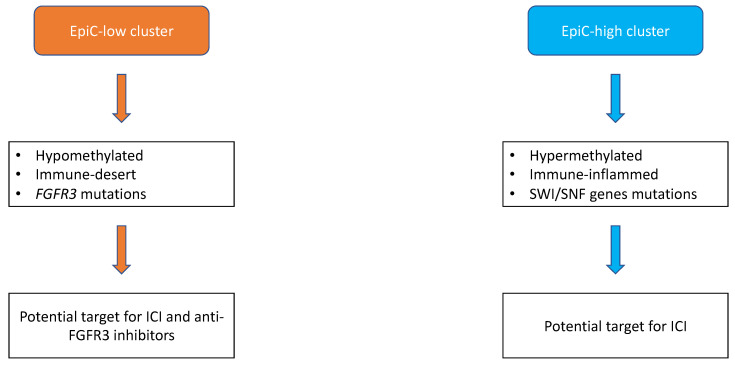
Upper tract urothelial carcinoma (UTUC) represents a rare and aggressive malignancy arising from the renal pelvis or ureter. It can develop sporadically or have a hereditary origin, such as Lynch syndrome, caused by DNA mismatch repair deficiency, leading to microsatellite instability phenotype. According to molecular characterization studies, UTUC presents different mutational profiles as compared to urinary bladder urothelial carcinomas. In particular, it has been reported that UTUC harbored a higher level of alterations associated with a T-cell depleted immune microenvironment. The therapeutic landscape in urothelial carcinoma is rapidly evolving, with immune checkpoint inhibitors forming part of the standard of care. A greater understanding of the molecular alterations and immune microenvironment leads to the development of new treatment combinations and targeted therapy. This review summarizes the available evidence concerning the use of immune checkpoint inhibitors and the biological rationale underlying their use in high-grade UTUC.
上尿路尿路上皮癌(UTUC)是一种起源于肾盂或输尿管的罕见且侵袭性强的恶性肿瘤。它可散发性发生,也可能有遗传起源,如由DNA错配修复缺陷导致微卫星不稳定表型的林奇综合征。根据分子特征研究,与膀胱尿路上皮癌相比,UTUC呈现出不同的突变谱。特别是,据报道UTUC存在与T细胞耗竭免疫微环境相关的更高水平改变。尿路上皮癌的治疗格局正在迅速演变,免疫检查点抑制剂已成为标准治疗的一部分。对分子改变和免疫微环境的更深入了解促使了新的治疗组合和靶向治疗的发展。本综述总结了关于免疫检查点抑制剂在高级别UTUC中应用的现有证据及其使用的生物学原理。