Key Laboratory of Reproductive Genetics (Ministry of Education) and Department of Reproductive Endocrinology, Zhejiang University, School of Medicine, Women's Hospital, Xueshi Road, No.1, Hangzhou, 310006, Zhejiang province, China.
International Peace Maternal and Child Health Hospital, School of Medicine, Shanghai Jiao Tong University, No. 910, Rd. Hengshan, Shanghai, 200030, China.
Reprod Biol Endocrinol. 2021 Sep 9;19(1):140. doi: 10.1186/s12958-021-00809-x.
There has been increasing interest in the relationship between body mass index(BMI) and pregnancy outcomes, especially in women undergoing frozen embryo transfer(FET). Several observational studies have been published, but so far with conflicting results.
A systematic review and meta-analysis was conducted according to PRISMA guidelines. Pubmed, Embase, Cochrane Library, Clinicaltrails.gov and Web of Science databases were searched based on established search strategy from inception through January 2021.
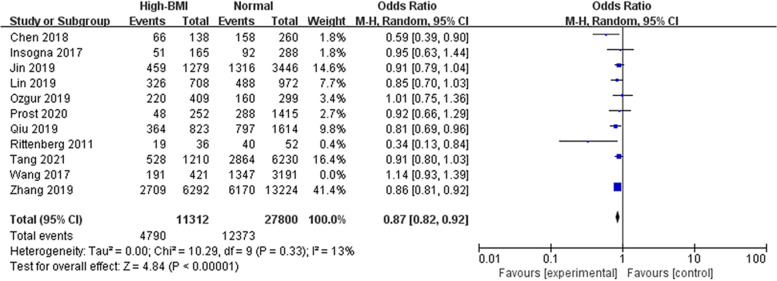
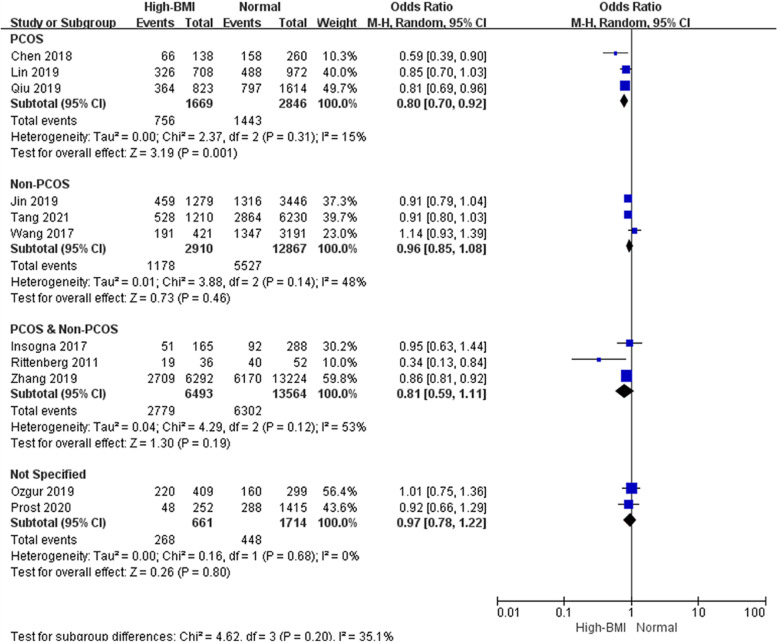
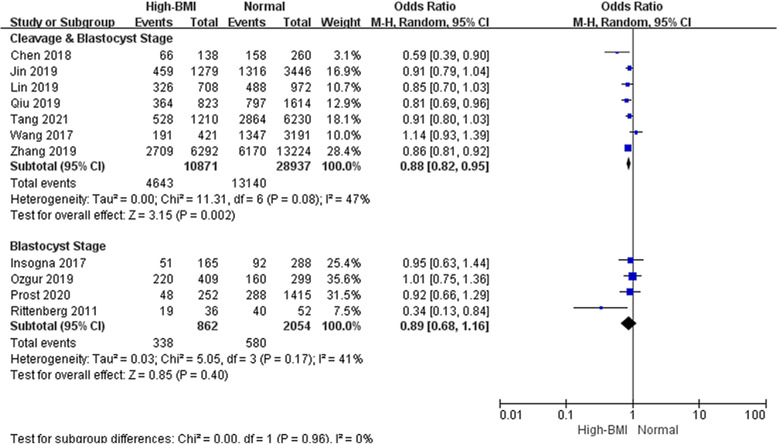
Twelve studies were eligible. In women following FET, high BMI (BMI ≥ 23 kg/m) was associated with an impaired live birth rate (LBR, OR: 0.89, 95% CI: 0.82-0.96, P = 0.002), but wasn't associated with the implantation rate or the clinical pregnancy rate. Subgroup analysis revealed higher LBR for women didn't complicated by polycystic ovary syndrome (PCOS, OR: 0.96, 95% CI: 0.85-1.08, P = 0.46) and women with blastocyst transferred (OR: 0.89, 95% CI: 0.68-1.16, P = 0.40). LBR did not differ between the low BMI group (BMI < 18.5 kg/m) and the normal weight group.
Our study showed that high BMI in women is negatively associated with LBR in FET cycles, whereas low BMI isn't. The results of subgroup analysis implied a need for women with a high BMI to get individualized weight management and treatment. Further evidence is still required to optimize preconception health and develop Nutritional and exercise guidelines.
人们对体重指数(BMI)与妊娠结局之间的关系越来越感兴趣,尤其是在接受冻融胚胎移植(FET)的女性中。已经发表了几项观察性研究,但到目前为止,结果相互矛盾。
根据 PRISMA 指南进行系统评价和荟萃分析。根据既定的搜索策略,从建库开始到 2021 年 1 月,在 Pubmed、Embase、Cochrane 图书馆、Clinicaltrails.gov 和 Web of Science 数据库中进行检索。
有 12 项研究符合条件。在接受 FET 的女性中,高 BMI(BMI≥23kg/m)与活产率(LBR)受损相关(OR:0.89,95%CI:0.82-0.96,P=0.002),但与着床率或临床妊娠率无关。亚组分析显示,未合并多囊卵巢综合征(PCOS)的女性(OR:0.96,95%CI:0.85-1.08,P=0.46)和移植囊胚的女性(OR:0.89,95%CI:0.68-1.16,P=0.40)的 LBR 更高。低 BMI 组(BMI<18.5kg/m)与正常体重组的 LBR 无差异。
我们的研究表明,女性 BMI 高与 FET 周期中的 LBR 呈负相关,而 BMI 低则不然。亚组分析的结果表明,BMI 较高的女性需要进行个体化的体重管理和治疗。仍需要进一步的证据来优化孕前健康状况并制定营养和运动指南。